
Choosing a desk lamp has a direct impact on your eye health and work efficiency.
In this article, we will help you find the perfect lamp for your needs from the vast array of products available. We will cover the basics of how to choose, including lamp types, brightness (illuminance), light color (color temperature), and color reproduction (color rendering), as well as specific points to consider based on your intended use.
 Ms.Gadgets
My eyes get really tired after working for long hours. Can a desk lamp help improve this?
 Mr.Gadgets
Yes, by choosing a light that is gentle on the eyes, you can reduce fatigue and create a more comfortable working environment.
How to Avoid Regrets When Choosing a Desk Lamp
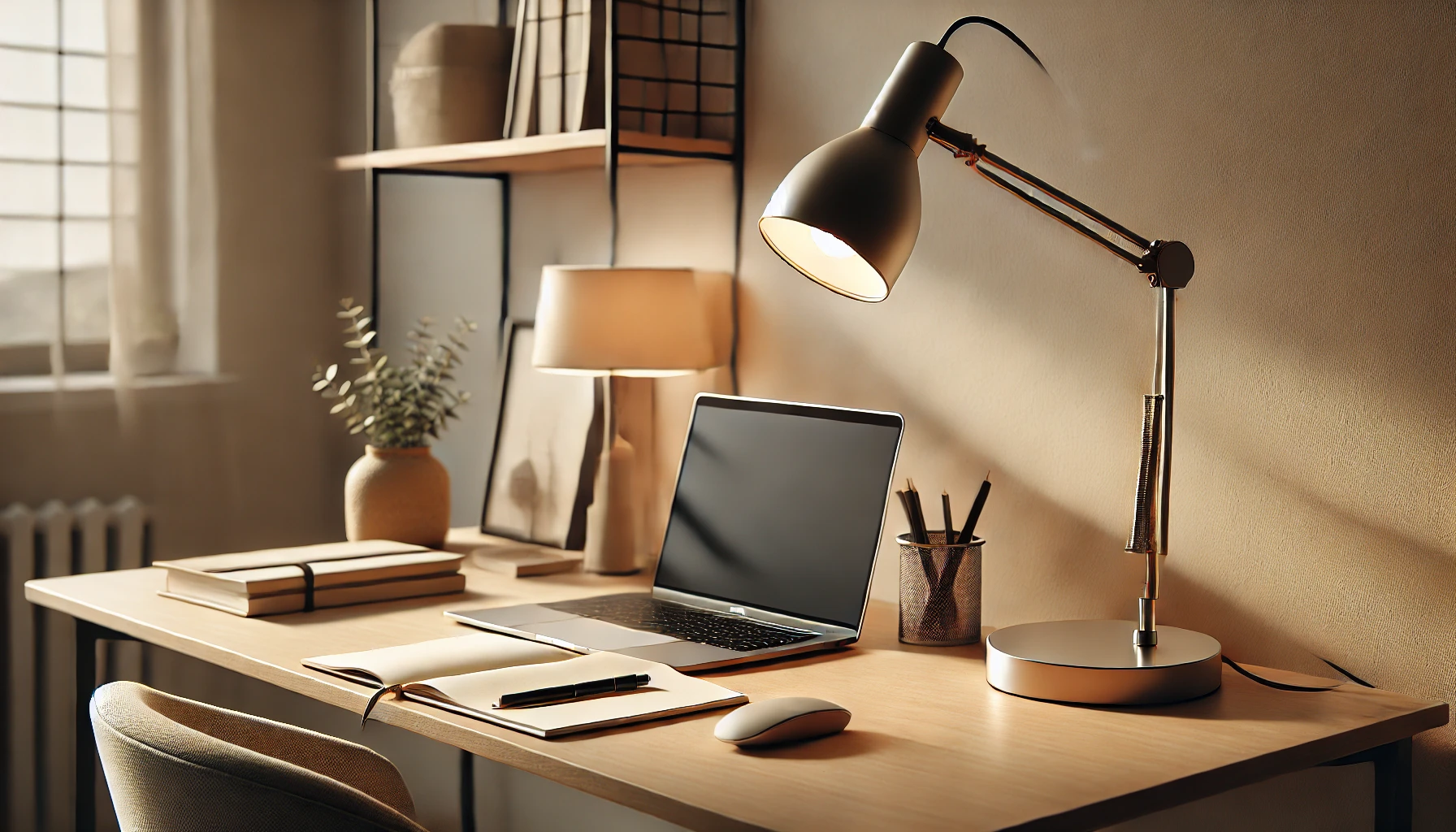
The Benefits of Eye-Friendly Lighting
For modern individuals who spend long hours at their desks, the quality of light is directly linked to physical condition.
- Reduced Eye Strain: By suppressing uneven brightness and flickering, you can reduce the strain on your eye muscles (ciliary muscles).
- Maintaining Concentration: Choosing a color temperature that helps keep the brain alert can improve work efficiency.
- Preventing Physical Discomfort: Proper lighting can also help prevent stiff shoulders and headaches caused by eye fatigue.
Especially when working on a computer, the most important thing is to minimize the “difference in brightness between the monitor screen and the surrounding area.” If this difference (contrast) is too large, the pupils must adjust frequently, which accelerates fatigue.
Ms.GadgetsMy eyes get really tired after working for long hours. Can a desk lamp help improve this?
Mr.GadgetsYes, by choosing a light that is gentle on the eyes, you can expect to reduce fatigue and create a comfortable work environment.
Types of Desk Lamps and Their Features You Should Know
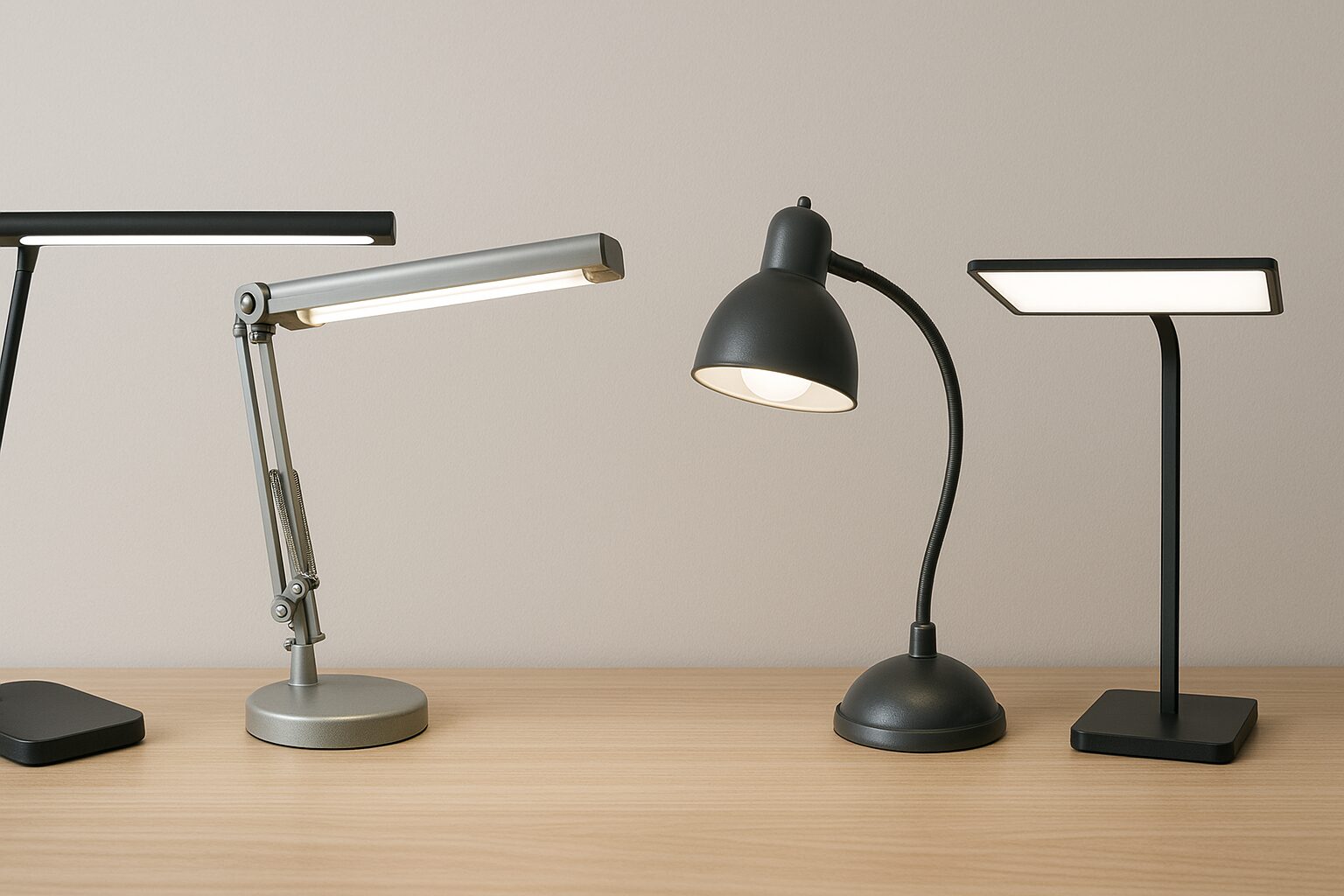
The first thing to understand when choosing a desk lamp is the type of light source.
Depending on the source, the quality of brightness, power consumption, and price can vary significantly.
The main light sources include LED, fluorescent, and incandescent, and in recent years, new types like OLED have also appeared.
It is important to understand and compare the characteristics of each.
| Light Source Type | Lifespan (Approx.) | Color Rendering (Ra) | Recommendation (As of 2026) | Notes |
| LED | Approx. 40,000 hours | 80–97 | ★★★★★ | Current standard. Energy-efficient & multifunctional. |
| OLED | Approx. 30,000 hours | 90–100 | ★★★★☆ | Next-gen source. Surface emission is extremely easy on eyes. |
| Fluorescent | Approx. 10,000 hours | 70–90 | ★☆☆☆☆ | Manufacturing, import/export banned by end of 2027. |
| Incandescent | Approx. 1,000 hours | 100 | ★★☆☆☆ | Good atmosphere, but heat generation and electricity costs are drawbacks. |
Choosing the optimal light source according to your usage, budget, and desired light quality is the first step toward creating a comfortable desk environment.
Features of LED Desk Lamps
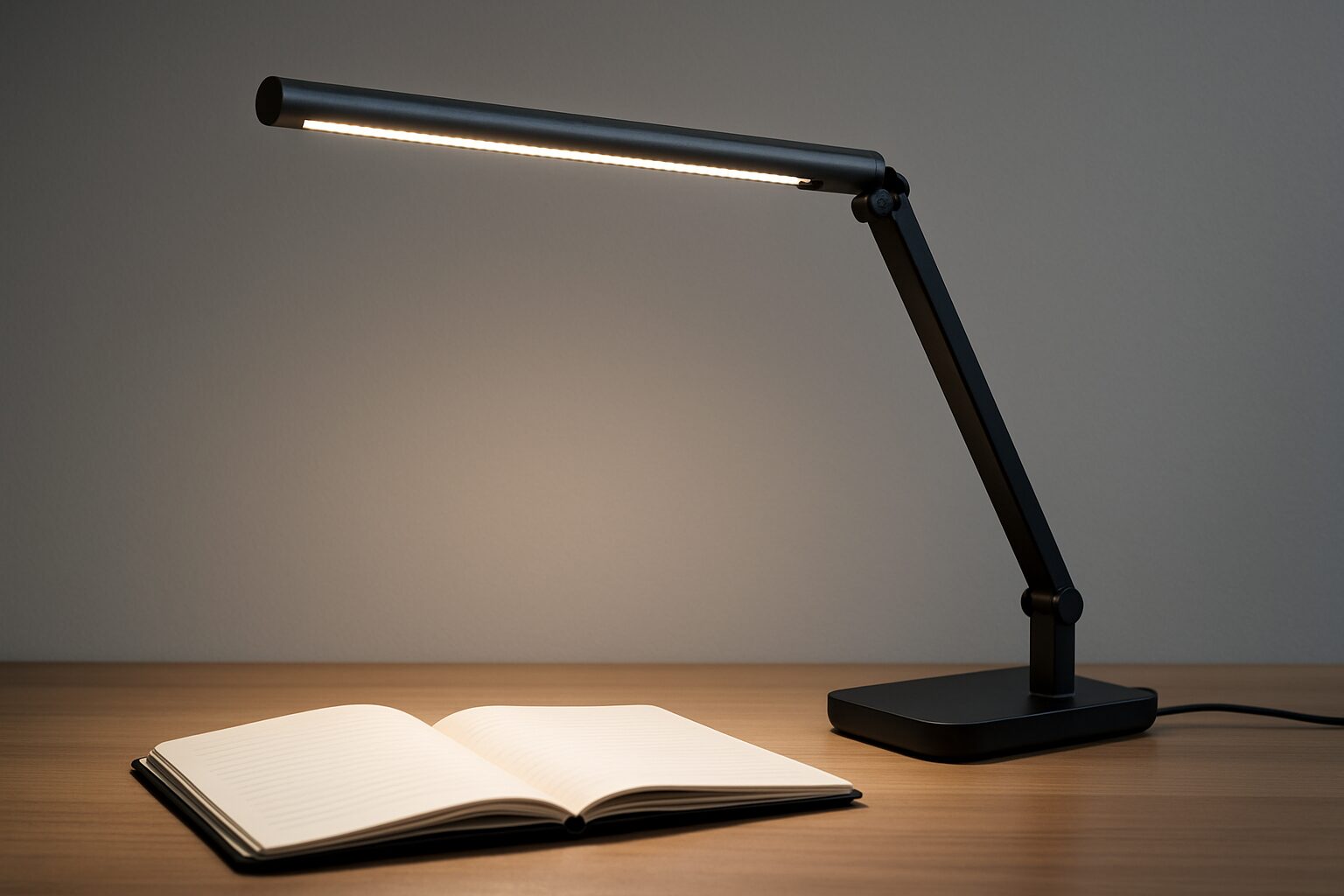
The current mainstream light source is the LED (Light Emitting Diode).
Its greatest feature is its long lifespan and energy efficiency, said to last about 40 times longer than incandescent bulbs and about 4 times longer than fluorescent lights.
Because power consumption is low, it also helps save on electricity bills.
Another appealing point is that many products are equipped with “dimming functions” to adjust brightness and “color tuning functions” to change the tone of the light.
| Pros | Cons |
|---|---|
| Long lifespan (approx. 25x incandescent, 4x fluorescent) Energy-efficient, saving on electricity costs Multifunctional (dimming, color tuning, timer, USB ports, etc.) Small, lightweight design possible |
Higher initial cost Multi-shadows can occur depending on the product Flickering may occur Intense light can sometimes strain eyes |
Ms.GadgetsI’ve heard that LEDs aren’t good for your eyes. Is that true?
Mr.GadgetsWith some cheaper products, flickering or multiple shadows can be a concern. However, many recent products have implemented countermeasures, so you can rest assured by choosing models that meet standards such as the JIS AA-shape equivalent.
While the initial cost tends to be higher than other light sources, considering the running costs and functionality, it is the most balanced option for most people.
Features of Fluorescent Desk Lamps
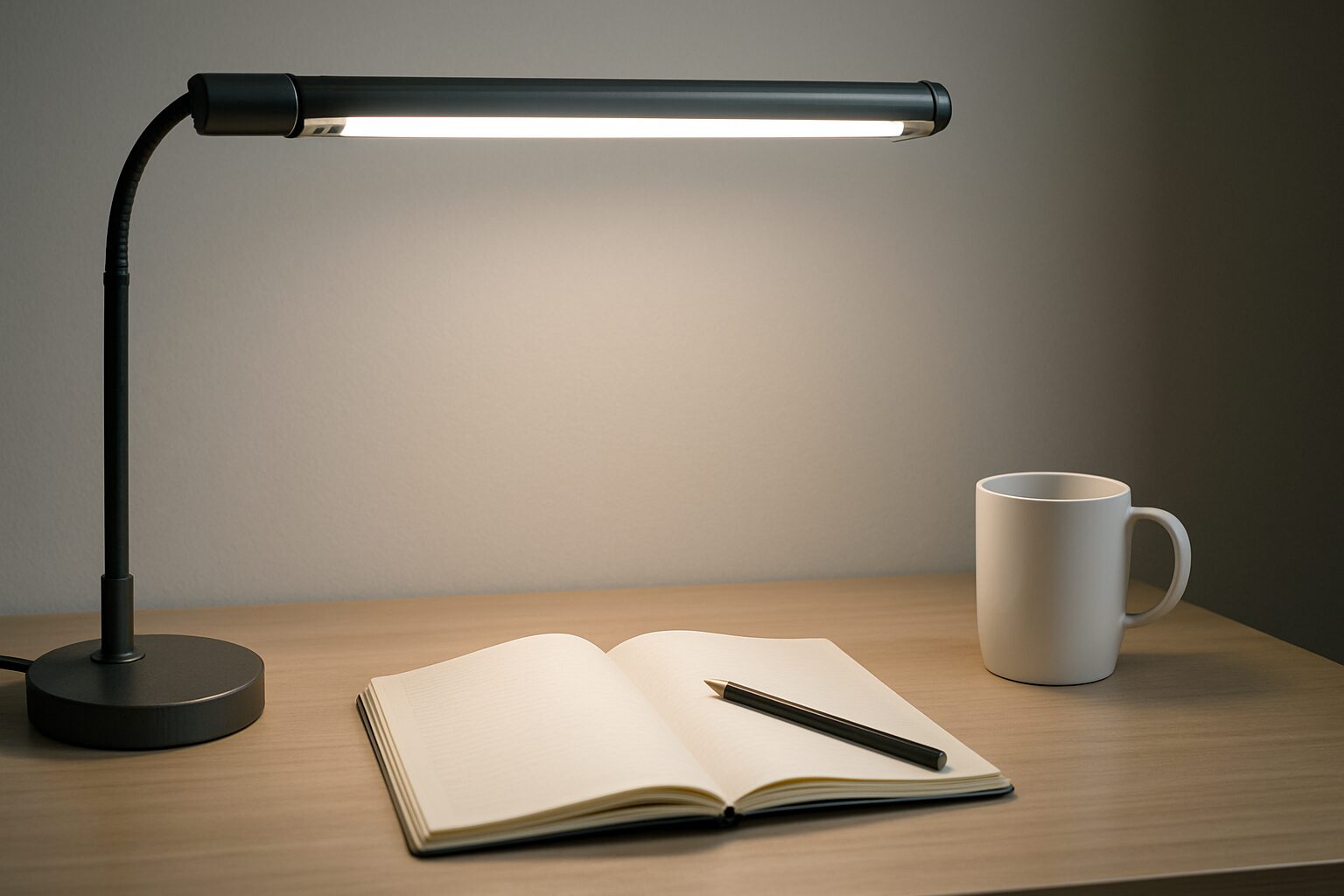
Fluorescent lights were once the mainstream light source for desk lamps.
They work by hitting fluorescent coating with ultraviolet rays generated by discharge in a glass tube, and they excel at illuminating a wide area evenly.
Before LEDs became widespread, they were used extensively in offices and for study desks.
| Pros | Cons |
|---|---|
|
Uniformly illuminates a wide area Relatively inexpensive Many feel it is gentle on the eyes | Many products lack dimming/color tuning Higher power consumption than LEDs Frequent turning on/off shortens lifespan Manufacturing/import/export banned by 2027 |
Important: Regarding the 2027 Phase-out of Fluorescent Lights
Based on the Minamata Convention (COP5), the manufacturing and import/export of general-purpose fluorescent lamps will be completely banned by the end of 2027. Because it will become difficult to obtain replacement bulbs in the future, we recommend buying “LED” lamps from now on.
Mr.GadgetsThe manufacturing and import/export of fluorescent lights will be banned by the end of 2027, so you should switch to a new type!
 Ms.Gadgets
Oh, so fluorescent lights are going away…
Features of Incandescent Desk Lamps
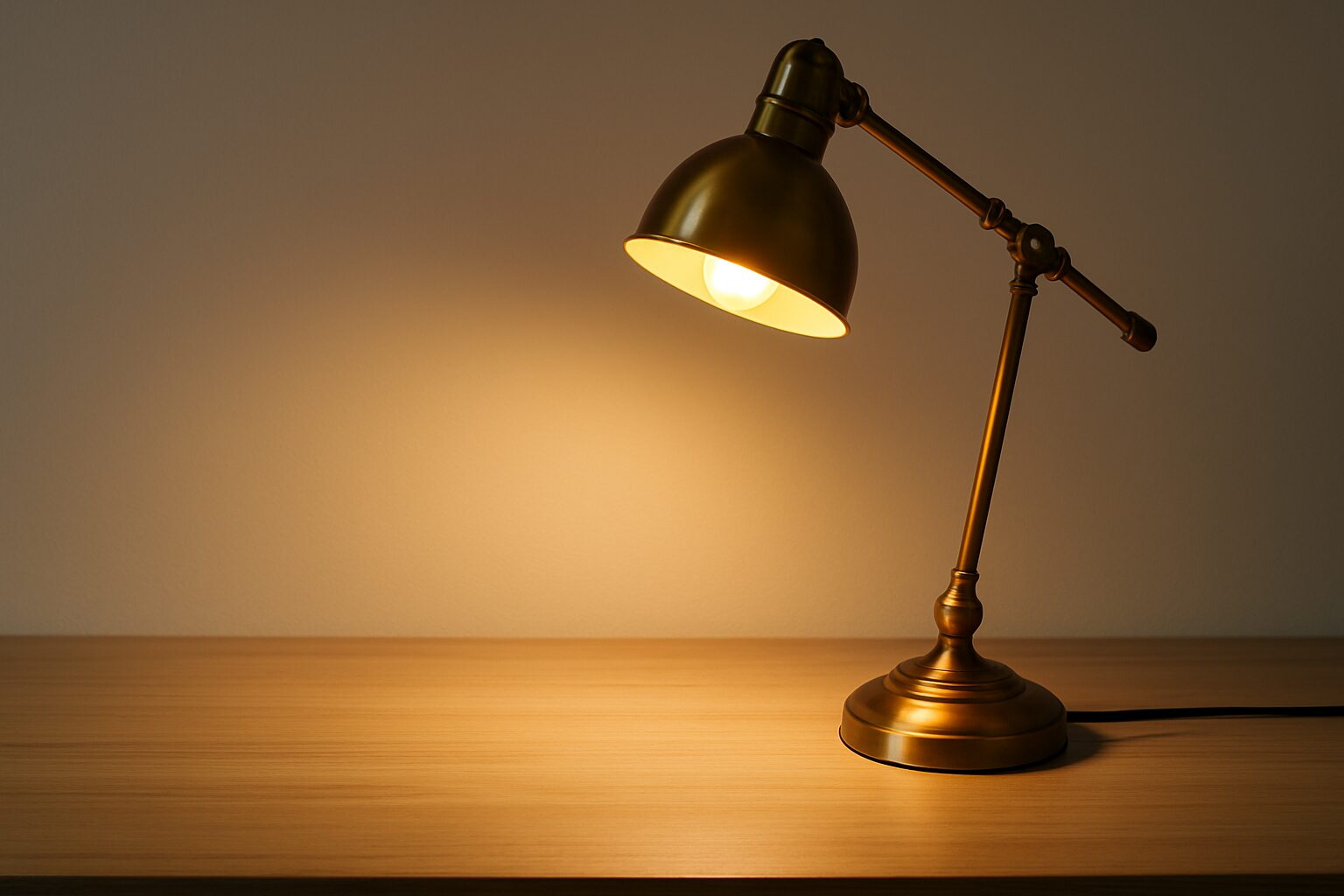
Incandescent lamps (incandescent bulbs) are a long-standing light source that produces light by passing electricity through a thin metal wire called a filament, heating it to a high temperature.
They are characterized by a warm, orange-colored light and have the advantage of extremely high color rendering (reproduction of colors).
They are often used in stylish, design-oriented desk lamps.
| Pros | Cons |
|---|---|
|
Warm, orange-colored light High color rendering (natural color reproduction) Inexpensive bulbs Many design-oriented products available |
Very high power consumption Generates significant heat, risk of burns Short lifespan (approx. 1,000–2,000 hours) Production declining due to environmental concerns |
On the other hand, they are energy-inefficient, as most of the power is converted into heat, leading to higher electricity bills.
The lifespan is also significantly shorter compared to LED or fluorescent lights, at around 1,000 to 2,000 hours.
Due to environmental impact, production and sales are being scaled back worldwide.
 Mr.Gadgets
I hate incandescent bulbs because they really use a lot of electricity.
Other Types of Desk Lamps (OLED, etc.)
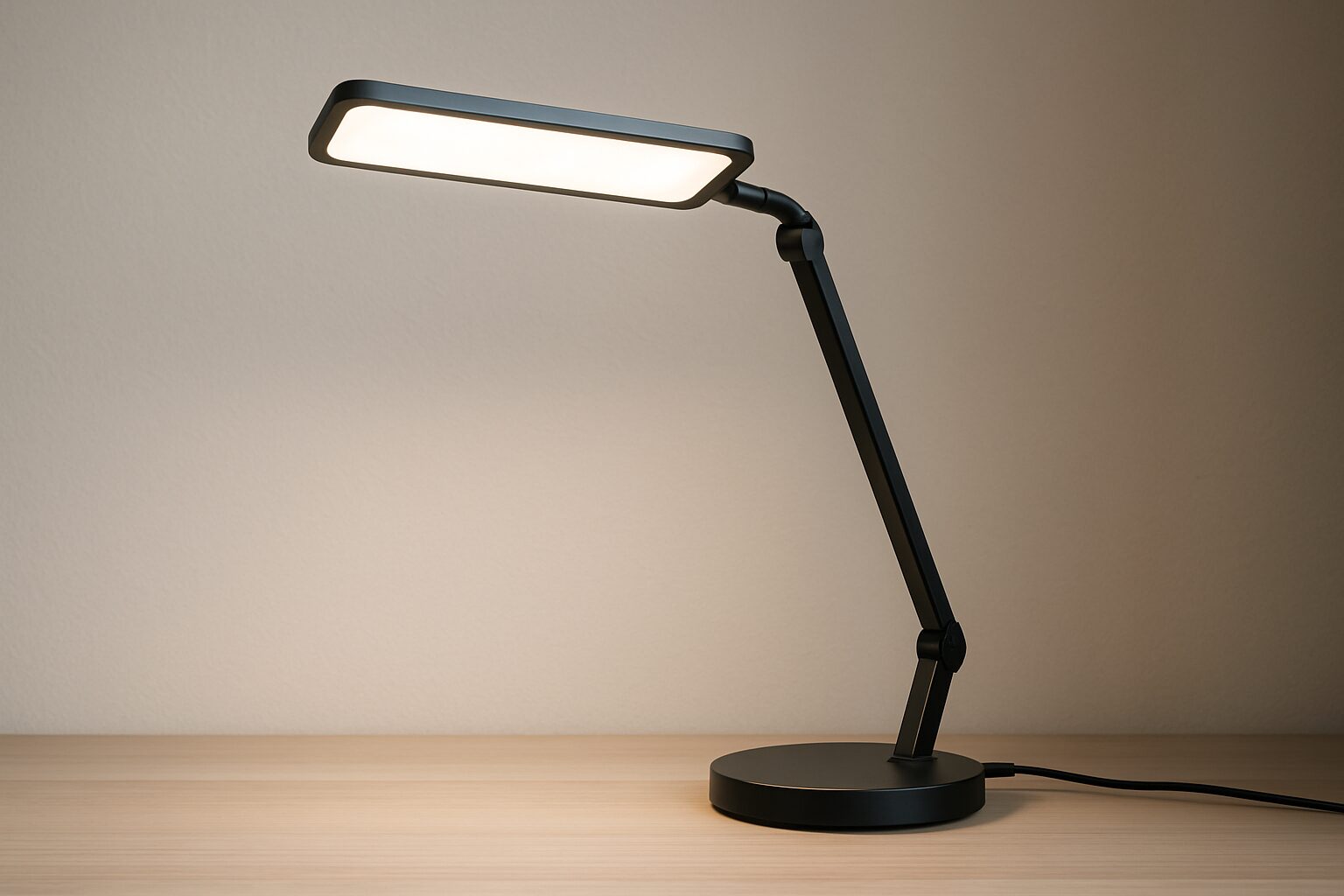
In recent years, desk lamps using new technologies other than LED, fluorescent, and incandescent have emerged.
A representative example is OLED (Organic Light Emitting Diode).
OLED is a light source that uses layers of organic compounds that emit light themselves when voltage is applied, and its biggest feature is that the entire surface emits light uniformly.
Therefore, it is less prone to creating multi-shadows and is considered a light that is gentle on the eyes.
It is also said to have lower blue light emission.
| Pros | Cons |
|---|---|
| Surface emission makes light soft and uniform Less prone to shadows, gentle on eyes Ultra-thin, lightweight design possible |
Fewer products available Higher price Limited selection |
Ms.GadgetsI haven’t heard much about OLED; what are its features?
Mr.GadgetsBecause it emits light from the surface, it is less prone to shadows compared to point light sources like LEDs, making the light very gentle on the eyes. It also has the advantage of allowing for thin and light designs.
Although the product lineup is still limited and prices tend to be high, it is a next-generation light source expected to see widespread adoption in the future due to its excellent characteristics.
Comparison of Pros and Cons for Each Type
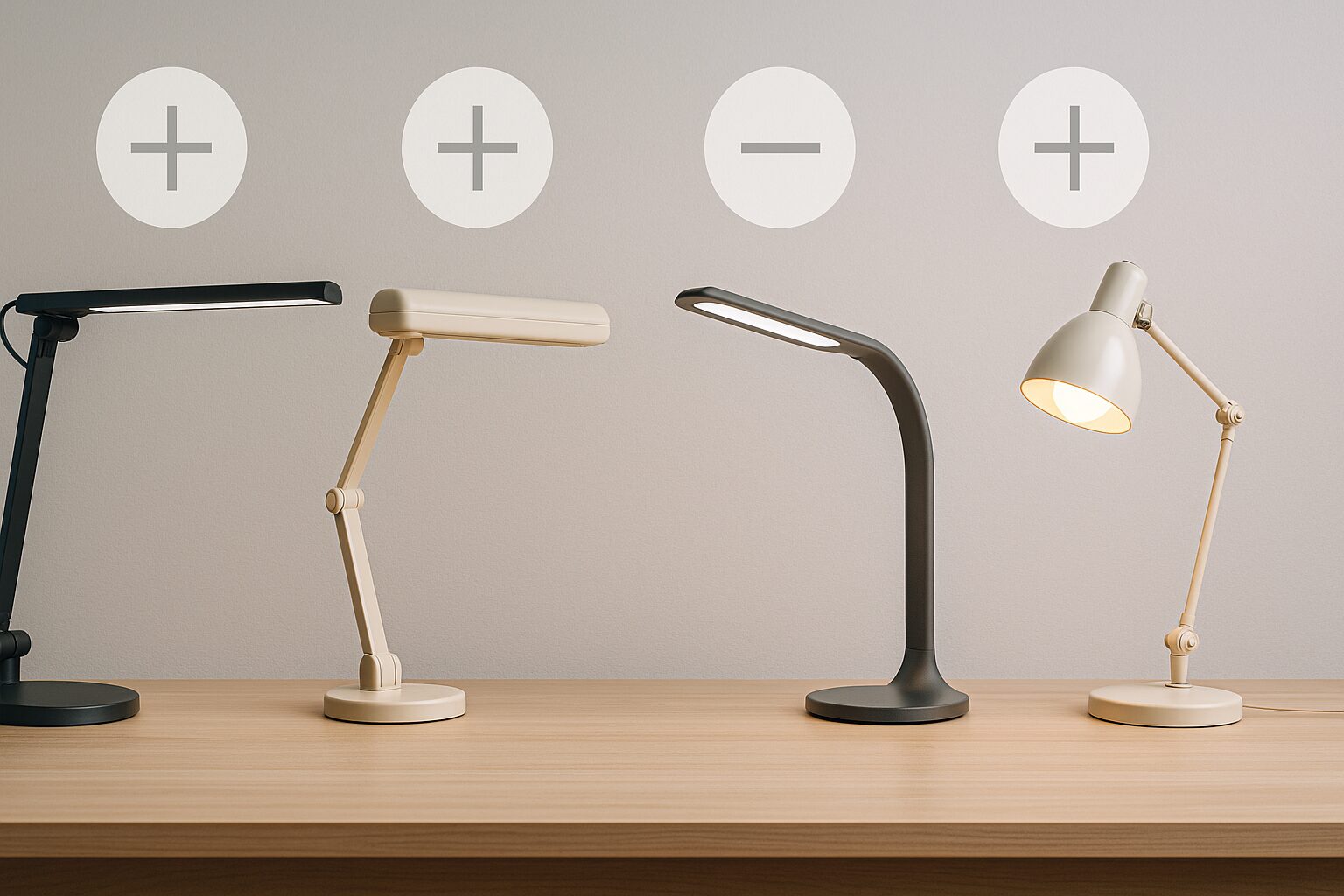
The light sources we have looked at each have their own pros and cons.
It is important to remember that it is not about which light source is “the best,” but rather about choosing the one that fits your specific usage.
How to Choose for a Comfortable Work Environment
Key Points in This Section!
- How to choose brightness: Appropriate illuminance for your tasks
- How to choose color temperature: Concentration and relaxation effects
- Importance of color rendering: Reproducing natural colors
- Other functions: Dimming/color tuning, USB ports, timers, etc.
- Design and placement: Harmonizing with your interior
The most important thing when choosing a desk lamp is to choose light that fits your usage and environment.
Because the quality of light is directly linked to eye fatigue and concentration, choose carefully.
Here, we will explain in detail the points of how to choose for a comfortable work environment, from light performance such as brightness, color temperature, and color rendering, to convenient functions and design/placement.
Comparing these factors comprehensively should help you find the perfect lamp.
How to Choose Brightness: Appropriate Illuminance for Your Tasks
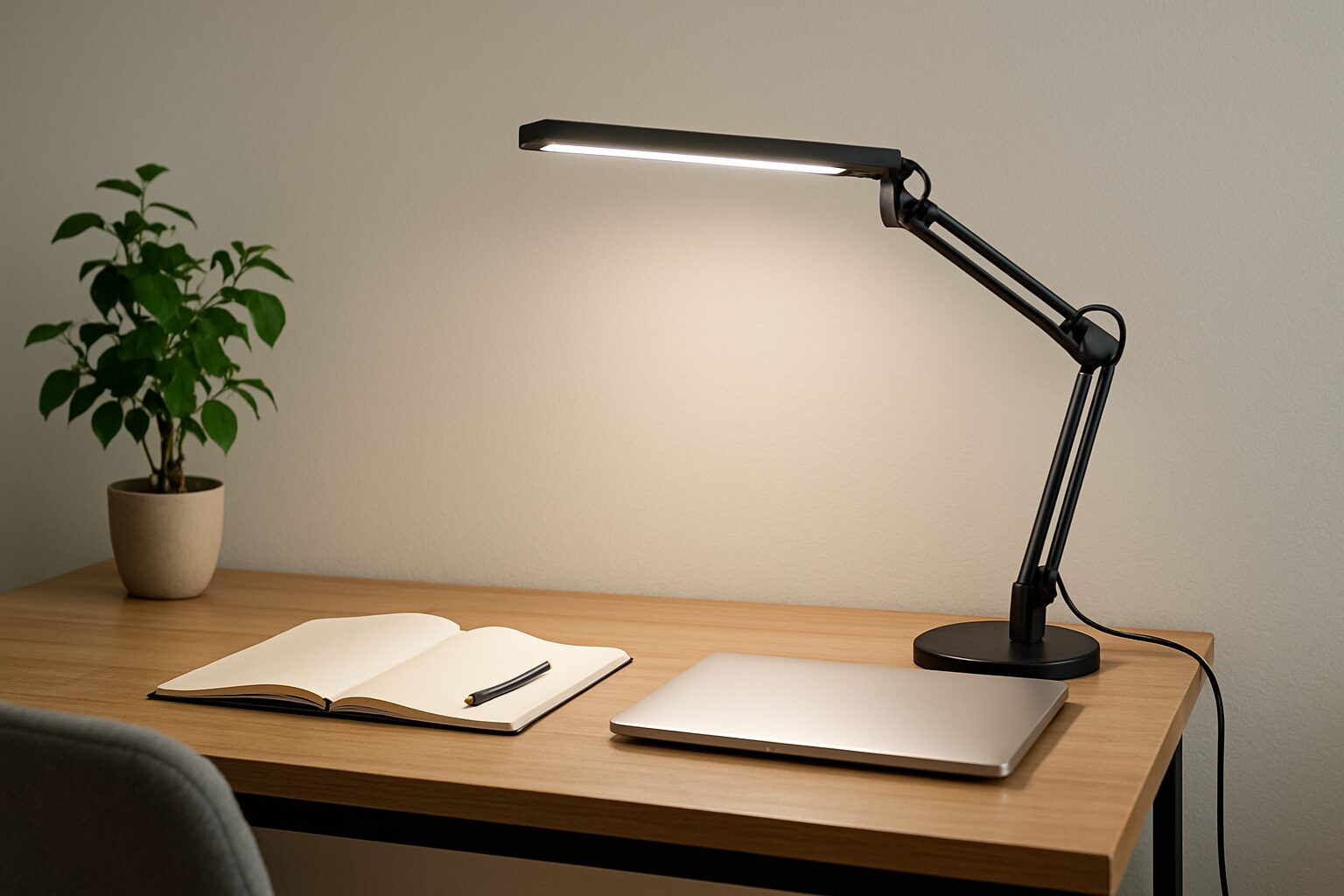
The first thing to check when choosing a desk lamp is “brightness.”
Brightness is mainly indicated by the unit illuminance (lx: lux), which represents how brightly a specific area of the desk is illuminated.
The required brightness varies depending on the task.
For general studying or reading, 500 to 1000 lux is recommended.
For detailed work, such as crafts or sewing, choosing a brighter light of 1000 lux or more will make it easier to see your hands.
Also, not just brightness, but the area of coverage is important.
JIS standards specify irradiation range, and the “AA-shape” can illuminate a wider area uniformly than the “A-shape,” making it recommended for study desks or areas where you need to cover a larger space.
Having a dimming function to adjust brightness is convenient because you can set the optimal brightness for your tasks and time of day.
Ms.GadgetsHow much brightness is gentle on the eyes?
 Mr.Gadgets
Being able to adjust it according to the task—not too bright and not too dark—is the key to being gentle on the eyes.
By choosing the appropriate brightness, you can reduce eye strain and realize a comfortable work environment.
How to Choose Color Temperature: Concentration and Relaxation Effects
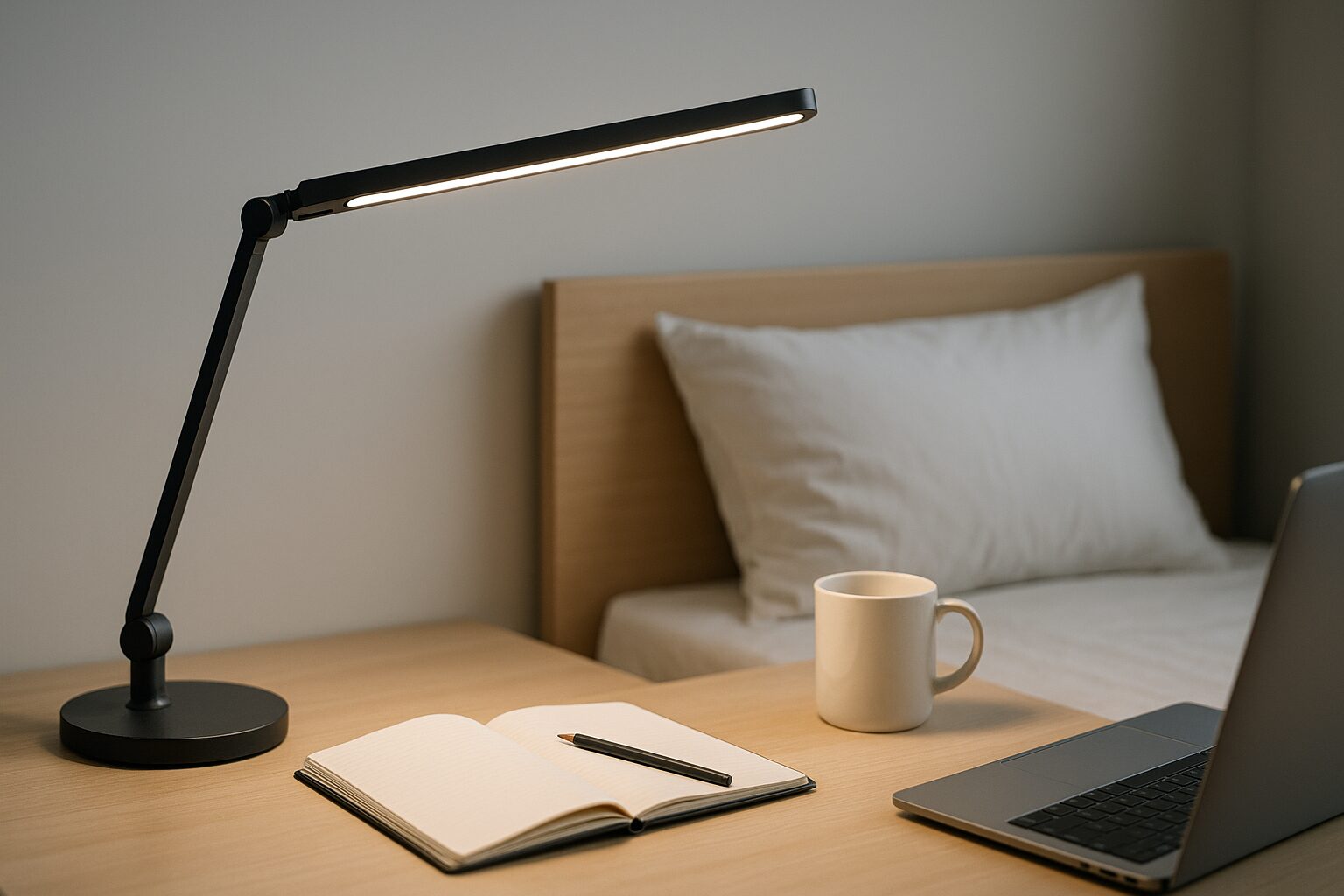
The color tone of light is represented by color temperature (K: Kelvin).
Depending on the color temperature, the atmosphere of the space and the effect on a person’s psychological state change.
The lower the color temperature, the warmer the light (orange-ish), and the higher it is, the cooler the light (bluish-white).
For study or work where you want to concentrate, daylight white (approx. 5000K) or daylight color (approx. 6500K), which are said to have an effect of waking up the brain, are suitable.
On the other hand, for reading or time before sleep when you want to relax, a warm light bulb color (approx. 3000K) is recommended.
Choosing a desk lamp with a color tuning function that allows you to adjust the light color according to the scene makes it possible to create the optimal light environment for your activities.
| Color Temperature Range | Light Color | Main Effects and Usage Examples |
|---|---|---|
| Low (–3300K) | Light bulb color | Relaxation effect, bedroom, living room |
| Mid (3300K–5300K) | Warm white / Daylight white | Natural colors, living room, dining, study |
| High (5300K–) | Daylight color | Concentration improvement, office, study room, study |
By choosing the light color according to the time of day and purpose, you can spend your time more comfortably and efficiently.
Importance of Color Rendering: Reproducing Natural Colors
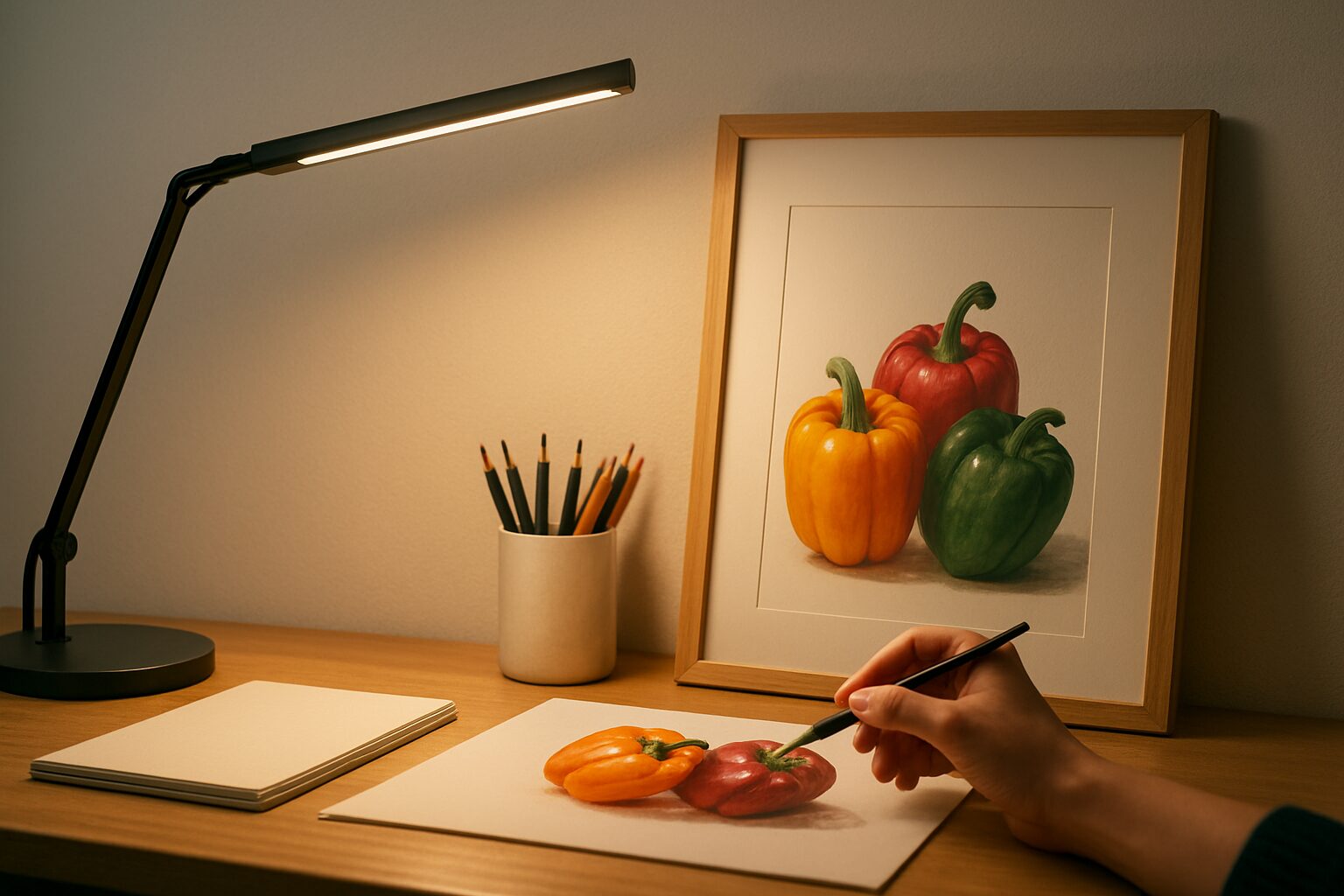
Color rendering (Ra) is an index that indicates how close an object’s color looks to natural light under the illumination.
Using the appearance of colors under sunlight as the standard (Ra100), the higher the value, the higher the color reproduction.
For tasks where color accuracy is required, such as design, illustration production, or skin tone in online meetings, it is extremely important to choose a desk lamp with high color rendering.
Generally, Ra80 or higher is sufficient for daily life and many tasks, but we recommend choosing a product with Ra90 or higher for tasks where color identification is important.
Under a light with low color rendering, colors of objects may look unnatural or dull, which can affect the quality of your work and lead to eye fatigue.
Ms.GadgetsWhat Ra value is good for color rendering?
Mr.GadgetsAim for Ra80 or higher for general tasks, and Ra90 or higher if color accuracy is required.
When choosing a desk lamp, focusing on color rendering in addition to brightness and color temperature will help you obtain a higher-quality light environment.
Other Functions: Dimming/Color Tuning, USB Ports, Timers, etc.
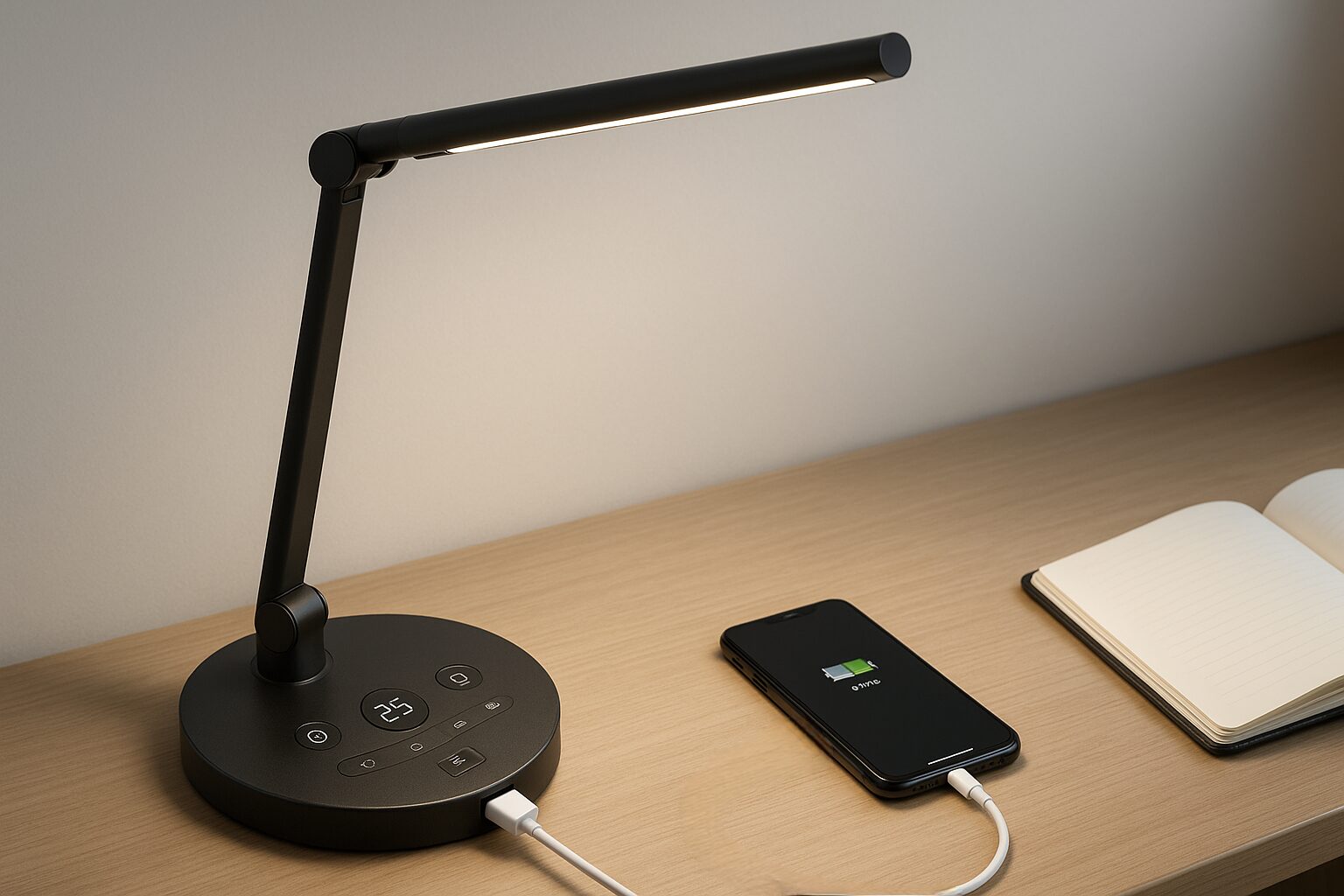
In addition to basic lighting functions, desk lamps have models with various additional functions that improve work efficiency and convenience.
Check if it has the functions you need based on how you use it.
The aforementioned dimming function (brightness adjustment) and color tuning function (color temperature adjustment) are very convenient as they allow you to create the optimal light environment for your time of day and task.
Other popular features include models with USB ports for charging smartphones, timer functions that automatically turn off at a set time, and touchless sensors that allow you to turn the light on/off without using your hands.
There are also multifunctional products that support wireless charging and incorporate pen stands, clocks, or calendar functions.
| Function | Pros |
|---|---|
| Dimming | Brightness can be adjusted in steps or seamlessly |
| Color Tuning | Light color (color temperature) can be changed according to use |
| USB Port | Can charge smartphones, etc., on the desk |
| Timer | Prevents forgetting to turn off, convenient for reading before sleep |
| Touchless Sensor | Hygienic, can be operated even with dirty hands |
| Wireless Charging | Can charge compatible smartphones just by placing them down |
By utilizing these functions, you can keep your desk area tidy and realize a comfortable work space.
Design and Placement: Harmonizing with Your Interior
Desk lamps have utility, but they also have an aspect as interior decor that colors your space.
Since there are products with various designs, there is also the fun of choosing one that matches the atmosphere of your room and the taste of your desk area.
The installation method is also an important choice.
There are mainly three types: “stand type,” “clamp type,” and “clip type.”
| Installation Method | Pros | Cons |
|---|---|---|
Stand Type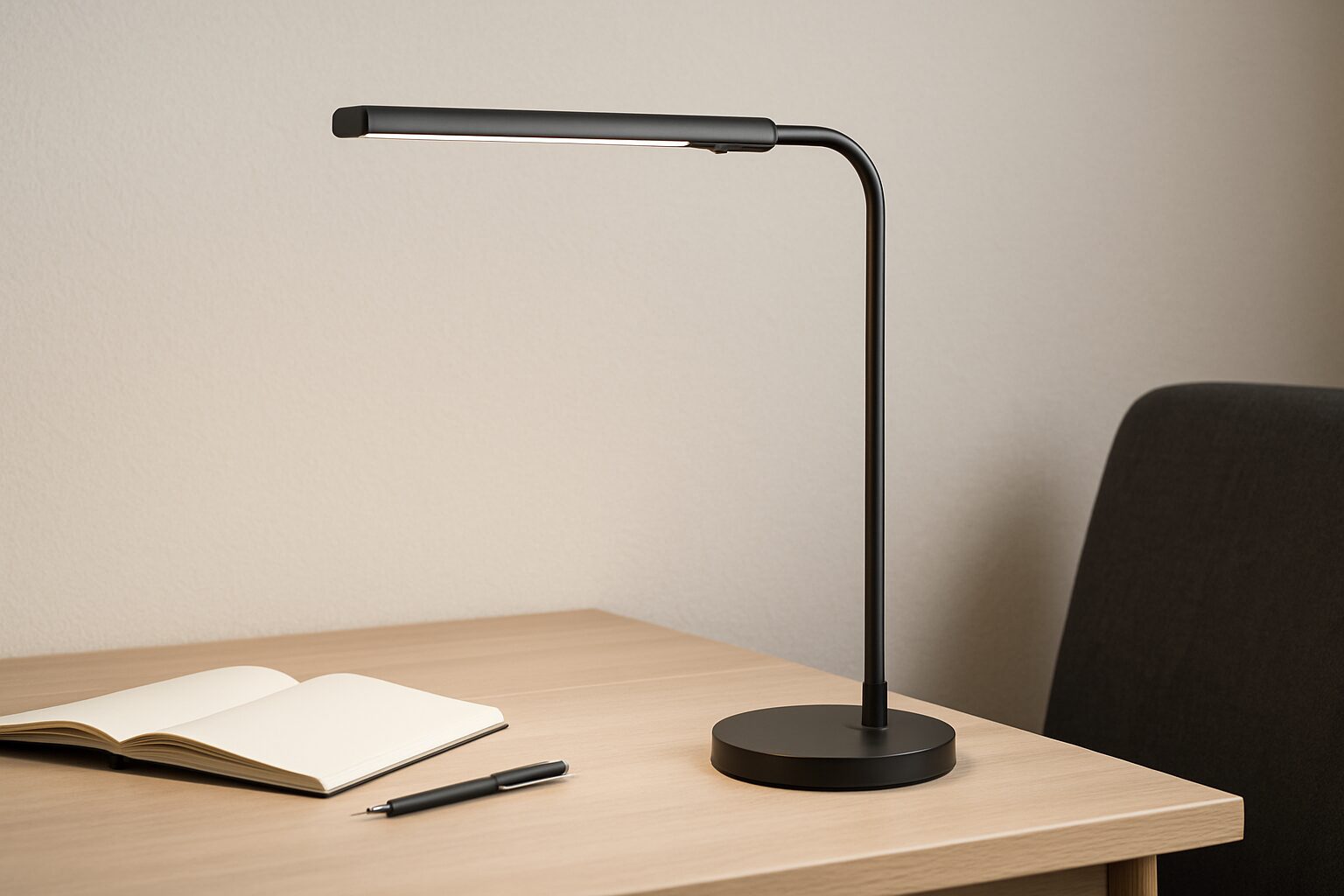 | Easy to install and move Abundant design variations | Takes up desk space |
Clamp Type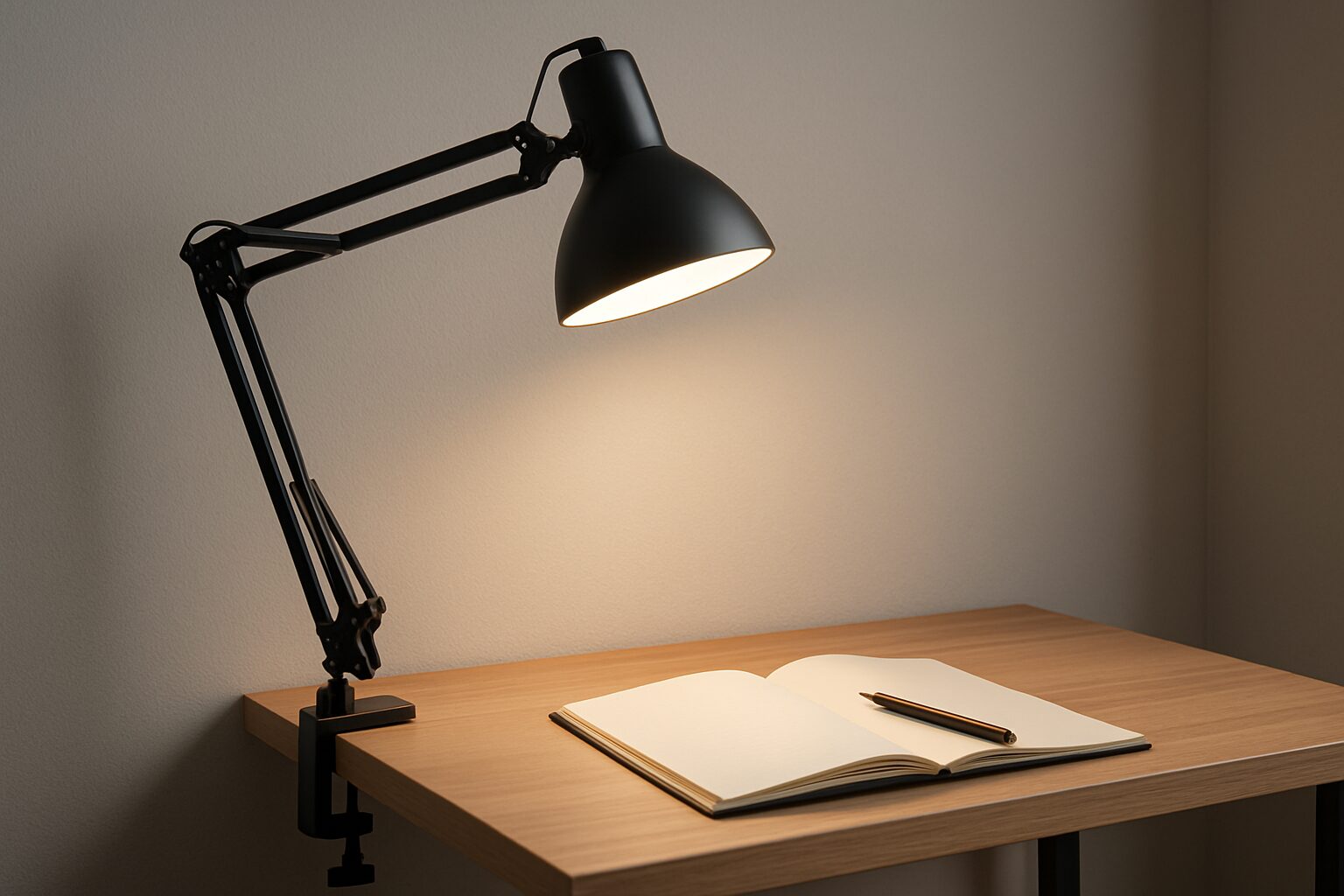 | Effective use of desk space Firmly fixed for high stability | Restrictions on installable desk top thickness Installation and movement are a bit cumbersome |
Clip Type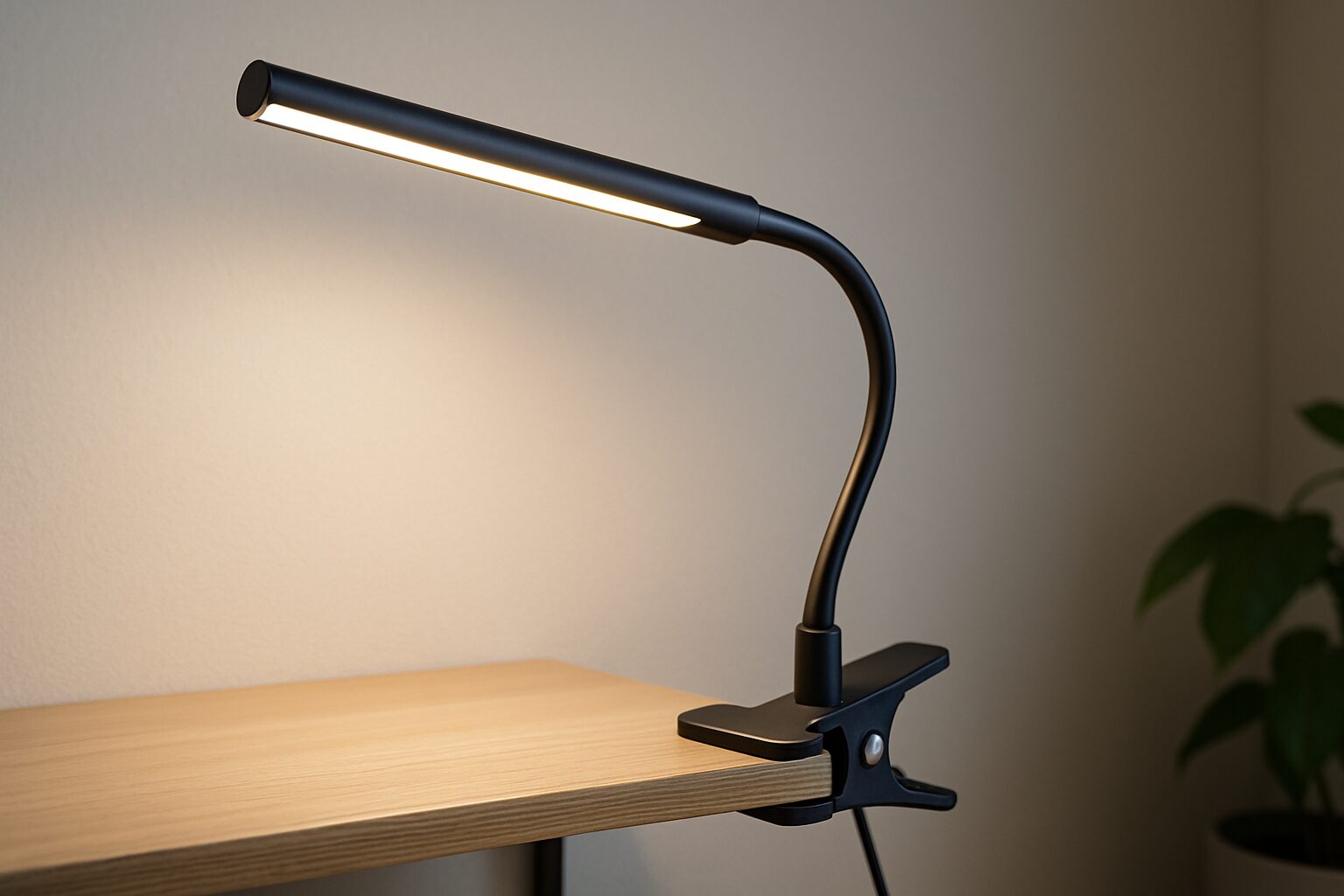 | High freedom of installation location Can be used in small spaces | Slightly worried about stability Restrictions on thickness it can grip |
The stand type is the most common and can be placed anywhere, but it requires space on the desk.
The clamp type fixes to the desk top, so you can use space effectively, but there are limits to the desk thickness where it can be installed.
The clip type can be easily installed on shelves or bed frames, but stability can be somewhat inferior.
Choose the optimal installation method and design according to your space and how you use it.
Choosing one with a wide range of motion for the arm is convenient as you can freely adjust the direction and height of the light.
Thank you for reading until the end!
- The evaluation in this article is unique to this site.
- Unless otherwise specified, product prices and information are current as of the time of writing.
- Please note that this site cannot be held responsible for any inaccuracies in this information.
- Product and service names mentioned on this site are trademarks of their respective companies.
This article was originally written in Japanese and has been translated.
Comments