

The number of devices requiring charging—such as smartphones, laptops, and tablets—increases year by year. Amidst this trend, numerous high-performance chargers priced under 3,000 yen have appeared on the market, and models featuring the latest standards and multiple ports are no longer uncommon.
In this article, we compare major models and introduce our top recommendations. Let’s start by organizing the specs in a comparison table before looking at the features of each model.
Author of this article: "Mr. Gadget"
- Studied under Masatoshi Ono, a million-selling singer who has performed at Kohaku Uta Gassen
- Experience supervising for Ameba Choice and the web media Picky's
- Individual member of the Word of Mouth Marketing Association
Nice to meet you!

Comparison Table & Ranking
商品ランキング
PR

Prices and availability may change. The information shown on the seller’s site at purchase applies.
| Rank | Product Name | Max Total Output (W) | Single Port Max Output (W) | Supported Standards | USB-C Ports | USB-A Ports | Dimensions (mm) | Weight (g) |
|---|---|---|---|---|---|---|---|---|
| 1 | Tama Electric PR-AP146UC2 | 65 | 65 | PD3.0 / PPS / QC3.0 | 2 | 1 | 54×32×52 | 123 |
| 2 | Amazon Basics 65W GaN USB-C | 65 | 65 | PD3.0 | 1 | 0 | 46×27.7×43.9 | 110 |
| 3 | Anker 511 Charger (Nano 3, 30W) | 30 | 30 | PD3.0 / PPS | 1 | 0 | 36×29×29 | 40 |
 Ms. Gadget
What should I be looking at? There are too many numbers and I don’t understand them.
 Mr. Gadget
Check three things: “Output,” “Number of Ports,” and “Supported Standards.”
Focus on output for laptop charging, port count for simultaneous charging, and PPS compatibility for the latest smartphones!
1st Place: Tama Electric PR-AP146UC2: Versatile use with 3 ports & 65W
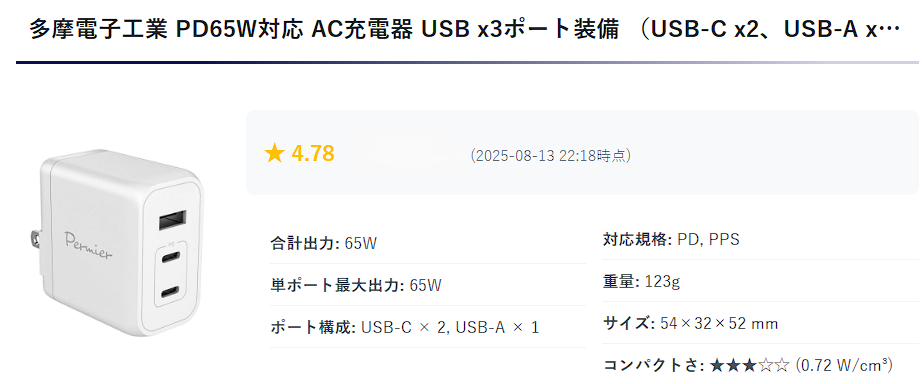
Adopting Gallium Nitride (GaN), it achieves a high maximum output of 65W while remaining compact. With a 3-port configuration consisting of two USB-C ports and one USB-A port, it supports simultaneous charging for smartphones, tablets, laptops, and gaming consoles.
It supports a wide range of fast-charging standards including PD3.0, PPS, and QC3.0, enabling efficient charging across various devices. Safety is also prioritized with built-in overcurrent and overvoltage protection features.
| Item | Details |
|---|---|
| Max Total Output | 65W |
| Single Port Max Output | 65W |
| Supported Standards | PD3.0 / PPS / QC3.0 |
| Port Configuration | USB-C × 2, USB-A × 1 |
| Dimensions | 54×32×52 mm |
| Weight | 123 g |
| Manufacturer | Tama Electric |
- Simultaneous charging possible via 3 ports
- Supports PPS and QC3.0 for optimal charging across a wide range of devices
- Slightly on the heavier side
 Ms. Gadget
Is it okay to charge a laptop and a smartphone at the same time?
Mr. GadgetThat is possible as long as it is within the 65W total limit. During high loads, prioritizing the laptop and adjusting the combination of cables and ports will help maintain stability.

2nd Place: Amazon Basics 65W GaN USB-C: High output with a simple design
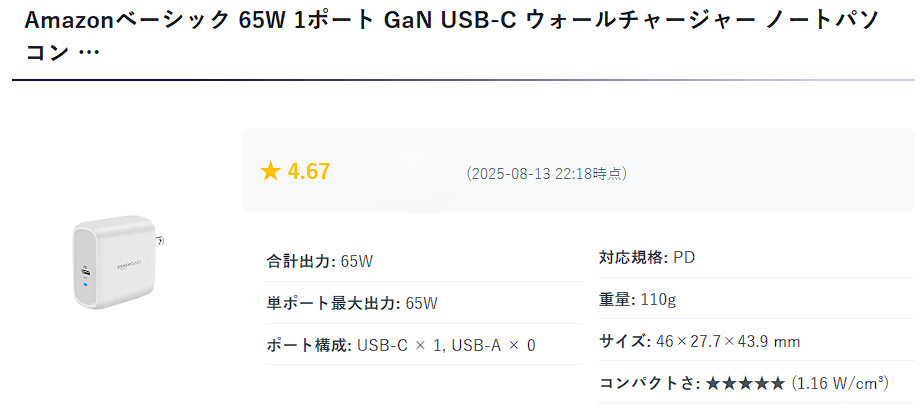
Featuring a simple design with a single USB-C port, it delivers up to 65W of output, making it suitable for charging laptops as well.
Thanks to GaN technology, it is compact and lightweight, making it convenient to carry around.
While it does not support PPS, PD3.0-compatible devices can achieve stable fast charging.
| Item | Details |
|---|---|
| Max Total Output | 65W |
| Single Port Max Output | 65W |
| Supported Standards | PD3.0 |
| Port Configuration | USB-C × 1 |
| Dimensions | 46×27.7×43.9 mm |
| Weight | 110 g |
| Manufacturer | Amazon |
- High output enables laptop charging
- Compact and lightweight with excellent portability
- Lacks PPS support, meaning maximum charging speeds may not be reached on certain smartphones
- Simultaneous charging is not possible
 Ms. Gadget
Is PPS essential?
Mr. GadgetCharging efficiency increases on PPS-supported devices, but you can still charge without issues using standard PD even if it’s not supported. However, it may not reach maximum speeds.
3rd Place: Anker 511 Charger (Nano 3, 30W): Prioritizing portability
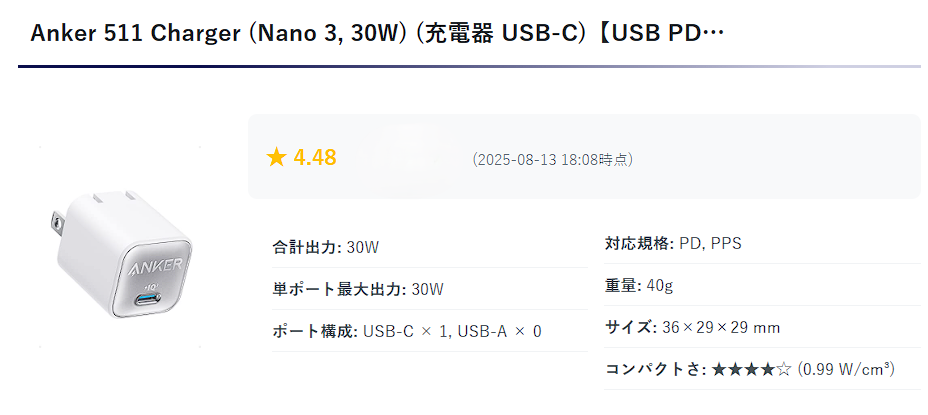
Extremely lightweight at just 40g and sized to fit in the palm of your hand. Despite its maximum 30W output, it supports PD3.0 and PPS, making it fully adequate for fast-charging smartphones and tablets.
While not suited for charging laptops, it is ideal as a secondary charger for going out or traveling.
| Item | Details |
|---|---|
| Max Total Output | 30W |
| Single Port Max Output | 30W |
| Supported Standards | PD3.0 / PPS |
| Port Configuration | USB-C × 1 |
| Dimensions | 36×29×29 mm |
| Weight | 40 g |
| Manufacturer | Anker |
- Extremely lightweight and easy to carry
- Supports PPS for fast charging of the latest smartphones
- Low output makes it unsuitable for laptops
- Simultaneous charging is not possible
Ms. GadgetHow is it for travel use?
Mr. GadgetIt is more than sufficient assuming you aren’t charging a laptop. For those focused primarily on smartphones, it is well worth choosing for its lightweight design.
Summary
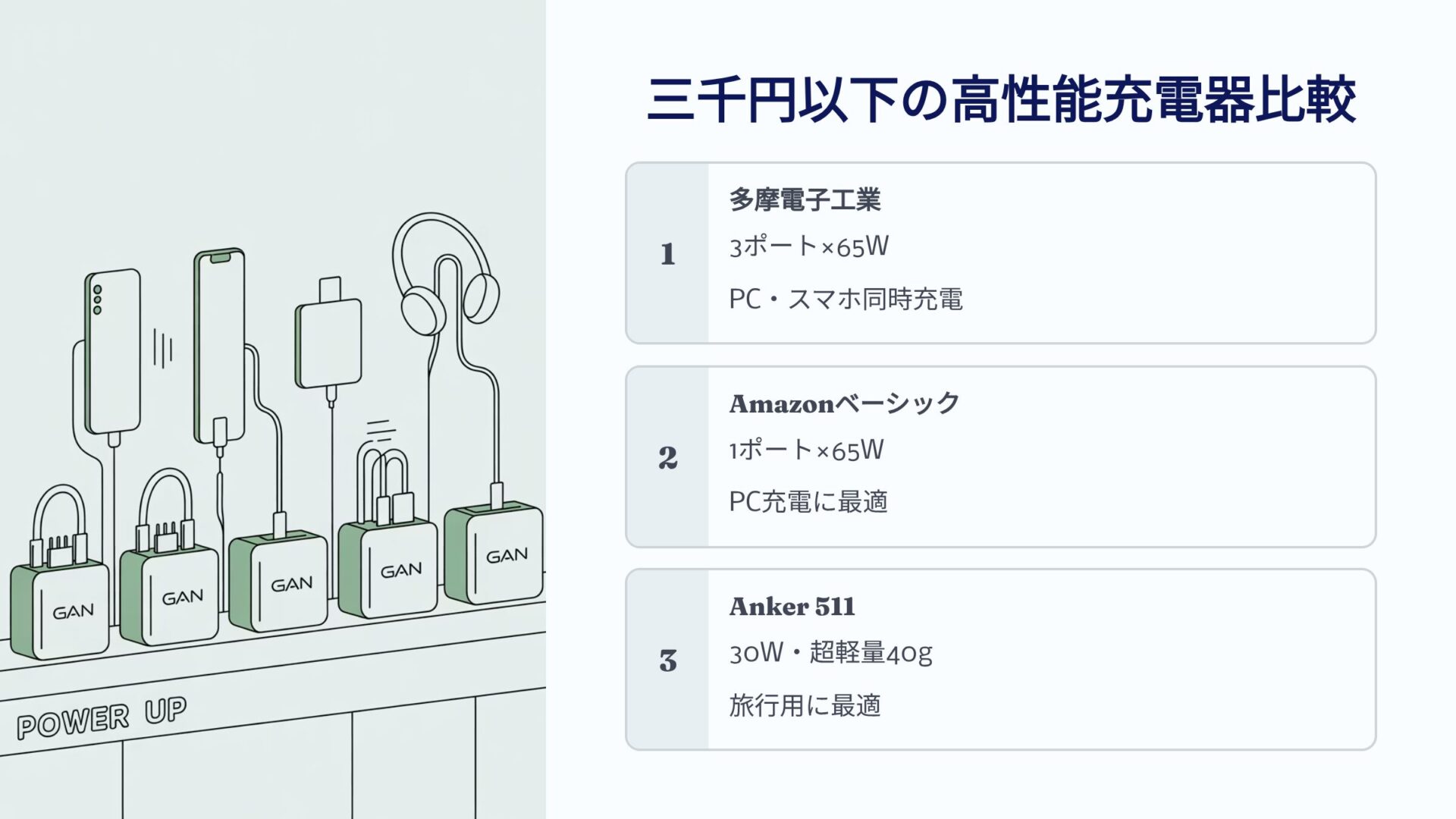
Even among chargers priced under 3,000 yen, there is a lineup of models with varying performance and features.
For instance, if you want to charge your laptop, smartphone, and tablet all at once at home or in the office, the 3-port configuration and 65W output of the PR-AP146UC2 make it a reassuring choice.
Conversely, if you prefer a single port but want to reliably charge your laptop, the high output and compactness of the Amazon Basics 65W are very appealing.
And for a secondary charger for travel or business trips focused mainly on smartphones, the ultra-lightweight 40g Anker 511 Charger offers overwhelming portability and is highly recommended.
- Multi-port + High output focusing on versatility → Tama Electric PR-AP146UC2
- Charging a single device at high output → Amazon Basics 65W
- Portable secondary device focusing on mobility → Anker 511 Charger
Ms. GadgetHow should I choose?
Mr. GadgetIf you’re thinking about future versatility and simultaneous charging, go with the #1 PR-AP146UC2.
If laptop charging is your main priority, choose the Amazon Basics.
If you need a secondary device for travel or going out, the Anker 511 makes for a straightforward distinction in choice.
Thank you for reading until the end!
- The evaluation in this article is unique to this site.
- Unless otherwise specified, product prices and information are current as of the time of writing.
- Please note that this site cannot be held responsible for any inaccuracies in this information.
- Product and service names mentioned on this site are trademarks of their respective companies.
This article was originally written in Japanese and has been translated.
Comments