
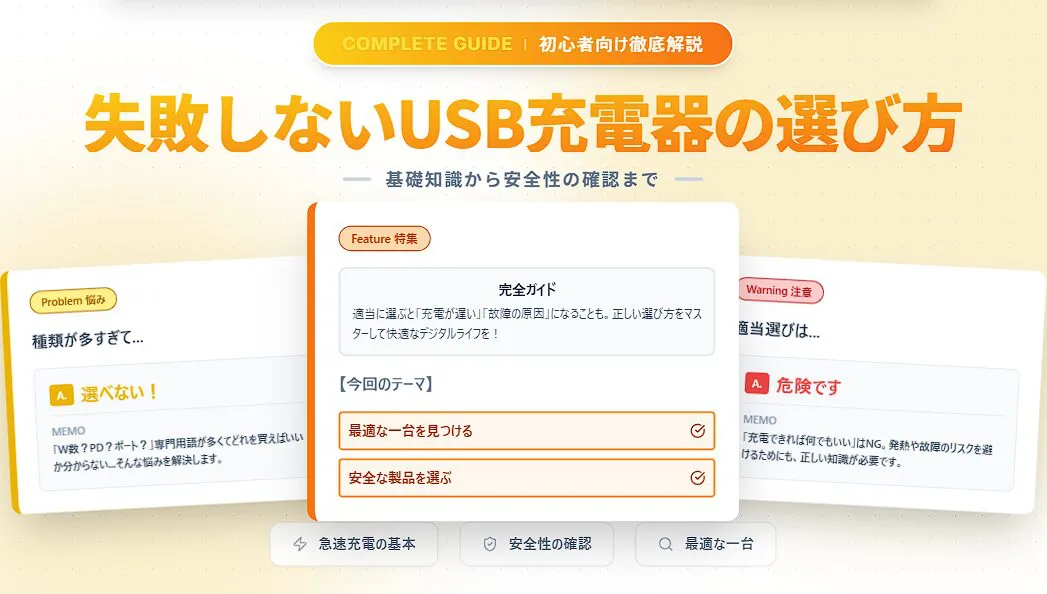
The number of devices that charge via USB—including smartphones, tablets, wireless earbuds, and laptops—has truly increased. Consequently, the variety of USB chargers available has become surprisingly diverse.
With so many technical terms appearing, such as output wattage, port types, and fast charging standards, many people may find themselves wondering, “Which one should I choose?”
 Ms.Gadgets
There are so many types that it’s difficult and confusing to know what to choose.
 Mr.Gadgets
Don’t worry, once you know the basics, you can choose the right one without any mistakes!
If you choose a charger based on incorrect knowledge, it won’t just result in slow charging; you might fail to leverage the full performance of your device, or in the worst-case scenario, it could lead to safety issues such as device failure or overheating.
Thinking “Well, anything is fine as long as it charges” and picking one at random is actually a very dangerous practice.
In this article, we will resolve these questions and anxieties regarding USB charger selection and explain, in a way that is easy for beginners to understand, how to confidently find the optimal charger for the devices you own.
Please read until the end to make your digital life more comfortable and safe.

What is a USB charger?
A USB charger is an “AC adapter” that takes electricity from a household outlet (AC 100V) and converts it into direct current (DC) to power and charge devices like smartphones. Previously, these were always included in the box when purchasing a smartphone, but significant changes have occurred in recent years.
The arrival of the smartphone era without chargers
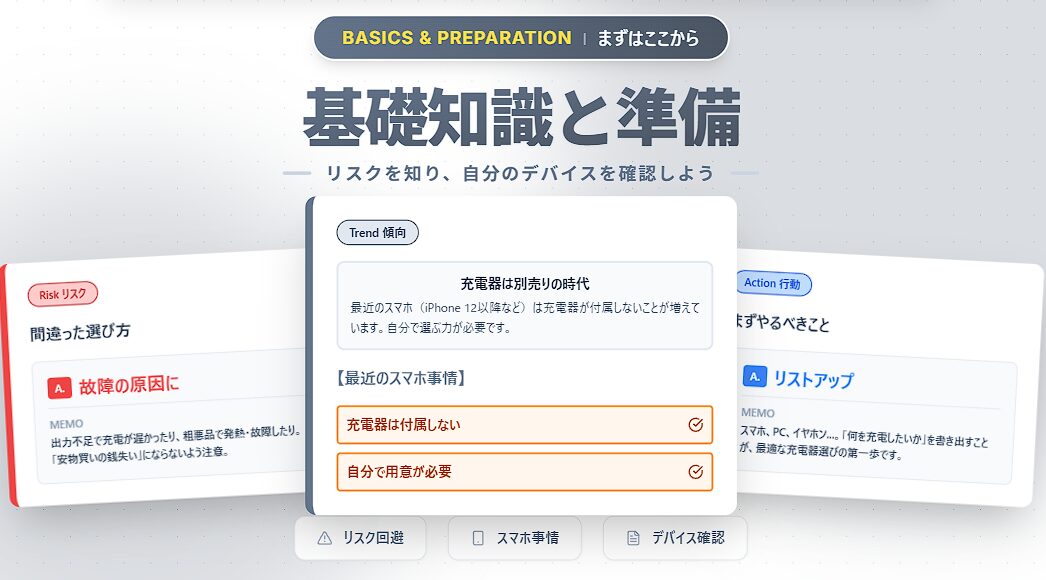
Starting with the iPhone 12 series and moving to many Android smartphones, chargers are no longer included in the box due to environmental considerations (reduction of electronic waste).
In other words, even if you purchase a new smartphone, you must prepare a charger separately on your own.
Even if you have been casually using the included charger until now, you must now understand how to choose one and find a product that fits your device.
Risks of choosing incorrectly
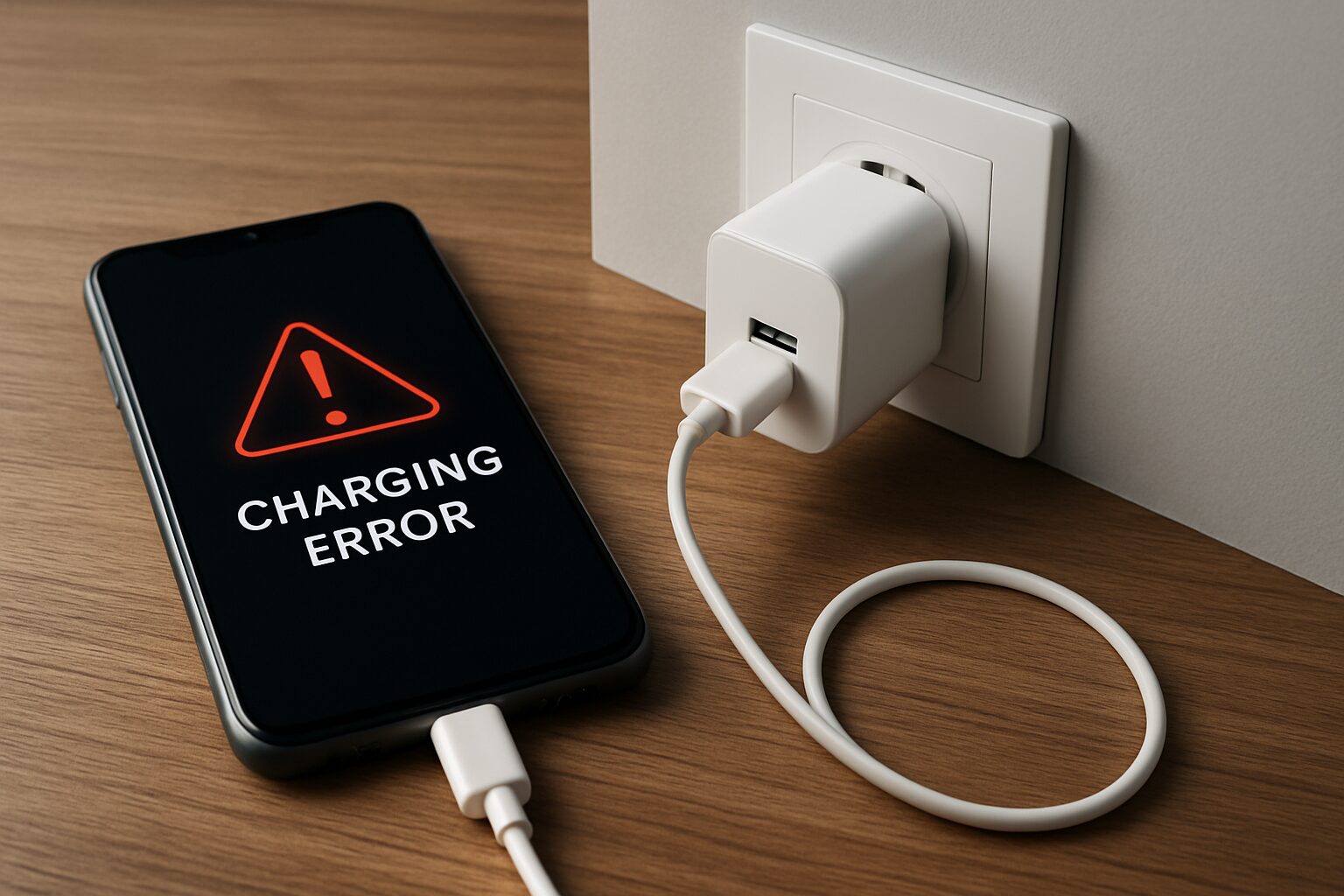
If you choose incorrectly, the following risks may occur:
- Charging time becomes extremely long (insufficient output)
- Accelerated battery degradation (low-quality power supply)
- Danger of overheating or ignition (inferior products that do not meet safety standards)
It’s not just a case of “penny wise, pound foolish”; you could end up breaking your precious device, which might cost tens to hundreds of thousands of yen. It is extremely important to have the mindset of “choosing something proper.”
Essential knowledge for choosing a USB charger
To choose the best one, I will explain “5 technical terms” you must know when looking at packaging or specification sheets.
If you understand these factors, the optimal charger for your device will become clear.
“Output (Wattage),” “Fast charging standards,” “Port types and quantity,” and “Size/Shape”—we will explain each point in detail.
① Output (Wattage): The number that determines charging speed
“W (Watt)” indicates the amount of power the charger can supply at once. The higher this number, the faster you can charge your device.
| Example device to charge | Estimated required output | Example fast charging standards |
|---|---|---|
| Smartphone | 18W–35W | PD, QC |
| Tablet | 30W–45W | PD, QC |
| Laptop | 30W–100W | PD |
Ms.GadgetsMy smartphone says it supports 25W, but is it okay to use a 30W charger?
Mr.GadgetsYou can use a charger with an output higher than what the device requires without any issues; the charging speed will be limited to the device’s maximum supported value.
Also, if you want to charge multiple devices at the same time, you need to choose a charger that has a total output equal to or greater than the sum of the wattage required by each connected device.
However, as I will explain in detail in the port section, please note that when using multiple ports, power is distributed to each, which may decrease the maximum output of each individual port.
By choosing a charger with appropriate output, you can shorten charging time and reduce daily stress.
② Fast charging standards (PD, PPS, QC)
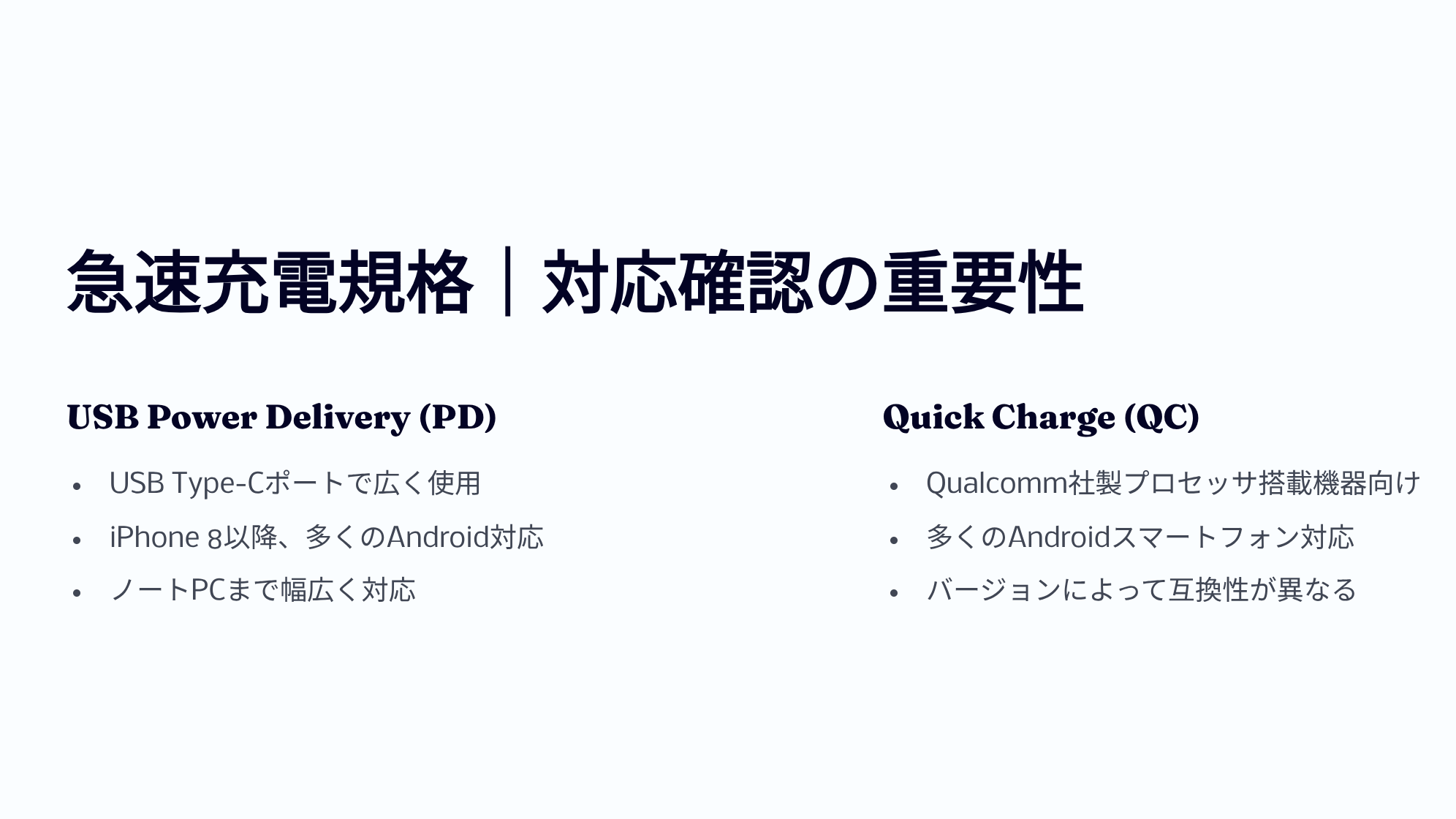
To maximize charger performance—not just by having high wattage—confirming support for fast charging standards is extremely important.
Representative standards include USB Power Delivery (USB PD) and Quick Charge (QC).
| USB PD (Power Delivery) | 【Current standard】 A common standard supporting up to 240W. Adopted by many devices including iPhone, iPad, MacBook, and Pixel. If you’re unsure, choosing “PD compatible” is the right move. |
|---|---|
| PPS (Programmable Power Supply) | 【PD option】 Technology that finely adjusts voltage and current to suppress heat. Essential for “ultra-fast charging” on Android smartphones like Galaxy. |
| Quick Charge (QC) | 【Older standard】 Qualcomm’s proprietary standard. Used mainly in Android, but many now have compatibility with PD. |
Also, understand that to perform fast charging, the device, USB charger, and USB cable must all be compatible with the same fast charging standard.
I have summarized the features of PD and QC in a table here.
| PD Version | Release Date | Max Power | Max Voltage | Main Features |
|---|---|---|---|---|
| 1.0 | July 2012 | 100W | 20V | Exchanged 5 power profiles with fixed values |
| 2.0 | August 2014 | 100W | 20V | Up to 100W power delivery and USB-C Alternate Mode for video/data on one cable; negotiates optimal power between devices; compatible with old standards |
| 3.0 | 2015–2017 | 100W | 20V | PPS※1 for fine voltage adjustment in 20mV increments; heat reduction |
| 3.1 | 2021 | 240W | 48V | Introduced EPR (Extended Power Range) mode, enabling power delivery over 100W; bidirectional power; hub communication (optional) |
※1 PPS (Programmable Power Supply) = A mechanism that efficiently charges by finely changing voltage and current according to the device’s requirements
| QC Version | Release Date | Max Power | Voltage Range | Main Features | USB PD Compatibility |
|---|---|---|---|---|---|
| 1.0 | 2013 | 10W | Max 6.3V | Automatically determines optimal current for each phone | None |
| 2.0 | 2014 | 18W (A) / 60W (B) | 5V/9V/12V/20V | Supports 3-stage voltage switching, dual charging※2 | None |
| 3.0 | 2015–2016 | 36W | 3.2V–20V (200mV increments) | Finely changes voltage to suppress heat | None |
| 4 / 4+ | 2016–2017 | 100W | QC: 3.6–20V / PD: 5V, 9V, PPS | PD compatible | Yes |
| 5 | 2020 | Over 100W | 3.3V–20V or more | USB PD PPS compatible, enhanced heat management, full backward compatibility | Yes (via PPS) |
※2 Dual charging = Shortens time by charging simultaneously with two independent power circuits
Ms.GadgetsI keep hearing about fast charging, but how can I check if my smartphone supports it?
Mr.GadgetsThe most reliable way is to check the product specifications in the instruction manual or on the manufacturer’s official website.
By understanding the fast charging standard your device supports, you can choose the optimal combination of charger and cable, significantly shortening charging time.
③ Port shape and quantity (Type-C / Type-A)
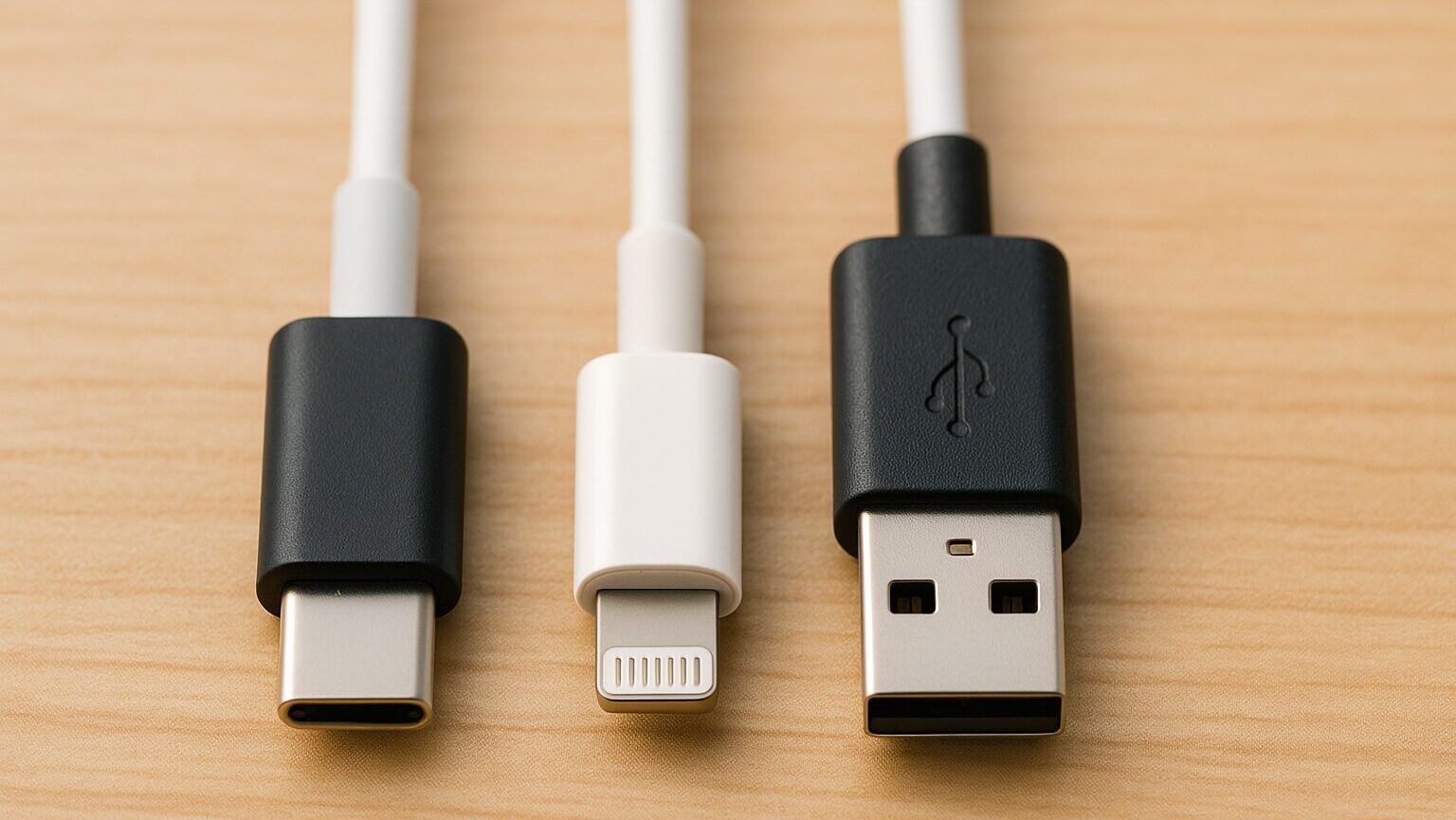
When choosing a USB charger, the “port type and quantity” significantly affect usability.
Main shapes include USB Type-A, USB Type-C, and Lightning.
 Mr.Gadgets
iPhones are also USB Type-C from the 15 series onwards!
It is important to check whether your device’s terminal is one of these three, or perhaps another shape like Micro USB Type-B.
To avoid situations where you want to charge but the terminal is wrong, please take a good look at your device’s ports.
④ GaN (Gallium Nitride): Miniaturization technology
“GaN” is a next-generation semiconductor material. Because it generates less heat and has better energy efficiency than traditional silicon materials, manufacturers have succeeded in dramatically shrinking charger sizes (down to the size of a golf ball).
 Mr.Gadgets
For carrying around, GaN-equipped models are overwhelmingly recommended. Considering the space for installation, choose the optimal size and shape of USB charger.
Choosing a charger with a user-friendly shape will make charging even more comfortable.
⑤ PSE Mark: Proof of safety


“PSE Mark” is proof of safety standards established by the national government, indicating that the product meets the technical requirements set by Japan’s Electrical Appliance and Material Safety Act.
Products without this mark are not permitted for sale or use within Japan.
To protect your precious devices and prevent unexpected troubles like fires or accidents, always choose products with the PSE mark when buying a USB charger.

How to choose a USB charger
Based on the foundational knowledge, I will explain the steps to actually choose the perfect one for you. By choosing with “evidence” rather than just “a gut feeling,” you can prevent post-purchase failures like “it’s slower than I thought” or “it didn’t work.” Let’s check following these 6 steps.
STEP 1: Check your devices
Check the types of devices you want to charge, their connection terminals, and their supported fast charging standards. First, list all the devices you want to charge on a daily basis. The specs of the charger you should choose will change significantly depending on whether it’s “just a smartphone,” “a smartphone and earbuds,” or “a laptop as well.”
Mr.GadgetsEspecially important is whether you will charge a “laptop.” Unlike a smartphone, the power required is high, so if you don’t decide this, you cannot move to the next step.
STEP 2: Required output (Wattage)
Among the listed devices, determine the wattage based on the “device that requires the most power.” If the wattage is insufficient, charging speed will become slow, or in the worst case, charging may not be possible at all.
Ms.GadgetsWith “better to have too much than too little,” is it safe to just buy one with a high wattage?
Mr.GadgetsThat’s correct! For example, if you charge a smartphone (20W) with a 65W charger, it is safe because it is adjusted automatically. If you are unsure, choosing a higher output (the 45W–65W class that can also charge PCs) is recommended for its high versatility.
STEP 3: Match fast charging standards
Confirm whether the device, charger, and cable support the same standards, such as PD (Power Delivery) or QC (Quick Charge). Especially now, choosing a product compatible with the global standard “USB PD (Power Delivery)” is the basic rule.
To realize fast charging, all three of the following must be compatible. If even one is incompatible, fast charging will not work.
- Device (smartphone, etc.)
- Charger (AC adapter)
- Cable
Mr.GadgetsWhat people often overlook is the “cable.” Old cables from 100-yen shops are often not PD-compatible, so please be sure to prepare a Type-C cable marked “PD-compatible.”
Also, please note that even with PD compatibility, the maximum output can change depending on the version.
STEP 4: Port types and quantity
Consider the terminal types like USB Type-A / Type-C and the number of ports you will use simultaneously. The mainstream from here on out is undoubtedly “USB Type-C.” If you are buying a new one, choose a model equipped with Type-C ports.
| Pros | Cons |
|---|---|
|
Convenient for charging smartphone and PC simultaneously Simultaneous charging possible with 2+ ports Can reduce the number of chargers carried when traveling |
Output per port drops when used simultaneously Example: 65W is split into 45W + 20W Tends to be larger than single-port models |
When choosing a multi-port model, be sure to check the “power distribution when used simultaneously.” It makes no sense if you want to charge a PC and a smartphone at the same time but the output for the PC becomes insufficient.
STEP 5: Size and shape
Prioritize compactness for carrying around, and stability for stationary use. Here, the keyword is “GaN (Gallium Nitride).”
 Ms.Gadgets
GaN-equipped chargers are overwhelmingly smaller and lighter than conventional products. For carrying, choosing one that is “GaN-equipped” and has “foldable plugs” is pretty much the only choice!
STEP 6: Safety (PSE Mark)
Finally, the most important thing is safety. Always check for the presence of the PSE mark, overcharge/overheat prevention functions, and manufacturer reliability.
Products without the PSE mark are prohibited by law from being sold in Japan. Please be careful, as parallel imports on sites like Amazon may sometimes lack this mark.
 Mr.Gadgets
Products without the PSE mark are out of the question! Don’t buy from unknown manufacturers!
If you confirm these 6 steps in order, you will definitely find the best charger for you. Because it’s something you use every day, please choose a safe and comfortable one.
Terminology and specifications to note
Charger lifespan and replacement timing
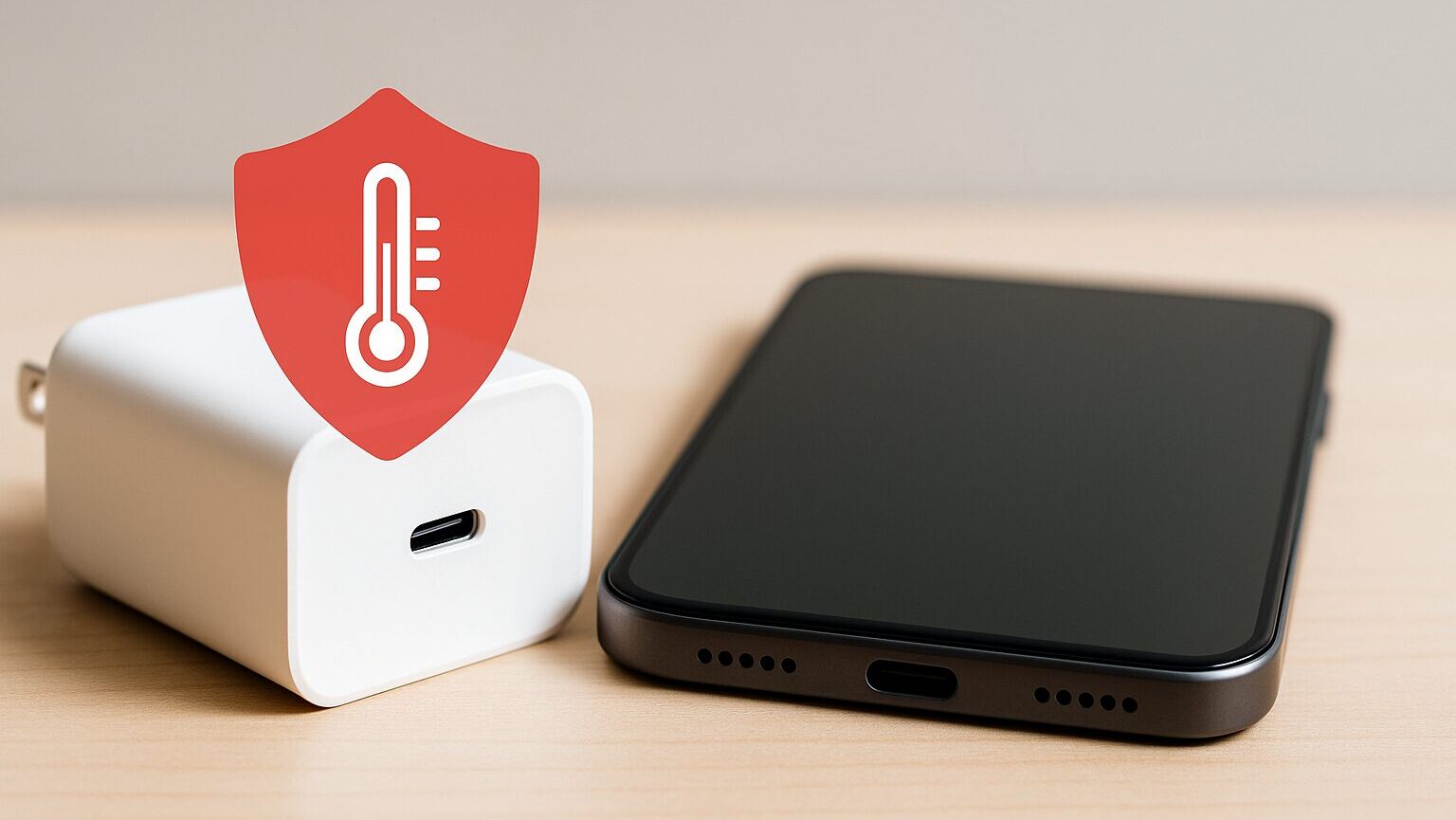
AC adapters (chargers) have a lifespan. Because internal components called capacitors degrade over time, they generally last about 3 to 5 years.
- Gets abnormally hot during charging
- Makes strange noises (a buzzing sound)
- Charging cuts out occasionally
If these symptoms appear, they are signs of failure. Don’t think it’s a waste—for your safety, please replace it with a new one.
How to choose reliable manufacturers
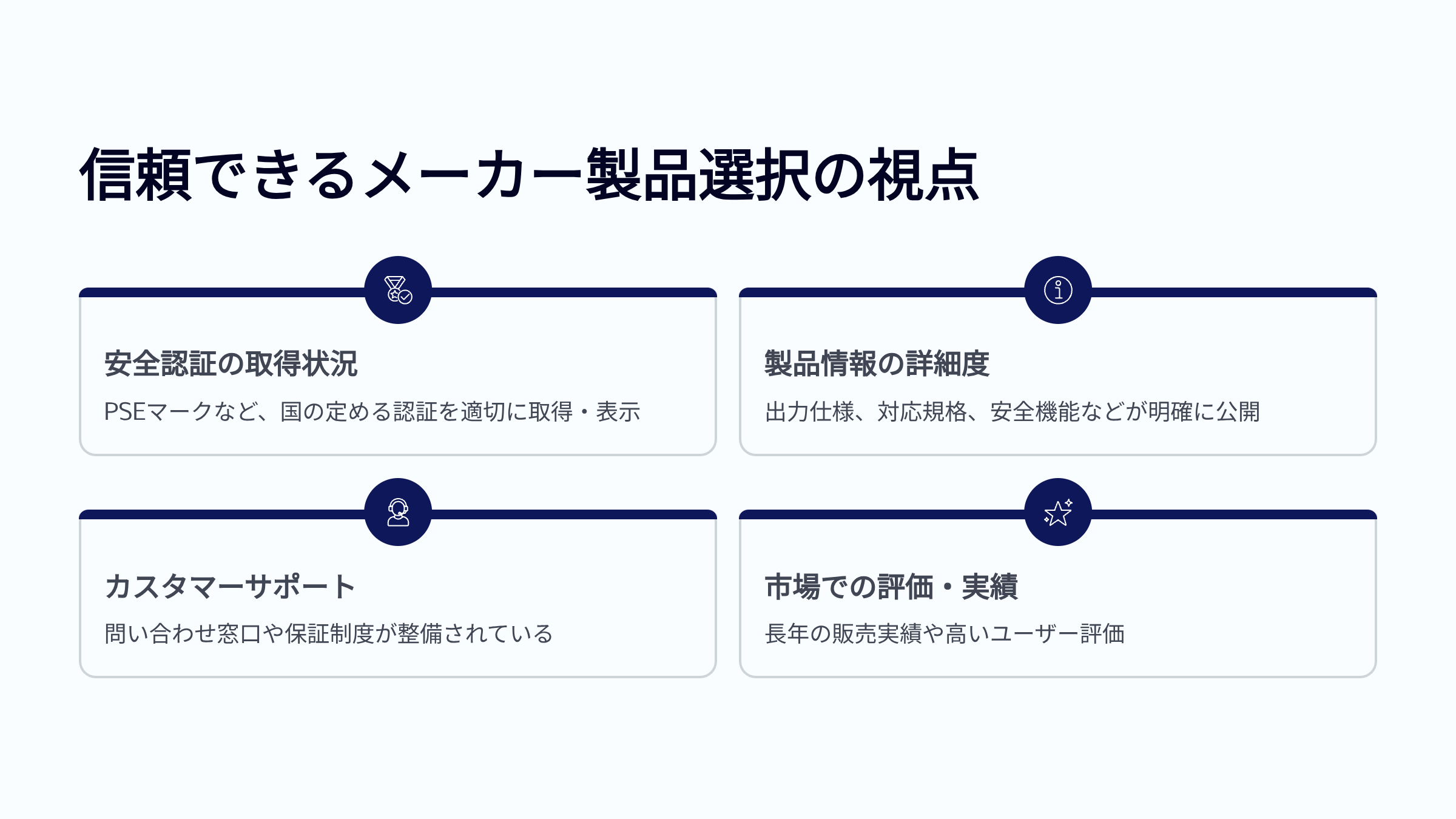
Lastly, I will list the manufacturers I personally trust. These have established support systems via Japanese subsidiaries and have also obtained PSE certification.
- Anker: Track record as world market share No. 1. Extensive lineup.
- CIO: Japanese manufacturer. Excels in miniaturization technology and is popular in crowdfunding.
- UGREEN: High cost-performance and stable quality.
- Belkin: High reliability, also handled on the official Apple website.
- Elecom / Buffalo: Japanese PC peripheral manufacturers. Offers peace of mind.
 Ms.Gadgets
Products without the PSE mark are out of the question!
Don’t buy from unknown manufacturers!
Final check for choosing the optimal USB charger
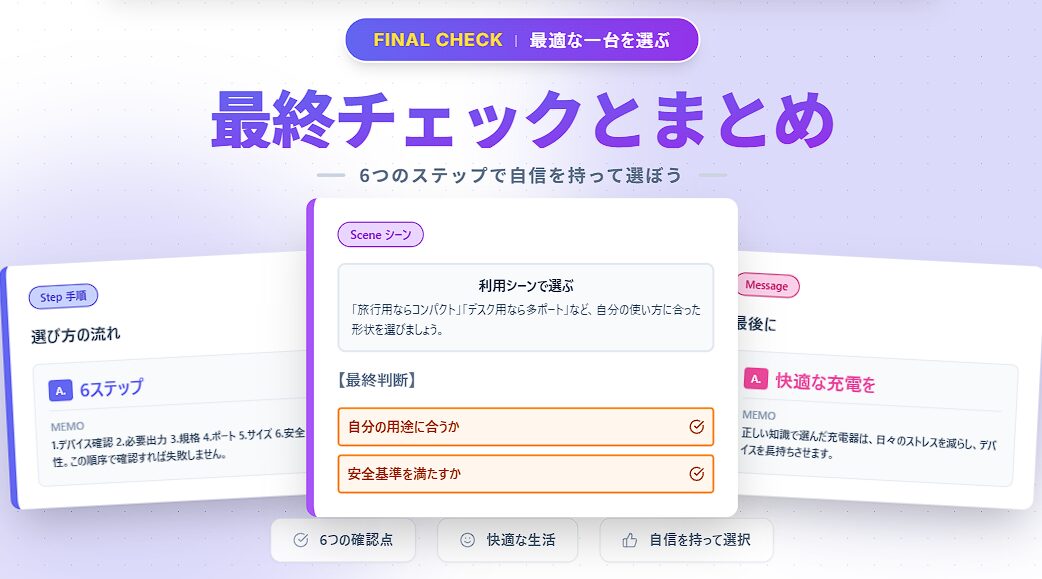
Reconfirming important points

First, let’s briefly look back at the 6 steps we’ve seen for choosing the optimal USB charger.
Check the types of devices you want to charge, their connection terminals, and their supported fast charging standards.
Understand the wattage required by each device and the total output when charging multiple devices simultaneously.
Confirm whether the device, charger, and cable support the same standards, such as PD (Power Delivery) or QC (Quick Charge).
Consider the terminal types like USB Type-A / Type-C and the number of ports used simultaneously. Also check power distribution.
Prioritize compactness for carrying, and stability for stationary use. Foldable plugs are also a point to consider.
Always check for the presence of the PSE mark, overcharge/overheat prevention functions, and manufacturer reliability.




Thank you for reading until the end!
- The evaluation in this article is unique to this site.
- Unless otherwise specified, product prices and information are current as of the time of writing.
- Please note that this site cannot be held responsible for any inaccuracies in this information.
- Product and service names mentioned on this site are trademarks of their respective companies.
This article was originally written in Japanese and has been translated.
Comments