
If you want to efficiently charge multiple devices and keep your desk area tidy, choosing a high-output charger is an important point that can dramatically improve your daily charging environment.
In this article, we will introduce four recommended high-output chargers that can quickly charge both laptops and iPhones in a ranking format.
 Ms.Gadgets
I’m lost as to which high-output charger to choose from so many…
 Mr.Gadgets
We will tell you the best way to choose based on your device configuration and intended use.
What you can learn in this article!
This article was created using the following tools.
Please feel free to use it!

Top 4 High-Output Charger Rankings
Choosing a high-output charger is an important point that can dramatically improve charging efficiency and desk environment.
A charger that can quickly charge multiple devices such as laptops, smartphones, and tablets at the same time will enhance the quality of your daily work and private life.
Let’s take a closer look at each product.
1st Place: Anker Prime Desktop Charger (240W, 4 ports, GaN)
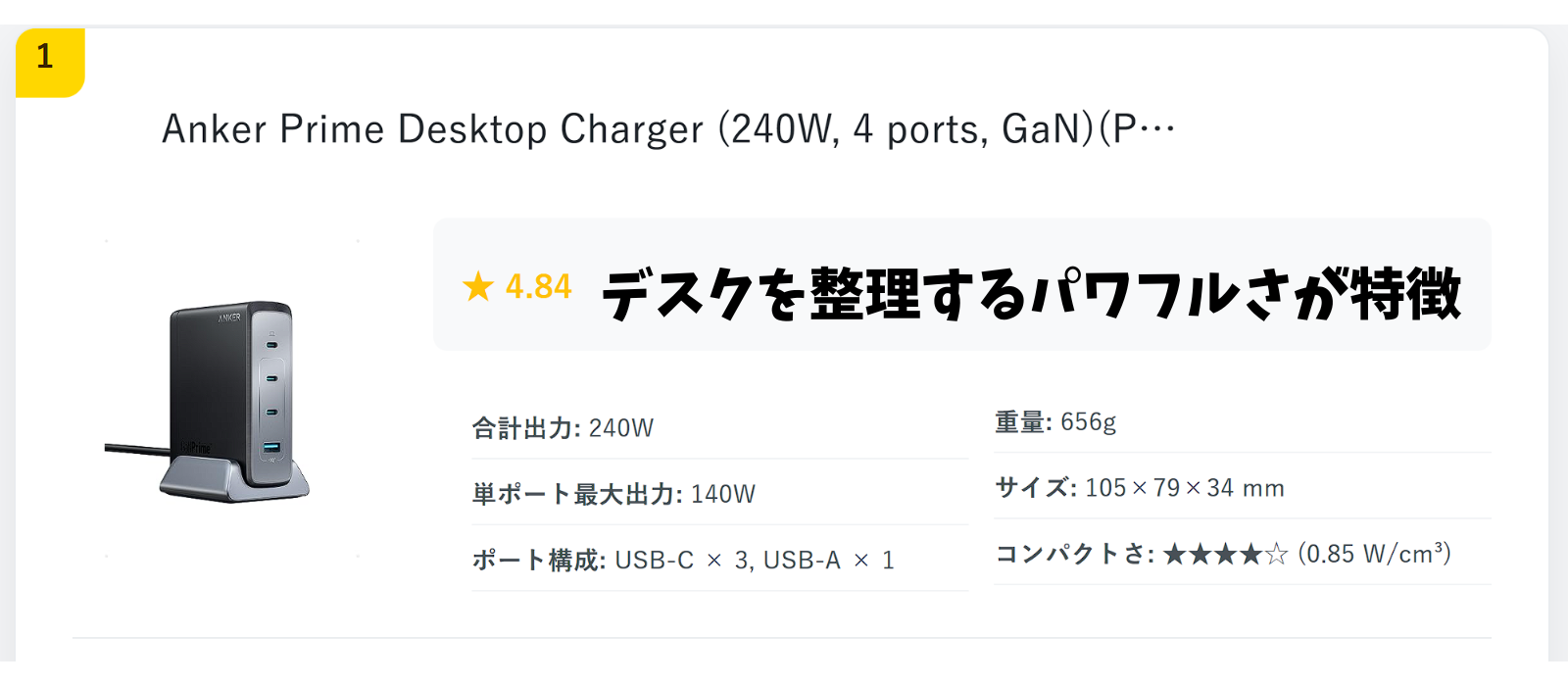
The Anker Prime Desktop Charger (240W, 4 ports, GaN) is the flagship product of the Anker Prime series.
Its greatest appeal is its overwhelming high output of a maximum of 240W in total, equipped with three USB-C ports and one USB-A port, allowing you to quickly charge up to four devices simultaneously.
| Merits | Demerits |
|---|---|
| High output of up to 240W in total Maximum 140W output with one USB-C port Can quickly charge two MacBook Pros simultaneously Removable vertical stand keeps your desk tidy | Charging cables are sold separately USB-C and Lightning cables need to be prepared separately |


 Pochipp
2nd Place: UGREEN NexodeX Charger 160W High Output, 140W Single Port
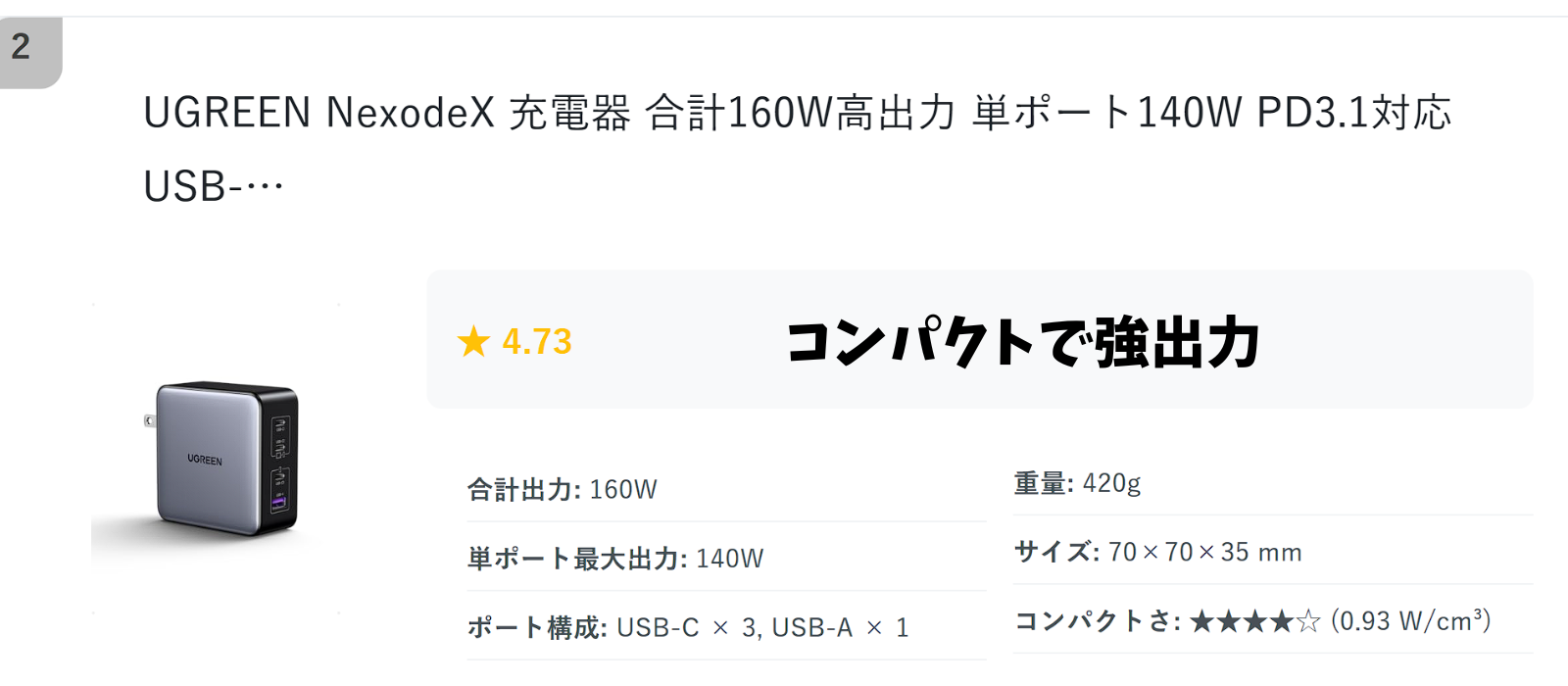
The UGREEN NexodeX Charger is a product that achieves a high output of 160W in total despite its compact size.
With three USB-C ports and one USB-A port, it supports multi-port compatibility and can charge multiple devices simultaneously.
| Merits | Demerits |
|---|---|
| Combines high output (maximum 160W) and compact size Compatible with a wide range of devices from smartphones to laptops USB-C1 supports a maximum output of 140W for MacBook Pro Reduces luggage by eliminating the need for multiple chargers | The main unit tends to generate heat during high output Caution is required for heat dissipation during use in high-temperature environments or for extended periods Power distribution may not be optimal during simultaneous charging There are variations in the quality of details such as packaging |
 Pochipp
3rd Place: Anker Charger (140W, 4 Ports) with USB-C & USB-C Cable
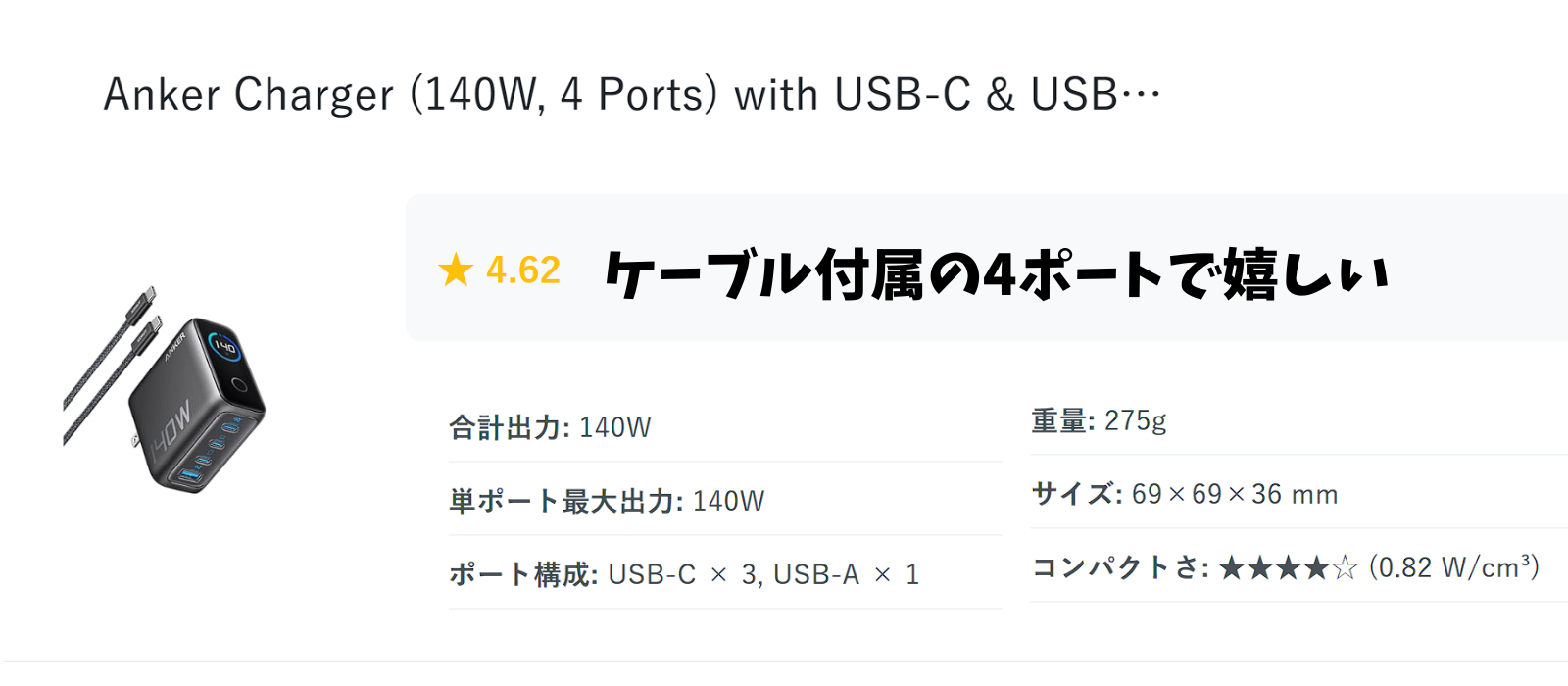
The Anker Charger (140W, 4 Ports) with USB-C & USB-C Cable is a charger made by Anker that supports a total output of 140W and has four USB-C ports.
| Merits | Demerits |
|---|---|
| USB-C cable included for immediate use after unpacking Port configuration focused on USB-C devices for easy use Wide compatibility from iPhone 15 to the latest MacBook Strong simultaneous charging with three USB-C ports |
 Pochipp
4th Place: NovaPort TRIOⅡ 140W3C
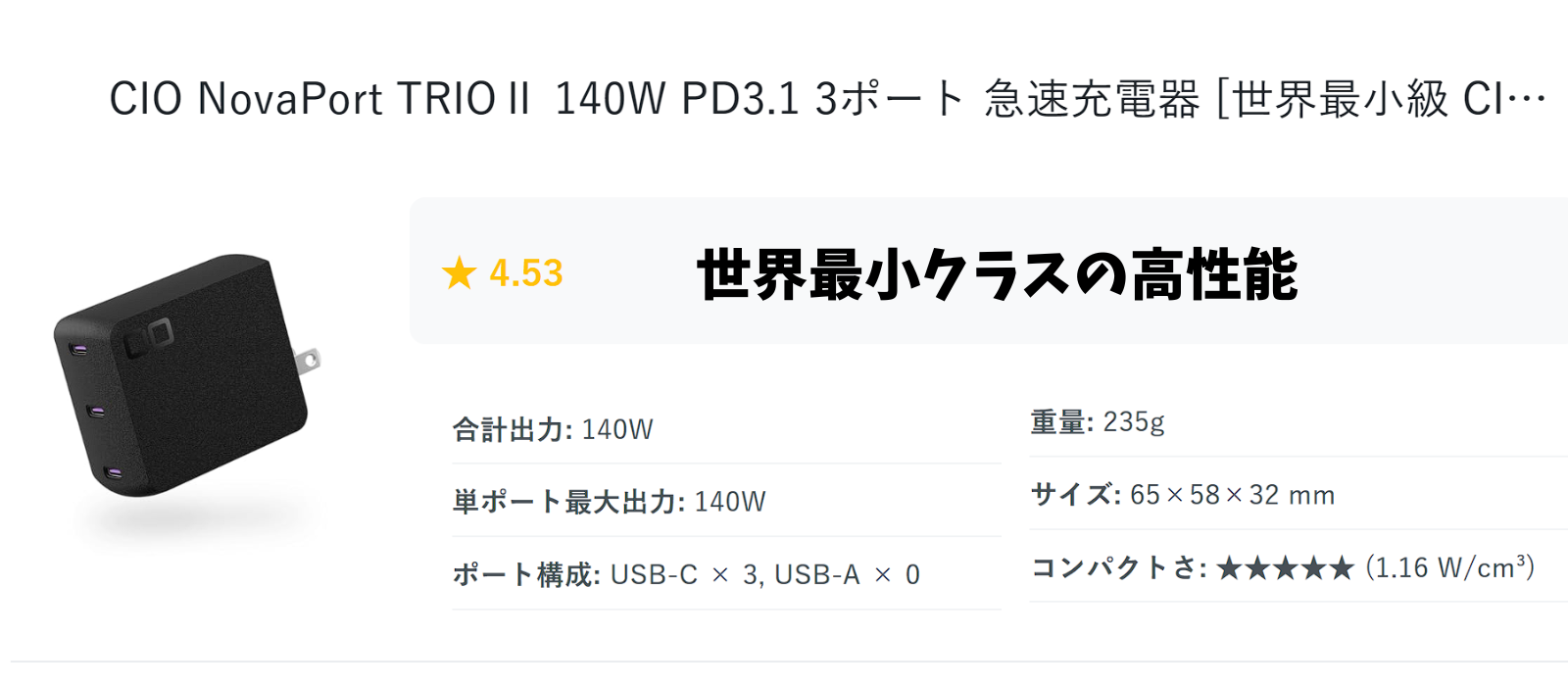
NovaPort TRIOⅡ 140W3C is a charger developed by CIO Co., Ltd., and stands out for its world’s smallest class compactness.
It supports a maximum output of 140W for a single port and complies with the USB PD3.1 standard, allowing you to efficiently charge the latest MacBook Pro.
| Merits | Demerits |
|---|---|
| World’s smallest class compact design for high portability PD3.1 compatible for charging high-output devices such as MacBook Pro Can flexibly charge up to three USB-C devices simultaneously Equipped with unique power optimization “Nova Intelligence” and safety protection function “NovaSafety2.0” | Maximum output is not guaranteed for all devices The main unit may become hot during high output |
 Pochipp
Points to Avoid Failure When Choosing a High-Output Charger
To avoid failure when choosing a high-output charger, it is most important to choose the appropriate specifications based on your intended use and devices.
Let’s maximize the performance of the charger and create a comfortable charging environment.
Ms.GadgetsThere are many products, what points should I look at to choose a charger that suits me?
Mr.GadgetsYou should choose based on four axes: “Output”, “Number of Ports”, “Size”, and “Safety”.
We have summarized the points to consider when choosing a high-output charger.
| Item | Points |
|---|---|
| Maximum Output and Number of Ports | Check the maximum W of the device that requires the most power, such as a laptop, and the number of devices to be charged. |
| Size and Portability | Choose whether it is for fixed use at home or for portability. Miniaturization is progressing with the adoption of GaN, but a certain size is necessary with increased output. |
| Safety and Heat Dissipation | Choose a product from a reliable manufacturer and check for the presence of safety functions such as overheat protection and overcurrent protection. Unique cooling technology and automatic power adjustment functions are also check items. |
By keeping these points in mind, you can find the optimal high-output charger for your digital life, avoid unnecessary expenses, and create a comfortable charging environment.
Summary
This time, we have explained the four recommended high-output chargers that can efficiently charge multiple devices and how to choose them without failure.
- Top 4 recommended high-output charger rankings
- Features of each product, such as maximum output, number of ports, size, and safety
- Points to optimize simultaneous charging of laptops, smartphones, etc., and organize your desk
Please refer to this article to find the high-output charger that is perfect for your device configuration and lifestyle, and realize a comfortable charging environment.






This article was originally written in Japanese and has been translated.
Comments