When searching for PC memory or SSDs, one name you will invariably come across is Kingston Technology.
“What country is this manufacturer from?” “When was the company founded?” “What are its key characteristics?”
To answer these questions, this article provides a clear, easy-to-understand explanation based on publicly available information from three perspectives: country of origin, history, and key features.
Knowing the background of their products should give you a helpful hint in determining whether they suit your specific needs.
- This article is structured from a neutral standpoint based solely on publicly available information from the manufacturer.
- Numerical figures and product lineups vary depending on the time period, region, and model number, so please check the latest official information when making a purchase.
What you will learn in this article!
Author of this article: "Mr. Gadget"
- Studied under Masatoshi Ono, a million-selling singer who has performed at Kohaku Uta Gassen
- Experience supervising for Ameba Choice and the web media Picky's
- Individual member of the Word of Mouth Marketing Association
Nice to meet you!

What country is Kingston Technology from?
Key takeaway from this section!
Kingston Technology is a company from the United States
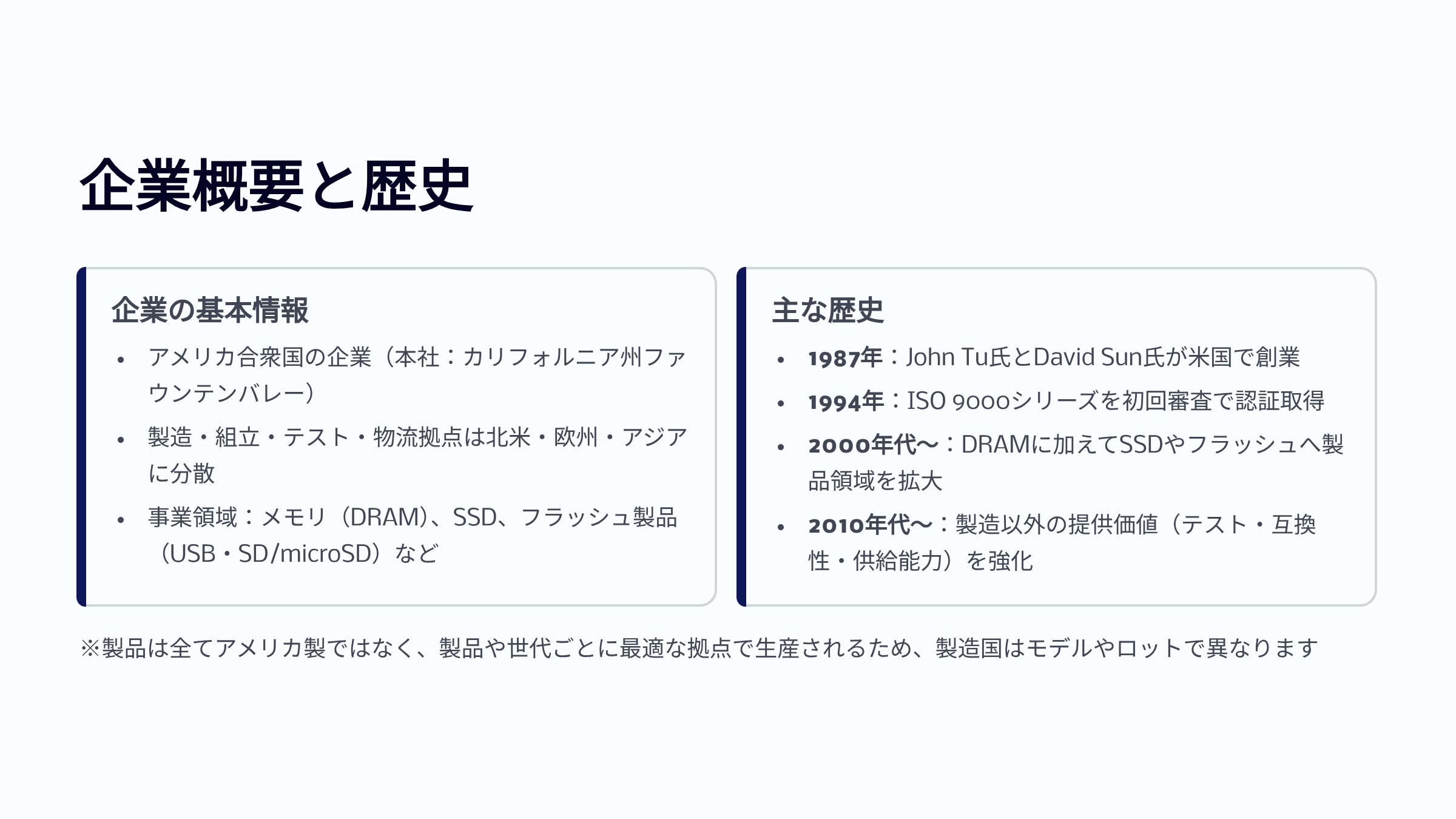
Headquartered in Fountain Valley, California, it is an American company. However, its manufacturing, assembly, testing, and logistics operations are distributed across North America, Europe, and Asia, establishing production and shipping systems in the US, UK, Ireland, Taiwan, China, and elsewhere.
As a result, even for products distributed in Japan, the country of manufacture may vary depending on the lot and model.
- Headquarters: Fountain Valley, California
- Global locations (examples): USA / UK / Ireland / Taiwan / China, etc.
- Business areas: Memory (DRAM), SSDs, flash products (USB drives, SD/microSD cards), etc.
 Ms. Gadget
If it’s an American company, are all products made in the US?
 Mr. Gadget
Because products and generations are manufactured at the most optimal facilities, the country of manufacture varies by model and lot. This operation is based on official global production and logistics systems.
The history of Kingston Technology
- 1987: Founded in the US by John Tu and David Sun, starting out in the memory module business.
- Early 1990s: Expanded production and sales networks alongside growing demand. Focused heavily on quality management from the early stages.
- 1994: Achieved certification for international quality management system standards (ISO 9000 series) on its first audit.
- 1996: Accelerated global expansion following a capital partnership.
- 1999: The founders bought back ownership, reinforcing the company’s independent identity.
- 2000s–Present: Expanded product offerings into SSDs and flash storage in addition to DRAM. Focused heavily on data center and industrial applications as well.
- 2010s–Present: Brought **value provided beyond manufacturing (testing, compatibility, supply capacity)** to the forefront, including verification labs and supply chain operations.
- 2020s: Continues expansion across a wide range of markets, from consumers to enterprises and data centers.
Ms. GadgetThey are called a “long-standing brand,” but what specifically are their strengths?
Mr. GadgetIn addition to their accumulated track record since their founding in 1987, it’s their consistent investment in quality control and compatibility verification. Years of compatibility data and verification equipment represent assets that are difficult to catch up with over a short period.
Key features of Kingston Technology
Key takeaway from this section!
Technological capability and quality control
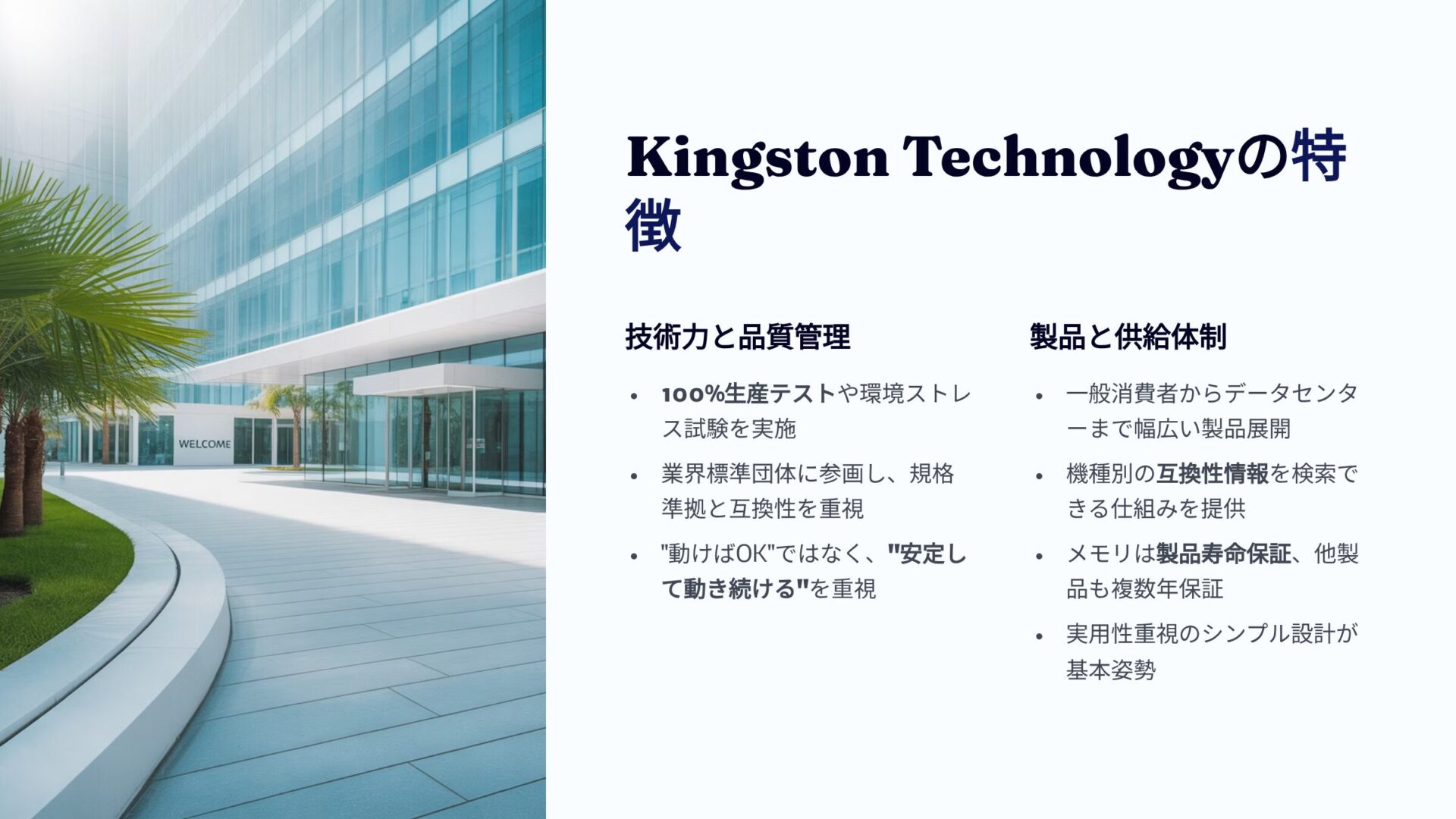
- Integrates 100% production testing, environmental stress testing, and compatibility/reliability testing into the manufacturing process, managing everything from raw components to assembly and inspection.
- Participates in industry standards organizations such as JEDEC, placing strong emphasis on standards compliance and ensuring compatibility.
- Performs verification under conditions closely resembling actual operating environments, even for server and workstation memory/SSDs.
 Mr. Gadget
The impression is that rather than just “working is fine,” they prioritize keeping things running reliably
Flagship products and applications
- DRAM Memory: A broad lineup ranging from laptop/desktop to server/workstation use.
- SSDs: Both SATA and NVMe, covering everything from consumer PCs to data center applications.
- Flash Products: USB flash drives, SD/microSD cards, etc.
- Target Users: General consumers, creators, gaming users, corporate IT, data centers, and the industrial/embedded sectors.
Supply system, compatibility, and support
- Compatibility Information: Provides a system to search for model-specific suitability information (memory and SSDs). Makes it easy to check compatibility prior to purchase.
- Warranty: Memory comes with a lifetime warranty, while SSDs, USB drives, and memory cards feature multi-year warranties depending on the model (details comply with each product’s warranty terms).
- Support: Well-established channels for technical information, deployment guides, and RMA (warranty service) support.
Design trends
- Consumer products center primarily on practical, simplicity-focused designs. Many appearances and enclosures are tailored to specific purposes like portability, durability, or heat dissipation.
- For data center and industrial applications, the design philosophy prioritizes stable operation and manageability over exterior appearance.
Mr. GadgetUsability over “decoration.” Providing the necessary functions to those who need them is their core philosophy
Summary
To answer “What kind of manufacturer is Kingston anyway?” in a single phrase: a comprehensive memory and storage manufacturer that has built up practical value centered around quality, compatibility, and supply capacity.
- Country of origin?: United States. Operates manufacturing and logistics bases globally.
- History: Founded in 1987. Founders are John Tu and David Sun. Expanded business rooted in quality control and compatibility verification.
- Features: Rigorous quality control such as 100% production testing, a wide product lineup, and a supply system and support framework covering corporate and industrial sectors.
Thank you for reading until the end!
- The evaluation in this article is unique to this site.
- Unless otherwise specified, product prices and information are current as of the time of writing.
- Please note that this site cannot be held responsible for any inaccuracies in this information.
- Product and service names mentioned on this site are trademarks of their respective companies.
This article was originally written in Japanese and has been translated.
Comments