
When searching for SSDs or microSD cards on Amazon or at electronics retailers, you may have noticed the brand “KIOXIA” appearing more frequently.
“What country is Kioxia from?” “I’ve heard the name, but is it reliable?” “I heard it’s related to Toshiba, but what does that mean?”
Many of you may have these questions.
In this article, we have thoroughly investigated Kioxia, from its headquarters location to its company history, technical capabilities, product lineup, and reliability.

Conclusion: Kioxia is a Japanese Company
Kioxia is a Japanese flash memory manufacturer headquartered in Minato-ku, Tokyo.
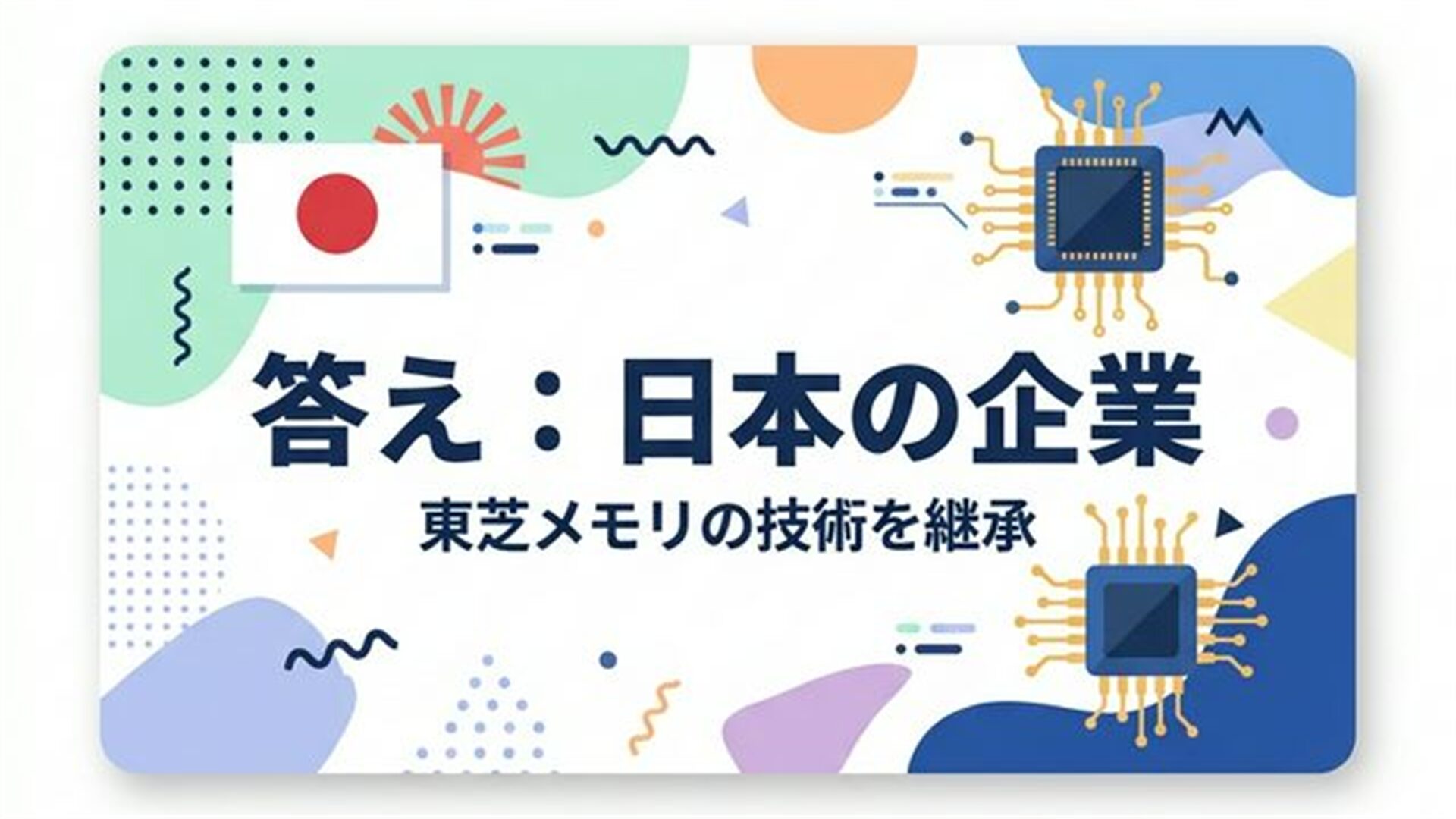
It was originally the memory business division of Toshiba, spun off as “Toshiba Memory Corporation” in 2017. In 2019, it was renamed to its current name, “Kioxia.” With approximately 14% of the global market share for NAND flash memory, it is the third largest company in the world, following Samsung and SK Hynix.
 Ms.ガジェット
I’ve been seeing Kioxia a lot lately, but what country is the manufacturer from?
 Mr.ガジェット
Kioxia is a Japanese manufacturer. It is the company that inherited Toshiba’s memory business and boasts the 3rd largest global market share in the NAND flash memory market. It was also listed on the Tokyo Stock Exchange Prime Market in December 2024.
Below is the basic information for Kioxia.
| Item | Details |
|---|---|
| Official Name | Kioxia Corporation |
| Holding Company | Kioxia Holdings Corporation |
| Established | April 1, 2017 (Spun off as Toshiba Memory) |
| Company Name Change | October 1, 2019 (Renamed to “Kioxia”) |
| Headquarters Location | Tamachi Station Tower S, 3-1-21 Shibaura, Minato-ku, Tokyo |
| Representative | President and CEO (As of the end of March 2025) |
| Number of Employees | Approx. 15,000 (Consolidated, as of the end of March 2025) |
| Net Sales | 1.7065 trillion yen (Consolidated, fiscal year ending March 2025) |
| Stock Exchange | Tokyo Stock Exchange Prime Market (Listed December 18, 2024) |
| Major Shareholders | Toshiba / Bain Capital-related funds / HOYA (Holding ratios for each company are fluctuating post-listing) |
| Major Manufacturing Bases | Yokkaichi Plant (Mie Prefecture) / Kitakami Plant (Iwate Prefecture) |
| Origin of Name | Japanese “Kioku” (memory) + Greek “axia” (value) |
Ms.ガジェットSo it’s listed on the Tokyo Stock Exchange Prime Market. That makes me feel secure.
Mr.ガジェットYes. Being a company listed on the Tokyo Stock Exchange Prime Market means it is required to disclose financial information and undergo audits by external audit firms. You could say the company has a high level of transparency.
Kioxia Company Overview
Kioxia is a semiconductor manufacturer with NAND flash memory as its core business. They offer a wide range of data storage products, including SSDs, microSD cards, and USB flash drives. Here, we will confirm the scale of the company and its position in the market.
Kioxia’s Basic Information and Scale
Kioxia is a company born from the spin-off of Toshiba’s memory business in 2017. The name “Kioxia” is a coined word combining the Japanese “Kioku” (memory) and the Greek “axia” (value), embodying the corporate vision of “uplifting the world with memory.”
Consolidated net sales are 1.7065 trillion yen (fiscal year ending March 2025), with approximately 15,000 consolidated employees. It is one of Japan’s leading semiconductor manufacturers.
It was listed on the Tokyo Stock Exchange Prime Market on December 18, 2024. The IPO price was 1,455 yen. The listing was originally planned for 2020, but was repeatedly postponed due to the COVID-19 pandemic and fluctuations in the semiconductor market, finally being realized after about four years.
Ms.ガジェットIt’s a company with sales exceeding 1 trillion yen. How big is it as a semiconductor manufacturer?
Mr.ガジェットAs a specialized manufacturer of flash memory, it is among the world’s top class. While Samsung and SK Hynix are comprehensive semiconductor manufacturers, Kioxia is characterized by its specialization in NAND flash memory.
Market Share in the NAND Flash Memory Market
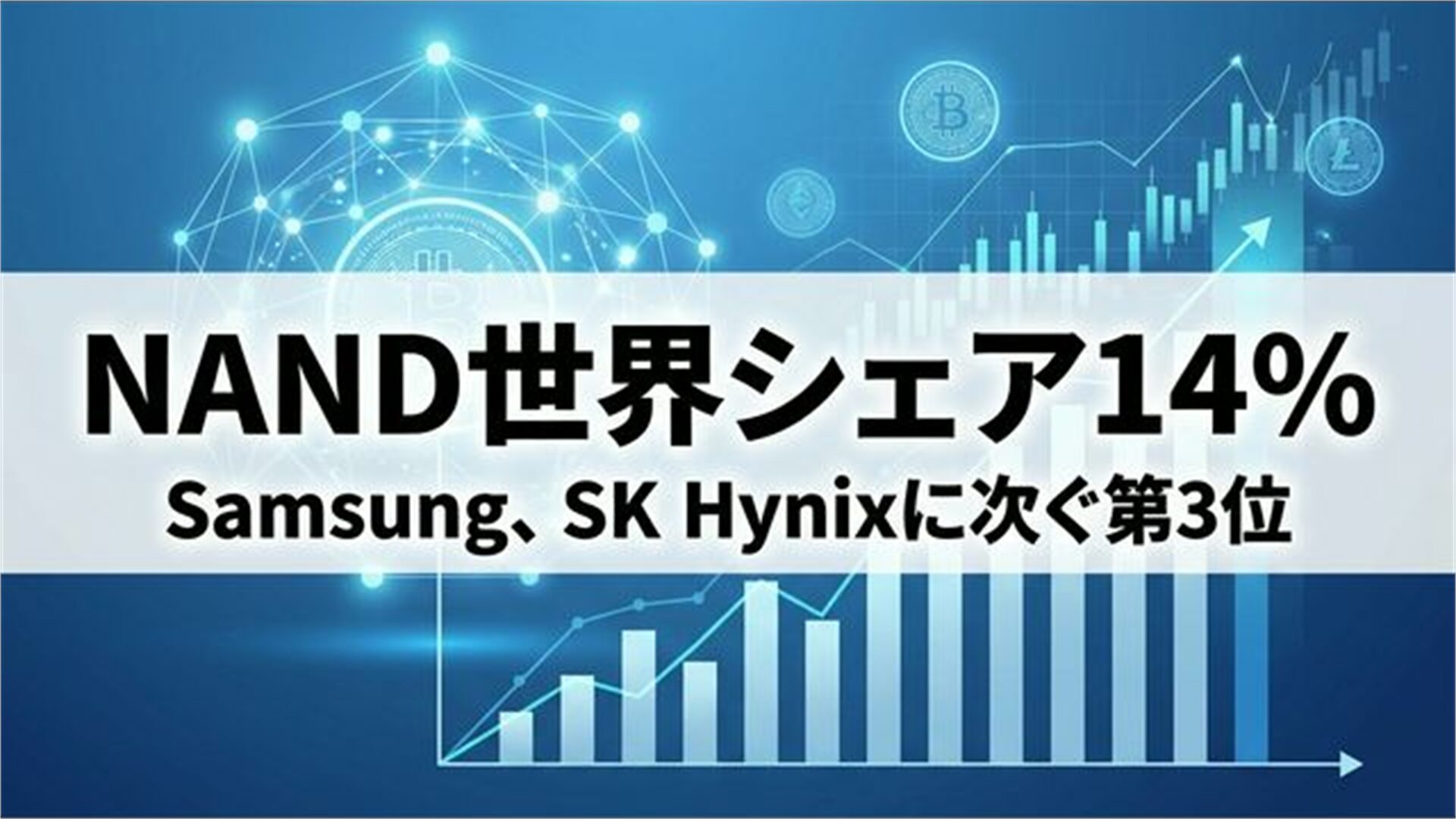
Kioxia’s greatest strength is its 3rd largest share in the global NAND flash memory market.
It holds approximately 14% of the global market share based on shipments in 2024, positioning it after Samsung and SK Hynix (Source: Morningstar, TrendForce). Further market share expansion is expected from 2025 onwards, driven by AI and data center demand.
NAND flash memory is a core component supporting modern information society, used in SSDs, smartphones, and data centers. Kioxia plays a critical role in that global supply chain.
Ms.ガジェット3rd in global share is impressive. Who are 1st and 2nd?
Mr.ガジェット1st is Samsung Electronics (South Korea), and 2nd is SK Hynix (South Korea). These top three companies, along with Micron (USA), account for over 70% of the NAND flash memory market. Kioxia is the only Japanese company in the top four.
Main Product Lineup
Kioxia offers a wide range of products from consumer to enterprise use. Its main brand is the “EXCERIA” series.
SSDs (Solid State Drives)
- EXCERIA PRO SSD (PCIe 4.0 compatible, up to 2TB) — For high-performance desktops and laptops
- EXCERIA G2 SSD (M.2 2280, max read 2,100MB/s) — For mid-range use
- EXCERIA BASIC SSD (PCIe 4.0, max read 7,300MB/s, up to 2TB) — Entry model
- EXCERIA PLUS Portable SSD (max read 1,050MB/s, shock-resistant design) — For on-the-go and creators
microSD / SD Cards
- EXCERIA (max read 100MB/s, up to 256GB) — For smartphones and tablets
- EXCERIA PLUS G2 (up to 2TB, V30/U3 compatible) — For 4K video recording
- EXCERIA HIGH ENDURANCE (up to approx. 40,000 hours of continuous recording) — For security cameras and dashcams
USB Flash Drives / Enterprise
- TransMemory series — Available in various capacities and USB 3.2 compatible models
- Enterprise SSDs — High-durability models for data centers and servers
Ms.ガジェットThe EXCERIA series has many types. Which is more popular, the SSDs or the microSD cards?
Mr.ガジェットFor consumers, the microSD cards have high brand recognition and are frequently chosen, especially for Nintendo Switch and dashcam use. On the other hand, the EXCERIA SSD series is gaining popularity for PC building and laptop upgrades.
Kioxia’s History and Reliability
We will examine the journey Kioxia took to establish its position as a global semiconductor manufacturer and its reliability derived from its technical capabilities.
From Toshiba Memory to Kioxia: History
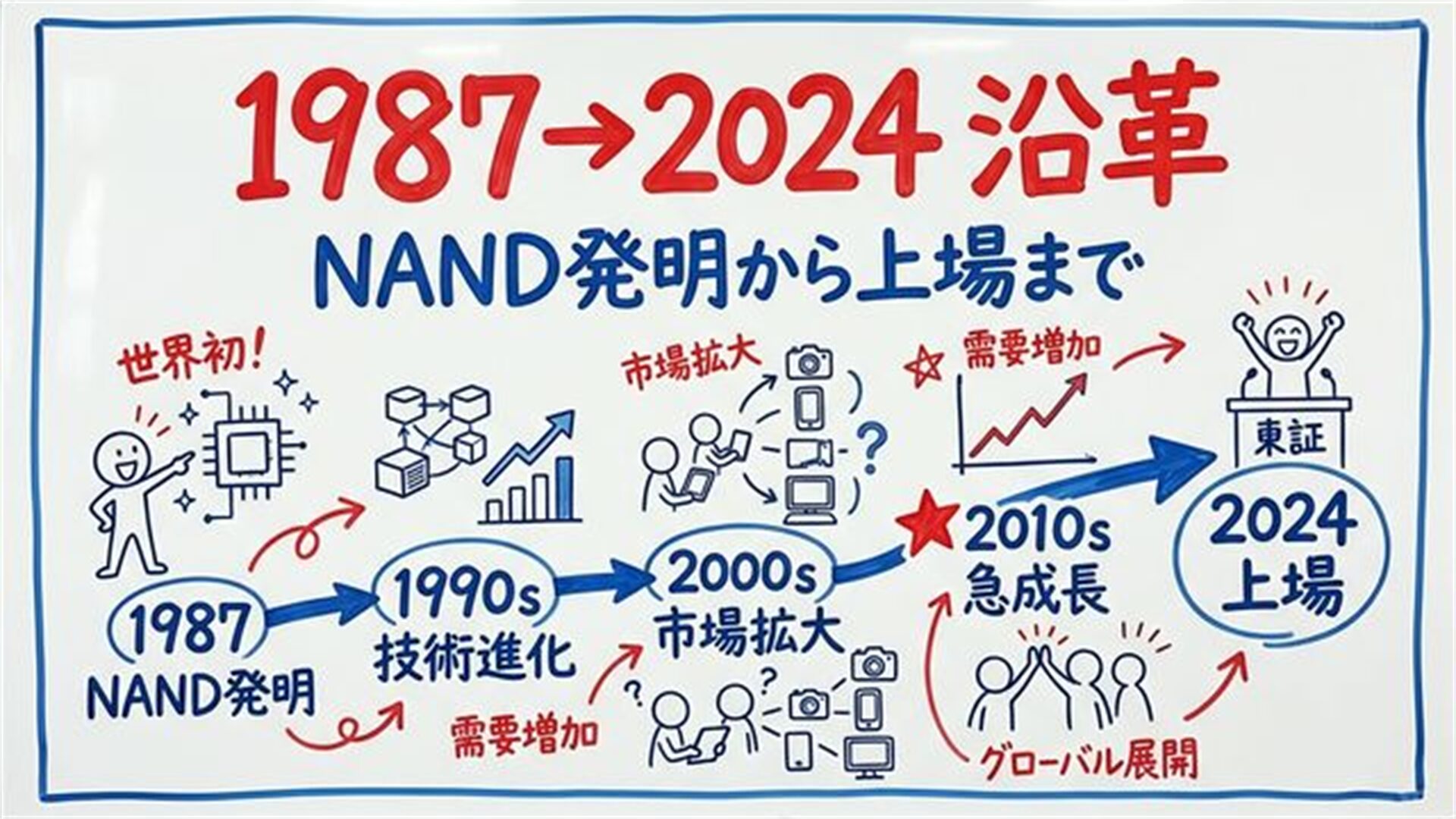
Kioxia’s history traces back to Toshiba’s memory business. Arranged chronologically, it is as follows:
- 1987: Toshiba’s Fujio Masuoka invents NAND flash memory. Announced at the IEEE International Electron Devices Meeting (IEDM)
- 1999–: Toshiba begins joint flash memory production with SanDisk (now Western Digital). Joint operation of the Yokkaichi Plant
- April 2017: Due to Toshiba’s management crisis, the memory business is spun off. Becomes independent as “Toshiba Memory Corporation”
- June 2018: A Japan-US-South Korea consortium led by Bain Capital acquires Toshiba Memory shares for approximately 2 trillion yen (Toshiba retains approx. 40%)
- October 2019: Changes company name to “Kioxia Corporation”
- 2020: Planned to list on the Tokyo Stock Exchange, but postponed due to the impact of the COVID-19 pandemic
- Autumn 2022: Production begins at the Yokkaichi Plant’s new Fab 7 (Y7) manufacturing facility
- February 2024: The Japanese government approves subsidies of up to 150 billion yen for the Yokkaichi and Kitakami plants
- December 18, 2024: Listed on the Tokyo Stock Exchange Prime Market (Stock Code: 285A)
Ms.ガジェットSo it was a company independent from Toshiba’s memory business. Why was it spun off?
Mr.ガジェットThe main cause was the accounting scandal at Toshiba revealed in 2015. Toshiba, which had fallen into a management crisis, needed to sell its most profitable memory business to secure funds. As a result, it was sold to the Bain Capital consortium, although Toshiba still held approximately 40% of the shares at the time of listing (this has been gradually changing post-listing).
Technical Capabilities: The Originator of NAND Flash Memory
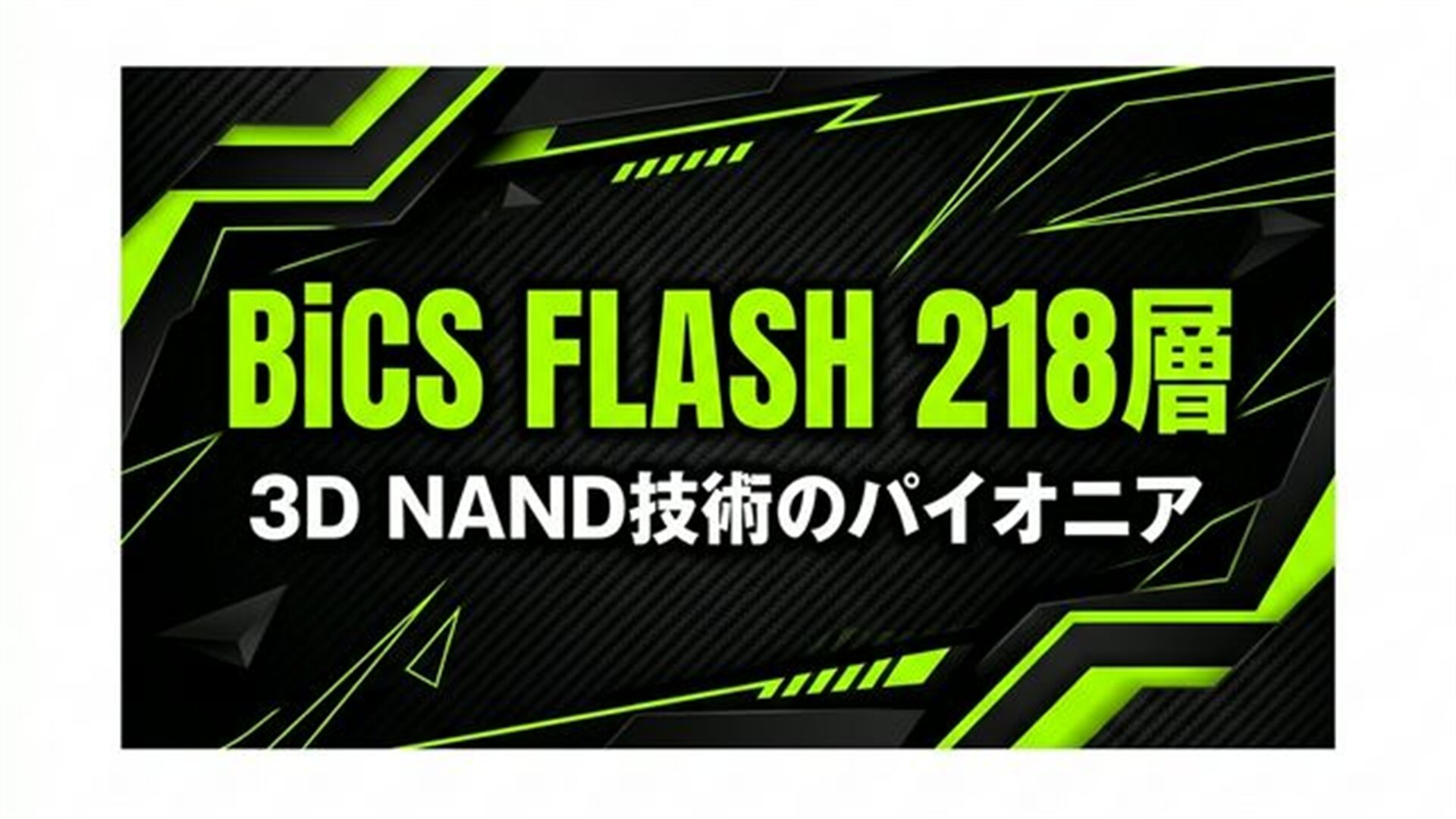
The foundation of Kioxia’s technical capabilities is the lineage of Toshiba’s technology, which invented NAND flash memory itself.
NAND flash memory, invented by Fujio Masuoka of Toshiba in 1987, became the foundational technology supporting modern SSDs, smartphones, and data centers. Kioxia directly inherited the technical assets of the inventor.
Kioxia’s current key technologies are as follows:
| Technology | Overview |
|---|---|
| BiCS FLASH™ | Kioxia’s 3D NAND flash memory technology brand. Achieves higher density, higher performance, and power savings by vertically stacking memory cells |
| 8th Generation BiCS FLASH | Achieves 218-layer stacking. Uses CBA (CMOS Directly Bonded to Array) technology to bond the circuit and cell array after manufacturing them on separate wafers |
| OPS Technology | On Pitch Select Gate. Eliminates conventional dummy areas to improve memory cell density |
| TLC / QLC | Technology that stores 3 bits (TLC) / 4 bits (QLC) per cell. Contributes to larger capacities |
In 2007, they announced the world’s first 3D flash memory (BiCS FLASH), and they are also the pioneers of 3D NAND technology.
Ms.ガジェットSo it’s the lineage of the company that invented NAND flash memory. That seems highly reliable.
Mr.ガジェットYes. The technical lineage of being the inventor of flash memory and a pioneer in 3D NAND technology is a major strength for Kioxia. The latest 8th generation BiCS FLASH achieves 218-layer stacking, and they continue to stand at the forefront of technical development.
Quality Control System and Manufacturing Bases
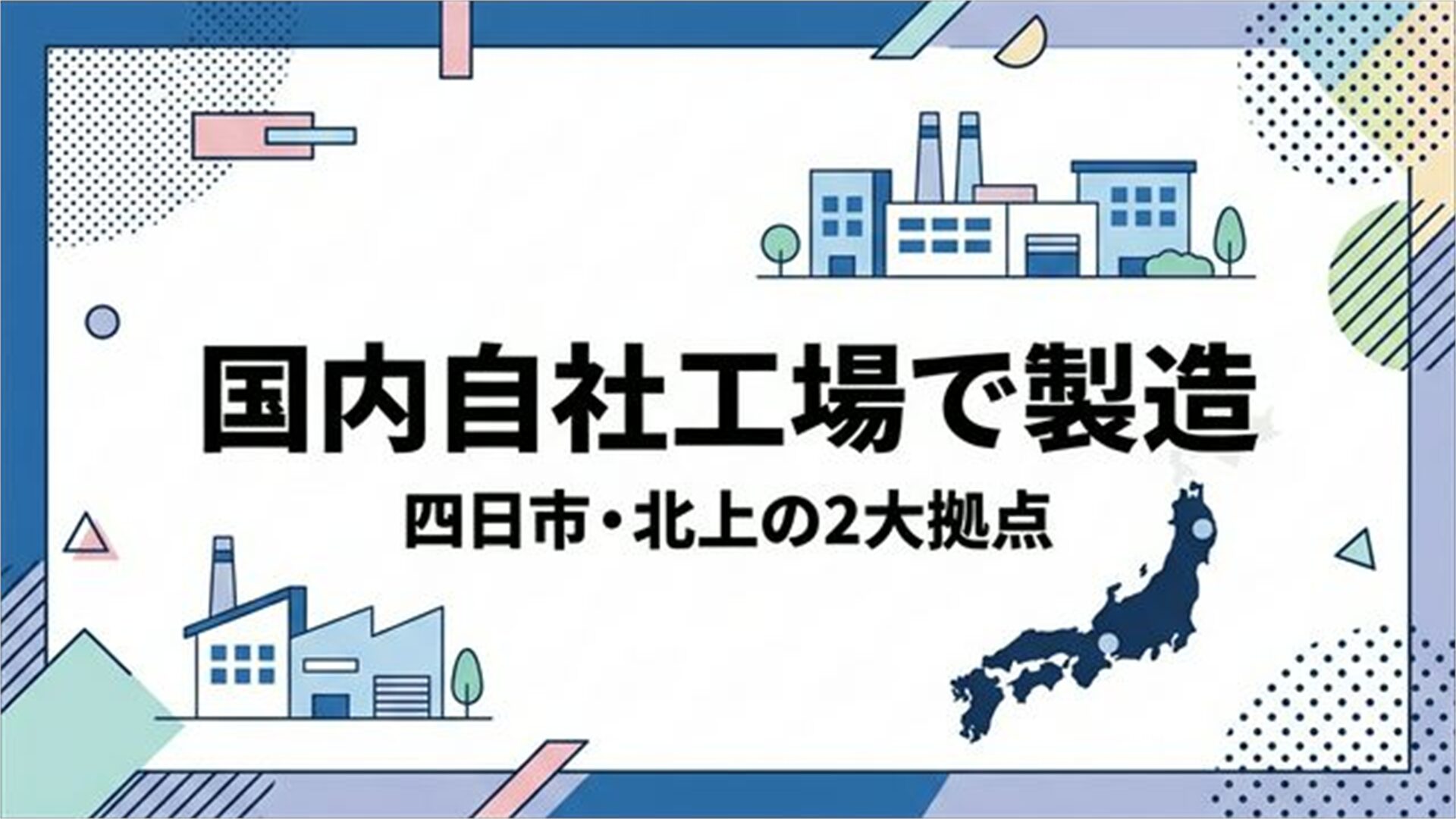
Kioxia’s NAND flash memory is manufactured in their own factories within Japan. There are two main bases:
Yokkaichi Plant (Yokkaichi, Mie Prefecture)
One of the world’s largest flash memory manufacturing plants. It is operated as a joint venture with Western Digital (formerly SanDisk), and the latest manufacturing facility, Fab 7 (Y7), began operations in the autumn of 2022. They are also working on optimizing production efficiency using AI technology.
Kitakami Plant (Kitakami, Iwate Prefecture)
The second major base following the Yokkaichi Plant, also a joint venture with Western Digital (formerly SanDisk). In February 2024, subsidies of up to 150 billion yen were approved by the Japanese government for both the Yokkaichi and Kitakami plants.
Ms.ガジェットSo they manufacture within Japan. How is it in terms of quality?
Mr.ガジェットAn integrated manufacturing system in domestic factories is a major advantage in terms of quality control. Since semiconductor manufacturing relies directly on cleanroom environments and the precision of process management, being able to manage all processes in their own factories leads to high reliability.
Summary: Is Kioxia Reliable?
Kioxia is a Japanese semiconductor manufacturer that directly inherits the technical lineage of Toshiba, the inventor of NAND flash memory. Its track record as the 3rd largest global market share holder, its transparency as a company listed on the Tokyo Stock Exchange Prime Market, and its integrated manufacturing system in domestic Japanese factories support the quality and reliability of its products.
| Pros | Cons |
|---|---|
| Inherits technology from the inventor of NAND flash memory (Toshiba) | Brand recognition as a consumer brand does not reach Samsung or SanDisk |
| Track record as 3rd in global NAND market share | Operating loss of 252.7 billion yen in the fiscal year ending March 2024 (due to market deterioration; recovered to operating profit in the fiscal year ending March 2025) |
| TSE Prime listed company (high financial transparency) | The listing was delayed by about 4 years from the original plan |
| Integrated manufacturing in domestic Japanese factories (Yokkaichi, Kitakami) | Samsung and Micron are dominant in the enterprise SSD market |
| Cutting-edge BiCS FLASH 218-layer (8th gen) technology | |
| Over 20 years of joint venture experience with Western Digital (SanDisk) |
Kioxia is highly recommended for:
- Those who want to choose a Japanese manufacturer’s product for an SSD or microSD card
- Those seeking quality backed by the technology of the inventor of NAND flash memory
- Those looking for highly durable microSD cards for dashcams or security cameras
- Those looking for highly reliable SSDs for PC building or laptop upgrades
If you are interested, please check out the Kioxia EXCERIA series on Amazon or at your local electronics retailer.
Points of this article!
- Kioxia is a Japanese flash memory manufacturer headquartered in Minato-ku, Tokyo
- Toshiba’s memory business was spun off (2017), renamed to current name “KIOXIA” in 2019
- Approx. 14% global market share of NAND flash memory (3rd largest)
- Listed on the Tokyo Stock Exchange Prime Market in December 2024 (Stock Code: 285A)
- Possesses cutting-edge 3D NAND technology with BiCS FLASH (218 layers)
- Manufactures NAND flash memory in domestic Japanese factories (Yokkaichi, Kitakami)
Thank you for reading until the end!
- The evaluation in this article is unique to this site.
- Unless otherwise specified, product prices and information are current as of the time of writing.
- Please note that this site cannot be held responsible for any inaccuracies in this information.
- Product and service names mentioned on this site are trademarks of their respective companies.
コメント