
Portable power stations are reliable allies for camping and disaster preparedness, but choosing the right one can be surprisingly difficult.
Because portable power stations are by no means inexpensive purchases, acquiring basic knowledge is the most important step to ensure you don’t regret your decision after buying one.
Why careful model selection is required, common mistakes in the selection process and their causes, how to clarify your usage and power requirements, and a proper understanding of product specifications will be explained in an easy-to-understand manner.
By grasping these fundamentals, you can take the first step toward finding the perfect unit for your needs from among the many products available.

Basic knowledge to avoid regret when choosing a portable power station
Key points for this section!
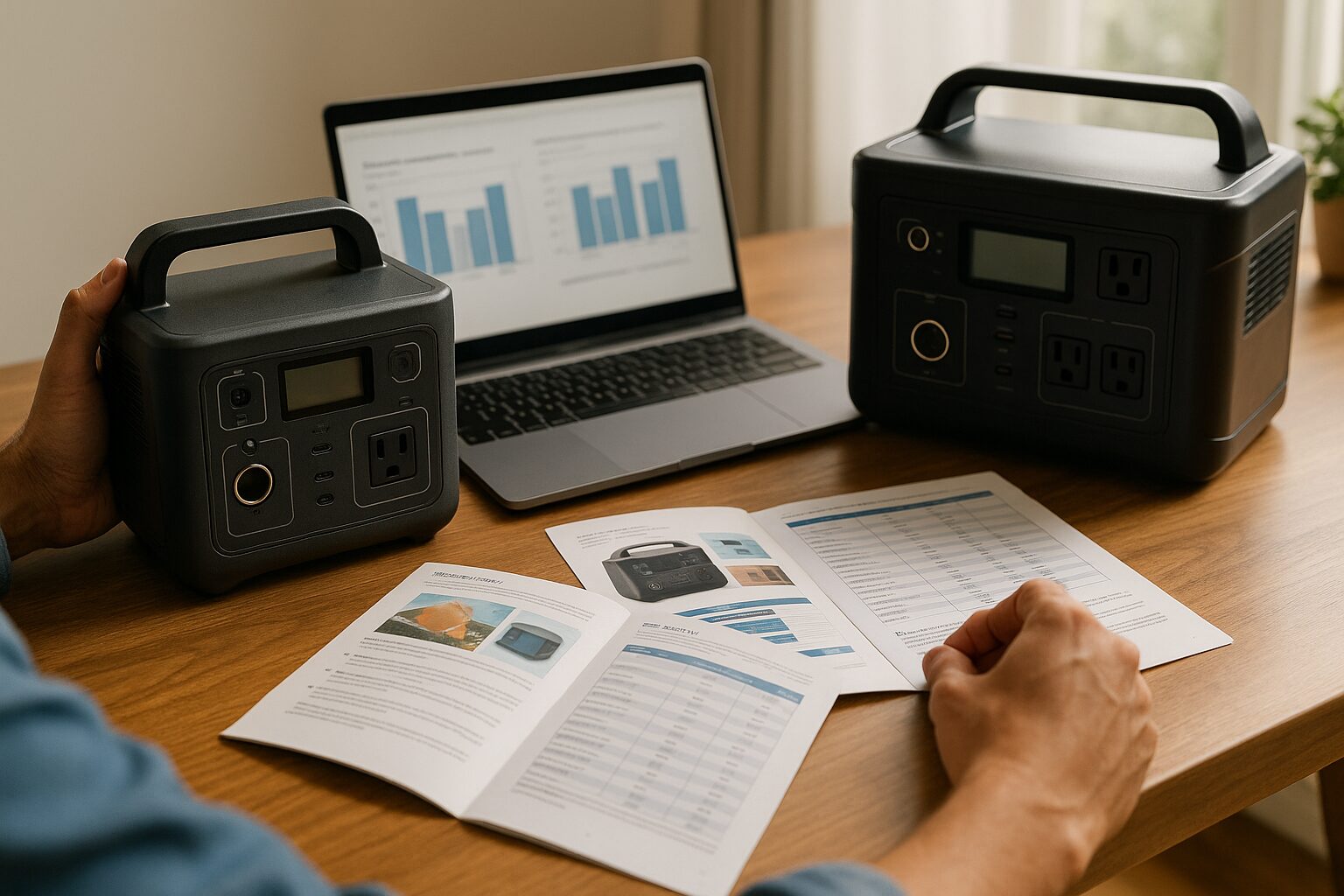
Quickly understand portable power station specs!
| Term | Meaning | Checkpoint |
|---|---|---|
| Wh | Total amount of usable electricity | Higher numbers mean longer use, but the unit will be heavier and more expensive |
| Rated Output (W) | Stable power output | Is it higher than the total W of the appliances you will use (simultaneously)? |
| Peak Output (W) | Maximum power for a split second | Ensure enough headroom if using appliances with motors |
| Pure Sine Wave | Smooth waveform, same as a wall outlet | Essential for precision equipment and some appliances |
| Hz | Frequency | Does it support both 50/60 Hz or allow switching? |
Clarifying your usage and power needs

Building a concrete image of “when,” “where,” “what kind of electrical appliances,” and “for how long” you want to use the portable power station is the starting point for choosing the optimal product.
| Use Case | Expected Devices | Estimated Capacity (Wh) | Estimated Rated Output (W) |
|---|---|---|---|
| Day camping / short tasks | Smartphone charging (multiple), LED lantern, fan | 200–500Wh | 100–300W |
| Overnight camping / car camping | Above + small fridge, electric blanket (low), PC charging | 500–1000Wh | 300–1000W |
| Multi-night camping / disaster prep | Above + small cooking appliances, multiple devices simultaneously | 1000Wh or more | 1000W or more |
| Minimum emergency preparedness | Smartphone charging, radio, LED light | 100–300Wh | Around 100W |
Note: The above figures are estimates only.
Required capacity and output will vary depending on the actual power consumption of the devices used and usage conditions.
 Ms.ガジェット
So it’s important to think about it specifically. It seems like the choice would change depending on whether camping or disaster preparedness is the main priority.
Mr.ガジェットExactly! Once your usage is clear, the necessary specs will naturally narrow down.
By clarifying your usage beforehand and researching the power consumption (W) of the electrical appliances you might use, you can prevent choosing an unnecessarily expensive and heavy product that is over-specced, or conversely, one that lacks the power to work when you need it. This allows for smart and efficient decision-making.
Careful model selection is required
Portable power stations are very convenient items, but easy, careless choices are likely to lead to “buyer’s remorse,” making careful model selection essential.
Price ranges vary widely, from several tens of thousands to over a hundred thousand yen, and there is a wide variety in storage capacity, power output, and features included.
Therefore, if you choose a product that doesn’t fit your usage, you may end up with a product that is unnecessarily expensive because you have more performance than you need, or conversely, face unfortunate situations like “the appliance I want to use won’t run” or “the battery dies immediately.”
Ms.ガジェットThey are expensive and there are so many types, so I’m afraid of picking one at random…
Mr.ガジェットThat’s right! That’s exactly why it’s important to firmly grasp the basic knowledge.
It is meaningless if it cannot be relied upon when you truly need power, such as during a disaster.
If you purchase without determining your usage and necessary specs, the possibility of regret increases, so gathering information and careful consideration beforehand is important.
7 checkpoints to avoid failure
Key points for this section!
- Required battery capacity (Wh)
- Required rated output (W) and peak output
- Check AC output waveform
- Confirm frequency (Hz) required for use within Japan
- Confirm types and number of output ports to match your devices
- Safety features and battery type
- Size/weight related to portability
- About charging methods
The most important thing when choosing a portable power station is to identify the “specs that truly match your usage.”
To avoid failing on an expensive purchase, let’s check the 7 points explained below.
Specifically, we will look at ” Capacity (Wh),” “Rated Output (W),” “AC Output Waveform,” “Frequency (Hz),” “Types and number of output ports,” “Safety features and battery type,” and “Size/Weight and charging methods” in order.
If you grasp these points, it will be easier to find the optimal portable power station for you.
Required battery capacity (Wh)
- Battery Capacity (Wh)
- Intended Use
First, clarify your specific usage and which appliances you want to use for how many hours, such as “I want to use an electric blanket while camping” or “I want to charge my smartphone during a disaster.”
By multiplying the power consumption (W) of the appliance you want to use by the number of hours you want to use it, you can calculate the approximate guideline for the required capacity (Wh = W × h).
| Usage | Capacity (Wh) Guideline | Characteristics |
|---|---|---|
| Smartphone charging focus | Under 300Wh | Lightweight, compact |
| Day camping | 300Wh–500Wh | Use of small appliances, multiple smartphone charges |
| Overnight camping | 500Wh–1000Wh | Electric blankets and small fridges also in scope |
| Disaster preparedness | 1000Wh or more | Preparedness for long-term power outages, simultaneous use of multiple appliances |
Ms.ガジェットIs it better if the capacity is just as large as possible?
Mr.ガジェットLarger capacity is more reassuring, but the price tends to be higher and the unit heavier. Choose while considering the balance between usage and portability!
Choosing a portable power station starts with clarifying your usage—”what” you want to use and “how much”—and estimating the necessary capacity.
Required rated output (W) and peak output
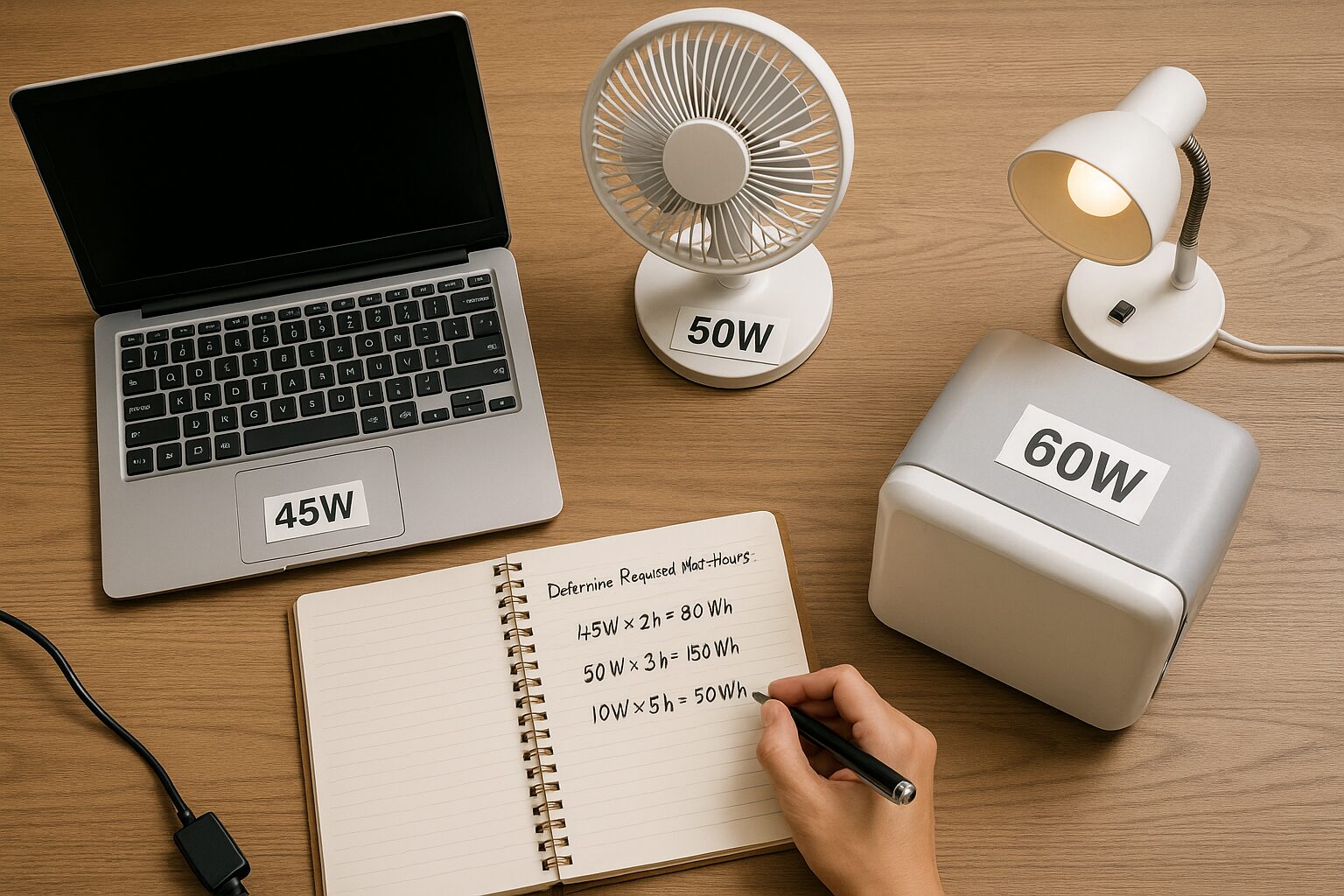
If you want to use multiple appliances at the same time, you must ensure that the total power consumption (W) of each does not exceed the rated output (W) of the portable power station.
Also, if you might use appliances that require a large amount of power temporarily when starting up (startup power), such as refrigerators, electric kettles, and hair dryers, it is safer to check the peak output (also called surge output).
| Output Item | Checkpoint |
|---|---|
| Rated Output (W) | Does it exceed the power consumption (W) of the appliances you want to use (total when used simultaneously)? |
| Peak Output (W) | Check is especially necessary if using appliances with high startup power (hair dryers, refrigerators, etc.) |
Ms.ガジェットIf the capacity (Wh) is sufficient, will any appliance work?
Mr.ガジェットNo, it won’t run if the rated output (W) is lower than the appliance’s power consumption (W). Checking both capacity and output is essential!
Once you have confirmed the required capacity (Wh), the next crucial step is to check if it has enough rated output (W) to reliably run the appliances you want to use, and check the peak output if necessary.
Check AC output waveform
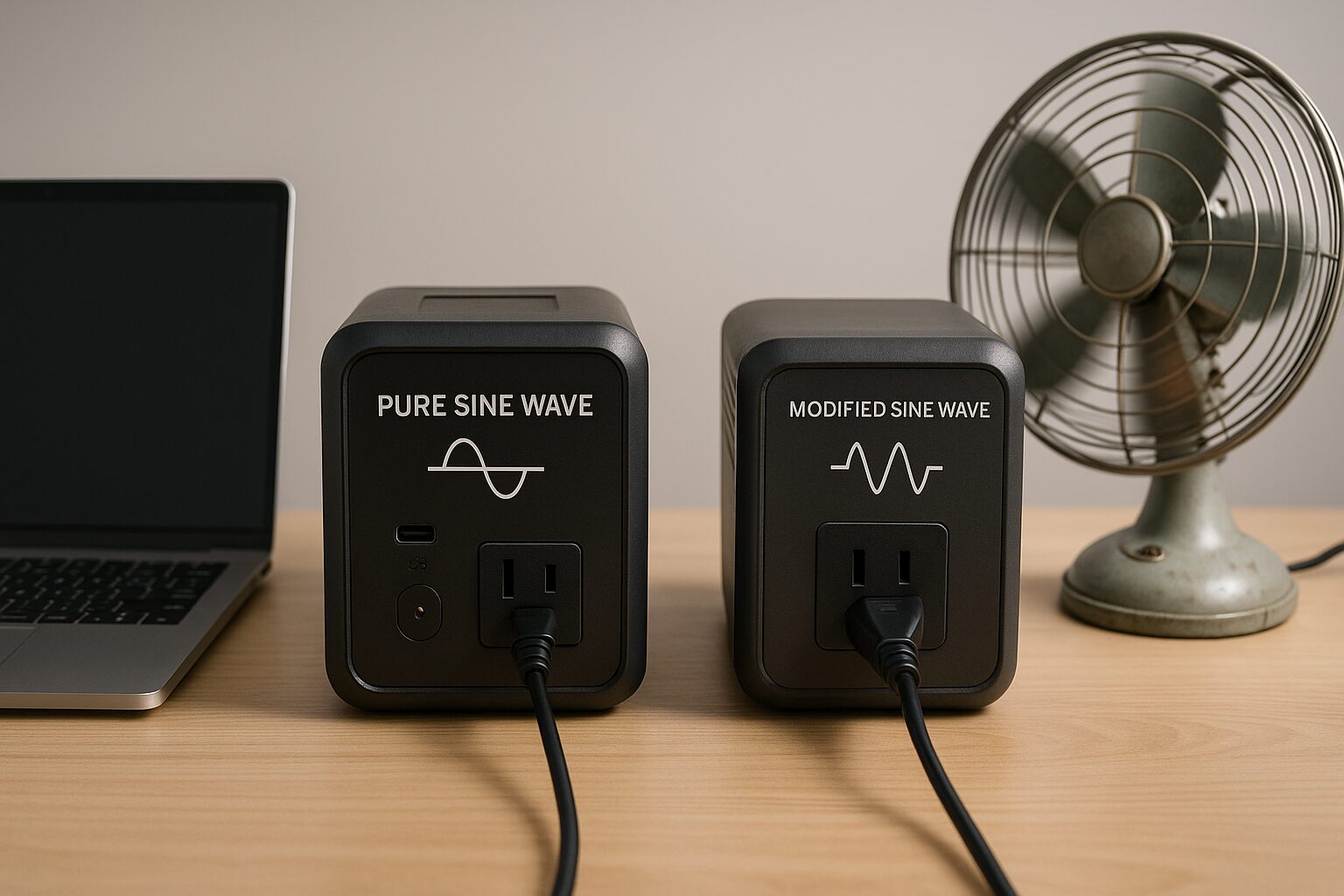
This has the same smooth, clean waveform as the wall outlets we use at home every day, and you can use almost any electrical appliance with peace of mind, including precision equipment like PCs, smartphones, TVs, and game consoles, as well as products like microcomputer-controlled electric blankets and some near-medical devices.
“Modified Sine Wave” or “Square Wave” seen in cheaper models have distorted waveforms, so depending on the device, there is a risk that it may not operate normally, produce abnormal noise, or in the worst case, lead to failure.
| Waveform Type | Characteristics | Supported Devices |
|---|---|---|
| Pure Sine Wave | Smooth waveform, same as household outlets | Compatible with almost all appliances (including precision equipment, microcomputer-controlled products) |
| Modified Sine Wave | Pseudo sine wave, staircase waveform | Possibility of malfunction or failure with some precision equipment or microcomputer-controlled products |
| Square Wave | Simple waveform that repeats ON/OFF | Supported devices are limited, unsuitable for precision equipment |
Ms.ガジェットIf it’s not a “Pure Sine Wave,” what kind of problems occur specifically?
Mr.ガジェットThe PC or electric blanket you want to use might not run, or in the worst case, the connected device could be damaged.
Especially if you want to use PCs, smartphones, or the latest home appliances, be sure to confirm that the AC output is a “Pure Sine Wave.”
 Ms.ガジェット
This part is really important!
Confirm frequency (Hz) required for use within Japan
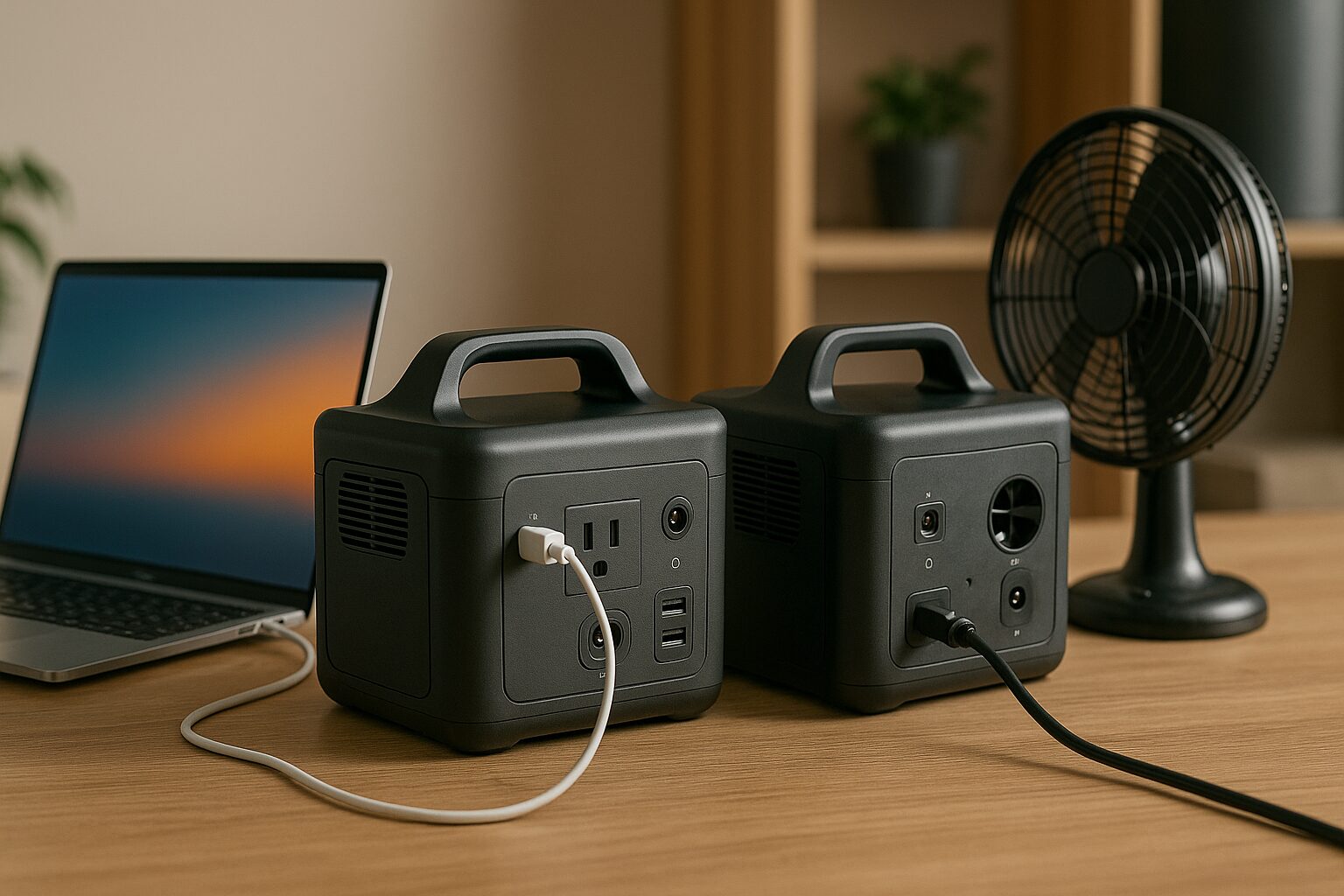
Most portable power stations are “compatible with both 50Hz/60Hz” or allow switching on the unit itself, so in most cases, they can be used anywhere in Japan without problems.
However, confirming the specifications just in case will allow you to use it with peace of mind even if you move or go traveling or camping in regions with different frequencies.
| Region | Frequency |
|---|---|
| Eastern Japan | 50Hz |
| Western Japan | 60Hz |
Ms.ガジェットI don’t usually worry about frequency, but is it important?
Mr.ガジェットRecent products are almost all compatible with both, but if it happens not to be, the device might not run. Checking just in case will give you peace of mind.
Thinking about where in Japan you might use it and checking the supported frequency ensures you won’t be troubled in a pinch.
Confirm types and number of output ports to match your devices
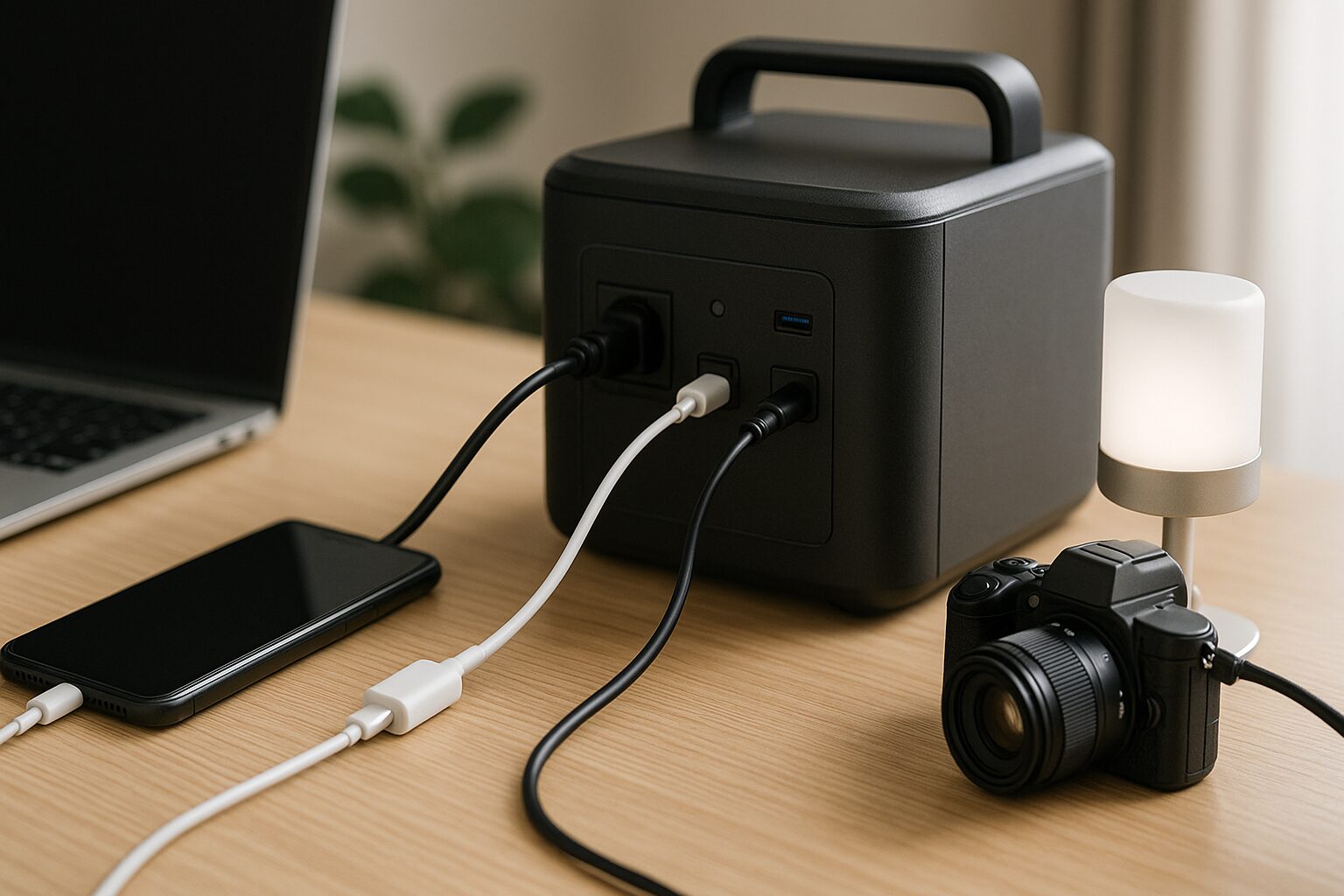
- Number of AC 100V (outlets)
- Number of USB ports
- USB port standards
- Support for fast charging standards (PD, etc.)
- Presence of DC output ports (cigarette lighter socket, etc.)
The necessary ports differ depending on what kind of devices you want to connect.
The main types of ports include AC outlets, which are the same as household outlets; USB Type-A, used for charging smartphones and tablets; high-output USB Type-C (it is good to check if it supports PD: Power Delivery), which can also charge notebook PCs; and DC ports/cigarette lighter sockets, used for vehicle-mounted equipment.
Think about the types and number of devices you want to connect at the same time and check if the port configuration allows for all of them to be connected.
| Port Type | Main Usage |
|---|---|
| AC Outlet | General electrical appliances (notebook PC adapters, small home appliances, etc.) |
| USB Type-A | Charging smartphones, tablets, portable chargers, etc. |
| USB Type-C | Charging latest smartphones, tablets, notebook PCs, etc. |
| DC Port/Cigarette Lighter Socket | Vehicle-mounted small refrigerators, etc. |
 Mr.ガジェット
The more ports, the better.
I think the number of AC 100V outlets is especially important, so please check that carefully!
Also, if the rated output and output ports are insufficient, you will be very troubled because you won’t be able to provide power, so be careful.
It is important to list your devices and the equipment you want to use while camping or for disaster preparedness, and check if it has the output ports that match them.
Safety features and battery type
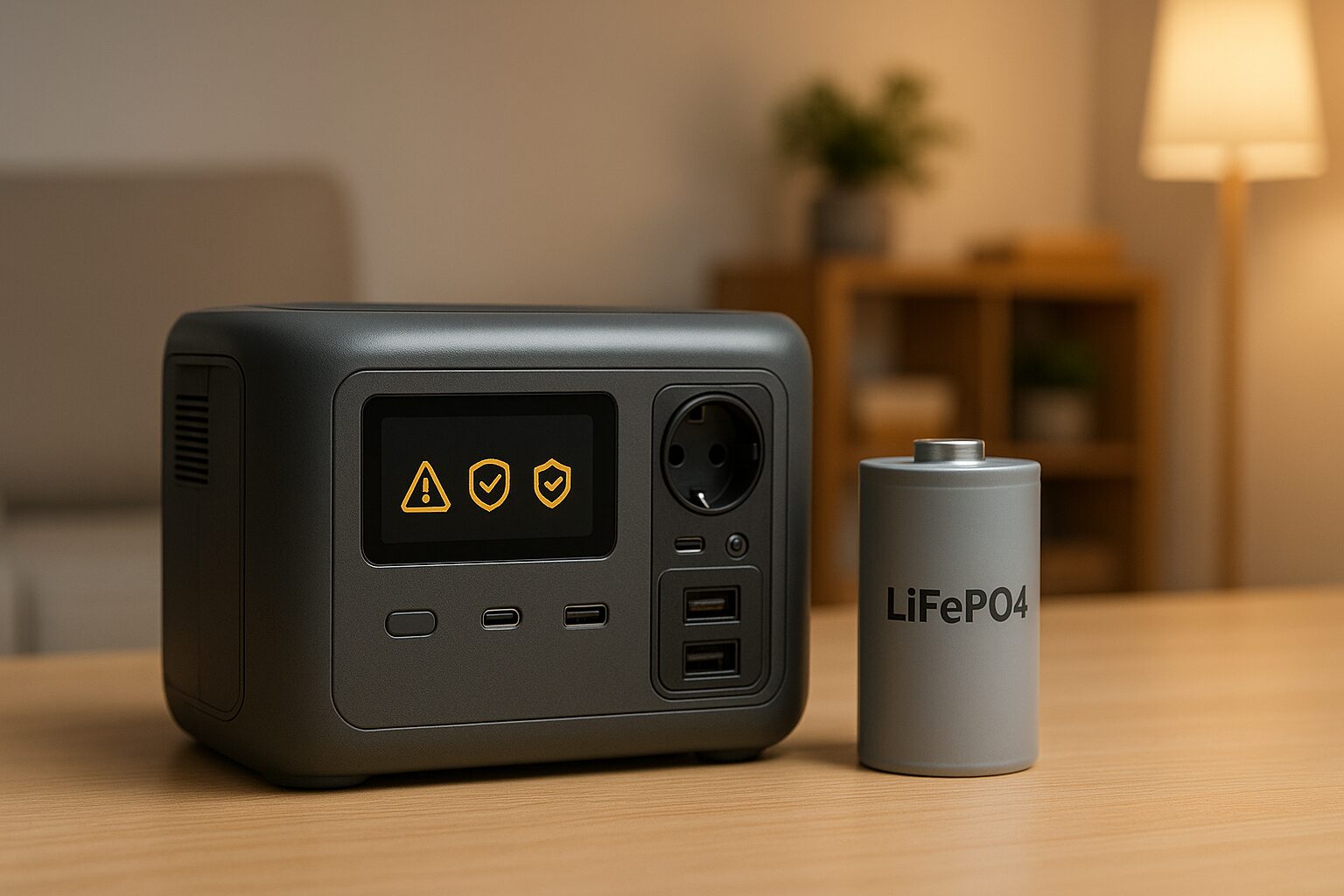
Check that protective functions such as a “BMS (Battery Management System)”, which prevents overcharging, over-discharging, short-circuiting, and abnormal temperature, are firmly included.
 Ms.ガジェット
It’s scary to think about what would happen if it exploded…
Also, the type of built-in battery is important.
In recent years, “Lithium Iron Phosphate batteries” have become mainstream.
You can check the characteristics of each battery here.
| Characteristics \ Type | Iron Phosphate | Titanate | Ternary | Manganese | Nickel | Cobalt | Semi-solid | Sodium-ion |
|---|---|---|---|---|---|---|---|---|
| Safety | ||||||||
| Lifespan | ||||||||
| Energy Density |
In addition, choosing products from reliable manufacturers is also an effective way to ensure safety.
 Ms.ガジェット
Are cheaper models okay? I’m a little worried about the safety aspect…
 Mr.ガジェット
Safety is a point you should never compromise on! Choose a reliable manufacturer and confirm the PSE mark!
To prevent accidents and continue using it safely for a long time, please be sure to check the safety features and battery type.
Size/weight related to portability
If you intend to carry it frequently for camping or car camping, it is important to consider the actual size and weight, such as whether you can carry it without strain given your physical strength, or whether it can be loaded into your car.
About charging methods
Solar charging, in particular, is a very reassuring ally for long-term camping or long-term power outages due to disasters.
| Charging Method | Characteristics | Pros | Cons |
|---|---|---|---|
| AC Outlet Charging | Charging from household outlets | Easiest and often the fastest charging speed | Requires an outlet |
| Cigarette Lighter Socket Charging | Charging from car cigarette lighter | Can charge while traveling by car | Charging speed is often slower |
| Solar Panel Charging | Connect separate solar panel to charge with sunlight | Can charge even in places without power, no electricity cost | Dependent on weather, requires separate panel |
| USB Charging | Charging via USB Type-C (PD support), etc. (mainly small capacity models) | Can sometimes charge like a portable battery | Limitations on charging speed and compatible models |
Ms.ガジェットWhen choosing, I just need to look at the capacity (Wh) and output (W), right?
Mr.ガジェットIf you buy it but it’s too heavy to carry or you can’t charge it where you want to use it, you’ll be troubled. Think about actual usage and also check portability and charging methods!
Beyond just specs, building a concrete image of the scenes where you will actually carry it and the environment where you will charge it, and choosing a model with the size, weight, and charging methods that are easy for you to use will lead to a satisfying choice of portable power station.
Making a final decision considering long-term use and safety
Key points for this section!
In order to choose the optimal portable power station, you are required to make a final decision after fully considering long-term use and safety, not just short-term convenience.
Regarding safety, it is important not only to check at the time of purchase, but also to check the state of the unit regularly after use begins, and to keep in mind appropriate use and storage according to the instruction manual.
Ultimately, by thinking about the balance of the capacity, output, functions, portability, and long-term use and safety we have considered so far, choosing the unit that best fits your own lifestyle and values is the key to avoiding regret.
Confirming manufacturer reliability and warranty period

Portable power stations are products that handle electricity, and they are by no means inexpensive purchases.
Therefore, confirming the quality and safety of the product itself, as well as the reliability and support system of the manufacturer is very important.
Ms.ガジェットIs it better to go for a cheaper one even if it’s from a manufacturer I haven’t heard of?
Mr.ガジェットPrice is important, but since it’s a product related to safety, consider reliability and the support system too!
In addition, check the length of the warranty period.
Generally, the longer the warranty period, the more evidence that the manufacturer has confidence in its quality.
Even if a failure or trouble occurs, if it is within the warranty period, the possibility of receiving support such as repairs or replacements increases.
If you want long-term peace of mind, be sure to confirm the manufacturer’s reliability and warranty period. In addition, check the length of the warranty period.
Frequently Asked Questions (FAQ)
- What are the guidelines for power consumption of appliances that can be used with a portable power station?
-
Think of an electric blanket (at low setting) as about 50W, smartphone charging as about 10–18W, and a small refrigerator for camping as about 40–60W.
However, these are only general guidelines.
Since actual power consumption varies depending on the product and usage, checking the specifications of each appliance you want to use is the first step to choosing a portable power station without failure.
Especially when using high-power appliances, allow headroom in the rated output. - How much does battery life differ between Iron Phosphate and Ternary?
-
The number of times you can repeatedly use it (cycle life) differs greatly depending on the battery type.
Generally, “Lithium Iron Phosphate batteries” are considered to have performance that does not easily degrade even after about 2000 or more charge/discharge cycles, and they are very long-lasting.
They are suitable for long-term storage for disaster preparedness or for usage involving frequent charging and discharging.
On the other hand, the cycle life of “Ternary Lithium-ion batteries” is roughly 500–1000 cycles.
While they tend to have a shorter lifespan than Iron Phosphate types, they have the advantage of being easy to make small and high-capacity.
It is good to remember that battery life also changes depending on usage conditions. - Does the AC output waveform absolutely have to be a “Pure Sine Wave”?
-
If you want to use appliances that require precise operation, such as PCs, latest game consoles, microcomputer-controlled electric blankets, or products close to some medical devices, it is essential to choose a portable power station with “Pure Sine Wave” output.
With “Modified Sine Wave” or “Square Wave” products, there is a risk that these devices will not operate normally, produce abnormal noise, or break down.
While they may operate with simple heaters or some lighting equipment, the appliances that can be used safely are limited, so I recommend Pure Sine Wave models for beginners as they are compatible with a wide range of appliances.
This is a point in how to choose a portable power station that can be used with peace of mind. - What are the points to watch out for when choosing a panel if I want to use solar panel charging while camping?
-
When choosing a solar panel, it is a prerequisite to first confirm whether the portable power station you have or plan to purchase supports solar charging, and whether the shape of the connection terminal matches.
Next, confirm the power generation capacity (W) of the panel.
The higher the W, the faster the theoretical charging speed, but the size, weight, and price of the panel itself also increase.
Since solar charging is greatly affected by weather, if you assume the actual usage scene and choose a panel with a slightly higher W rating, your worries will decrease relatively.
In many cases, choosing a genuine solar panel recommended by the portable power station manufacturer makes it safer as problems with connections or compatibility are less likely to occur. - Regarding safety, are there points to confirm other than the PSE mark?
-
Safety is the most important item when choosing a portable power station.
In addition to the PSE mark acquisition for included AC adapters, etc., depending on the product, compliance with the UN’s “UN38.3” transport standard for lithium-ion batteries, and acquisition of international safety standard certifications (UL, CE, FCC, etc.) can also be guidelines for safety.
Also, confirming in the product specifications whether protective functions for overcharging, over-discharging, abnormal temperature, etc., by a Battery Management System (BMS) are firmly installed is very important.
Information regarding safety features should be checked on the manufacturer’s official website. - How can a beginner tell if a manufacturer is reliable?
-
There are several points to distinguish a reliable manufacturer.
First, check if the manufacturer’s official website exists and if product information (specifications, safety features, warranty details, etc.) is stated in detail and clearly.
Next, whether the warranty period is sufficiently long (e.g., 2 years or more) and whether the support system within Japan (inquiry counters via phone or email, repair response, etc.) is in place are also important judgment materials.
Referring to purchaser reviews is also effective, but while discerning the reliability of the information source, ultimately, judging these points comprehensively yourself is how to choose a portable power station without regret.
Portable power station manufacturers
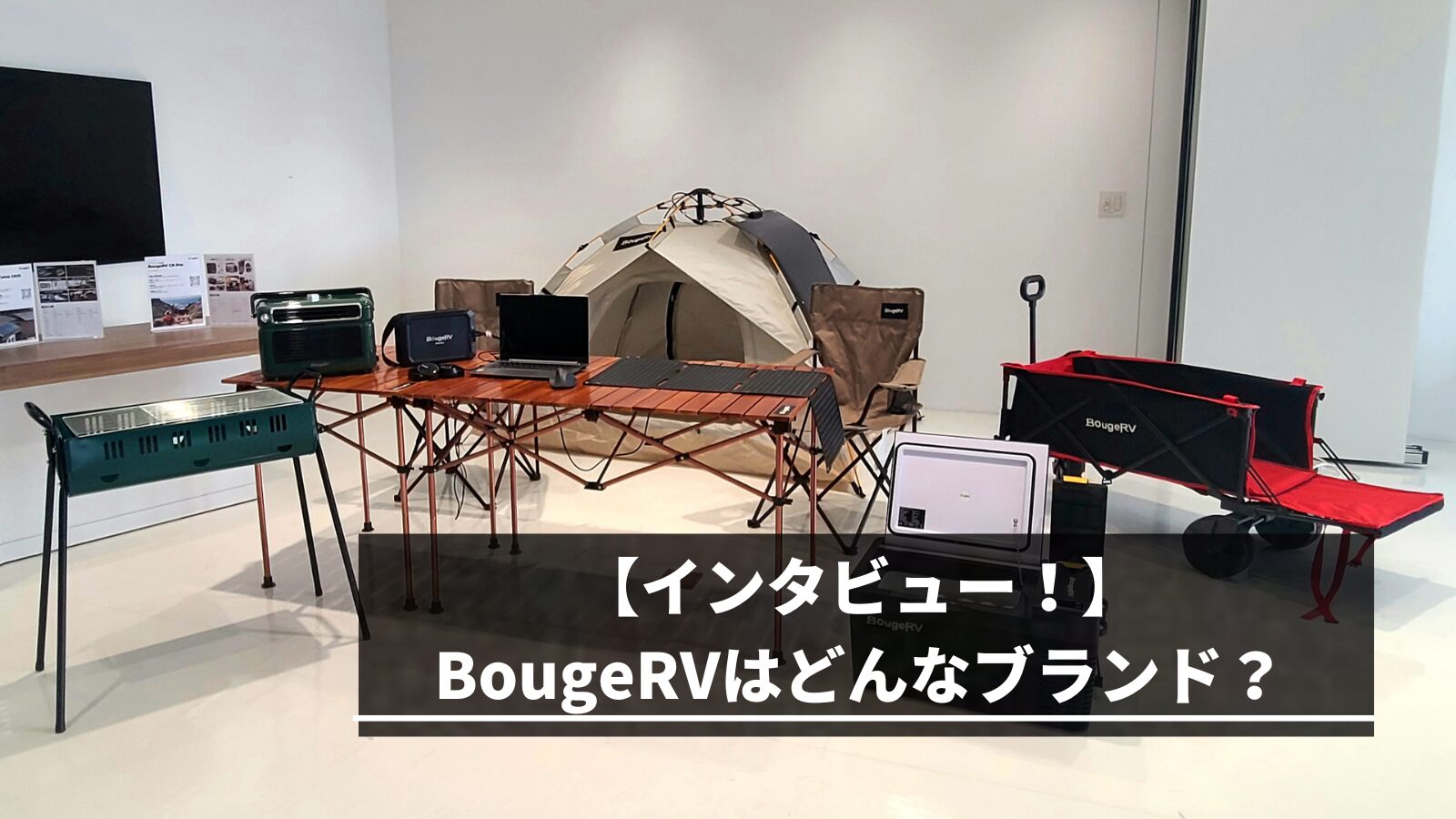
BougeRV

Based on the philosophy of “making a freer outdoor life for everyone,” BougeRV develops multi-functional, high-durability products useful for car camping, camping, and disaster preparedness, such as portable refrigerators, solar panels, and portable power stations.
They offer a diverse lineup based on usage and needs, including high-capacity models with up to 2,200W output and long-life models equipped with lithium iron phosphate batteries. Their design, which enables stable use even in harsh environments through unique temperature control technology and high safety standards, is a strength. With global expansion, their visibility is also rising within Japan, and they are gathering attention as a next-generation power solution.
Jackery
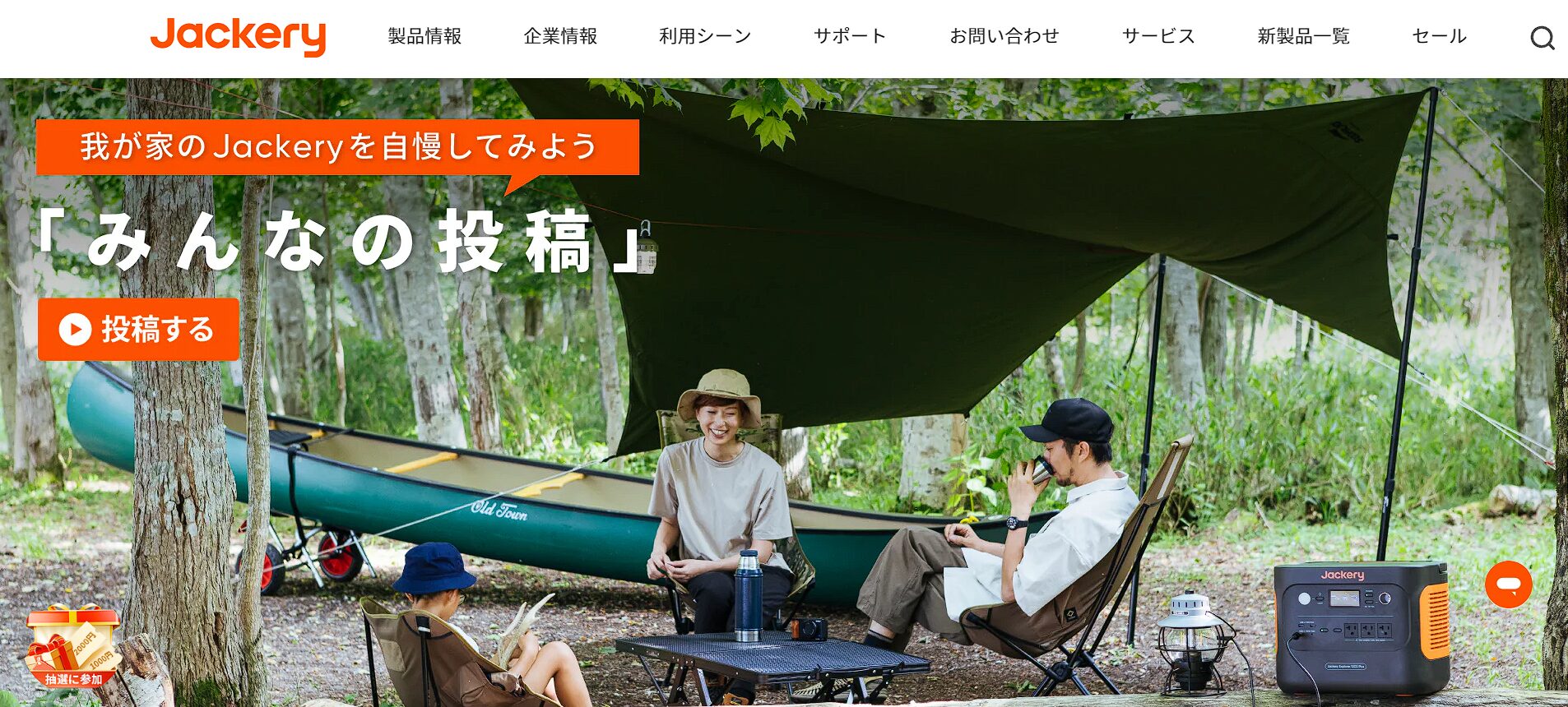
Based on the vision of “providing green energy to everyone, everywhere,” Jackery delivers safe and highly reliable portable power station and solar panel products useful for disaster preparedness, car camping, camping, and daily energy saving. We have a wide lineup from super high-capacity models of up to 30kWh to lightweight models of 965g. In the 12 years since our founding, we have achieved industry-leading sales performance with over 4 million units sold worldwide, and have been trusted by a wide range of users over the long term.
Thank you for reading to the end!
- Product prices, information, etc., are information as of the time the article was written.
- Please note that this site cannot be held responsible even if this information is incorrect.
- Product and service names described on this site are trademarks of their respective companies.
コメント