
Are you fed up with the charging speed of your current smartphone charger?
If you read this article and think, “This is perfect for me,” be sure to read on and find the best smartphone charger for you right now.

This article uses the following tool to create its rankings.
Please feel free to use it yourself!

Mr. Gadget’s Top Picks: 2025 Latest Ranking of 30W and Under Smartphone Chargers
Key points in this section!
- List of 30W and Under Smartphone Chargers
- 1st Place: Anker 511 Charger (Nano 3, 30W) — An amazingly small and powerful unit
- 2nd Place: CIO USB Rapid Charger PD20W — Stress-free simultaneous charging with 2 ports
- 3rd Place: UGREEN Nexode Mini 30W PD Charger — The fusion of high cost-performance and cutting-edge technology
- 4th Place: [Docomo Genuine] Portable AC Adapter OW03 — Unwavering peace of mind through genuine quality
Here, I will introduce the four models I truly recommend, selected from a vast number of 30W and under smartphone chargers that I have personally compared and vetted, presented in a ranking format.
I will help you solve the “troubles” that lead to mistakes in choosing a charger and assist you in selecting the perfect one.
List of 30W and Under Smartphone Chargers
商品ランキング


1st Place: Anker 511 Charger (Nano 3, 30W)
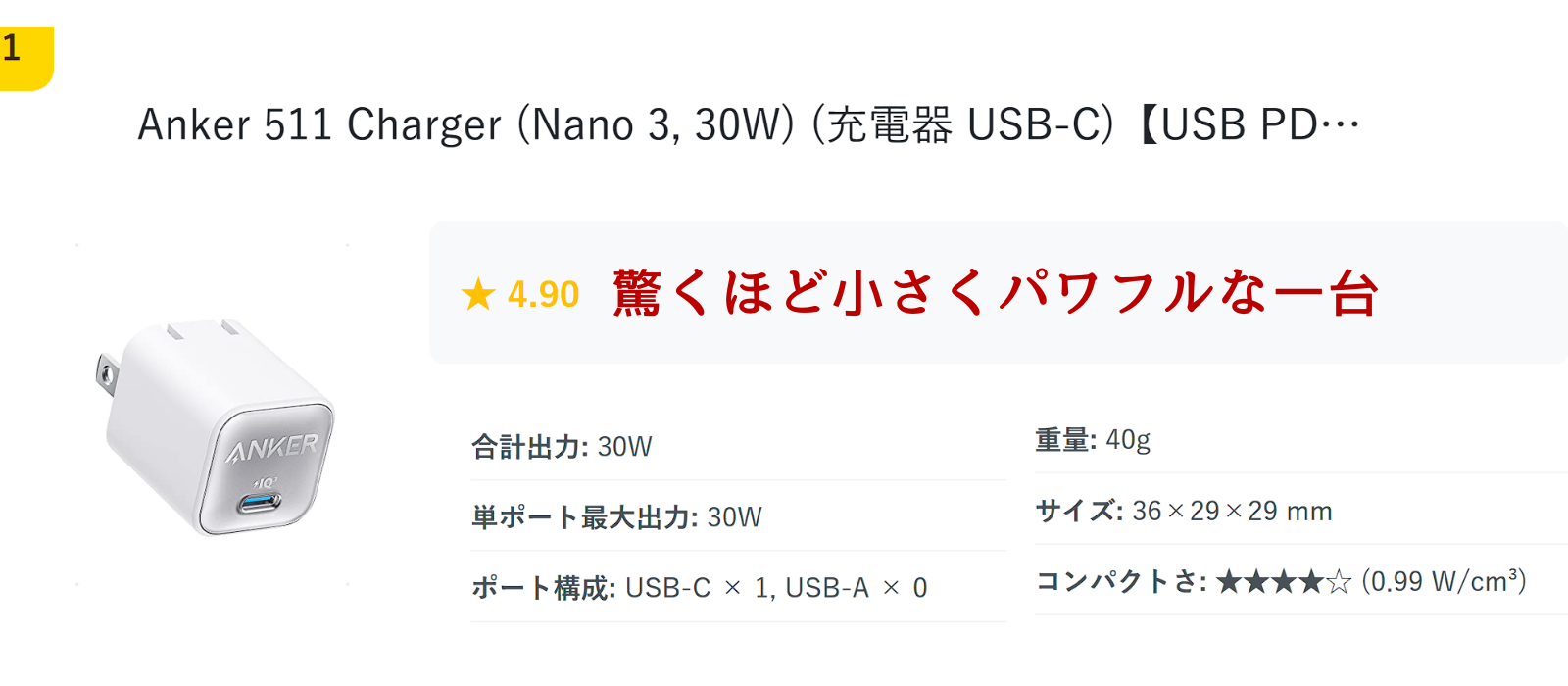
The Anker 511 Charger (Nano 3, 30W) is the best choice if you refuse to compromise on portability.
Its ultra-lightweight design of approximately 40g and palm-sized dimensions mean it won’t be a burden for daily carry, or for business trips and travel.
Going beyond mere miniaturization, this charger boasts a powerful maximum output of 30W.
It charges iPhone 8 and later models at the fastest possible speeds and allows for speedy charging of not just iPads, but even laptops like the MacBook Air equipped with M1/M2 chips.
You will be freed from the “trouble” of worrying about battery levels while on the go.
Main Specifications
| Item | Details |
|---|---|
| Product Name | Anker 511 Charger (Nano 3, 30W) |
| Model Number | A2147 |
| Output Port | USB-C × 1 |
| Max Output | 30W |
| PPS Output | 3.3–11V/3A or 3.3–16V/2A (Max 30W) |
| Size (excluding plug) | Approx. 36 × 29 × 29 mm |
| Weight | Approx. 40g |
| Plug Type | Foldable |
| Pros | Cons |
|---|---|
| Incredible light weight of approx. 40g makes it stress-free to carry. Features a foldable plug, so it won’t easily snag on other items in your bag. With 30W high output, it can rapidly charge not only smartphones but also iPads and MacBook Airs with M1/M2 chips. PPS support allows for optimal charging speeds across a wide range of Android smartphone models. | It only has one USB-C output port, so you cannot charge multiple devices at once. A charging cable is not included, so you need to prepare a USB-C to C or USB-C to Lightning cable that suits your device separately. |
Once you use the Anker 511 Charger (Nano 3, 30W), you will be surprised by its compactness and power.
I guarantee that your lifestyle will change dramatically with just this charger, and charging stress will become a thing of the past.
2nd Place: CIO USB Rapid Charger PD20W
With your current charger, do you feel like you’re wasting time “eventually” waiting for a charge because you can’t charge your earphones or other devices while charging your phone? Especially when the batteries of multiple devices are draining at the same time while you’re out, the “trouble” of deciding which one to prioritize is a very common issue.
I empathize with that “trouble” of yours.
You want to make effective use of your time, so you naturally want to avoid having your actions restricted because of charging.
 Ms.ガジェット
I want to charge multiple devices at once, but I’m worried that the charging speed will drop.
Mr.ガジェットWith CIO’s 2-port charger, you can efficiently charge multiple devices without sacrificing speed.
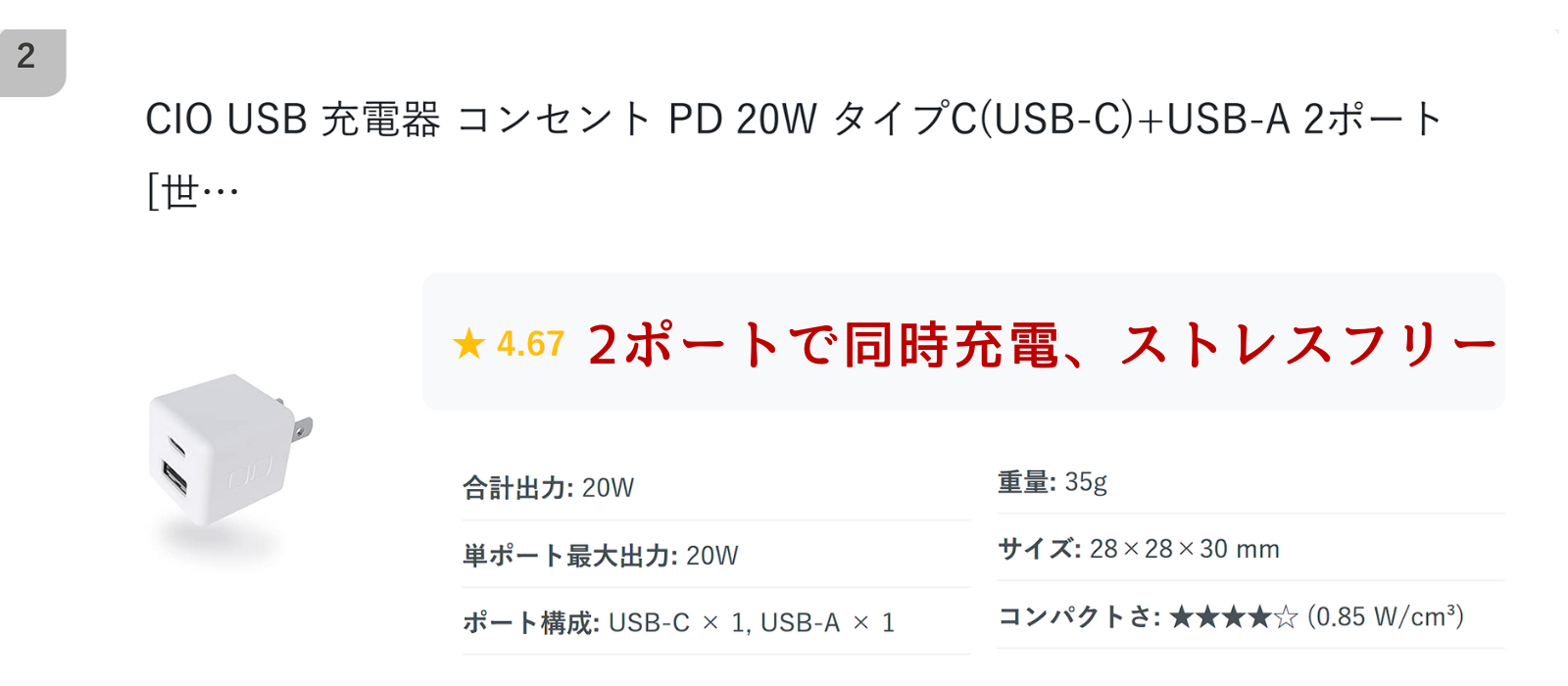
This CIO USB Rapid Charger PD20W blows away such “troubles” with the unique solution of being equipped with two ports: one USB-C and one USB-A.
With just one outlet, you gain the “freedom” to efficiently charge two devices at the same time, such as your smartphone and wireless earphones.
I personally often carry multiple devices, so I feel that the convenience of these two ports is a “surprisingly” large benefit.
This compact charger shows its true value, especially when outlets are limited at hotels or cafes.
No more “wasted” time wondering which to charge first.
| Pros | Cons |
|---|---|
| Equipped with both USB-C and USB-A ports, allowing you to charge another device at the same time as your smartphone. Ultra-lightweight design of approx. 35g and a palm-sized footprint of approx. 28×28×30mm makes it very easy to carry. Features a unique compact design that is less likely to obstruct adjacent outlets when plugged in. Equipped with multiple safety features, including PSE certification, so you can use it with peace of mind for a long time. | The plug is fixed, so it cannot be folded. Since the maximum output is 20W, it cannot provide full-speed charging for some laptops that require 30W. When using both ports simultaneously, the total output is automatically distributed to 20W, so charging speed may decrease compared to single-port use. |
Main Specifications
| Item | Details |
|---|---|
| Product Name | CIO USB Rapid Charger PD20W |
| Model Number | CIO-PD20W1C1A |
| Max Output | 20W (Max 20W even when used simultaneously) |
| Output Ports | USB-C × 1, USB-A × 1 |
| Size (excluding plug) | Approx. 28 × 28 × 30 mm |
| Weight | Approx. 35g |
| Plug Type | Fixed |
The CIO USB Rapid Charger PD20W will dramatically improve your charging environment, promising you the “freedom” to use your devices without worrying about time or place.
You no longer need to suffer through the “trouble” of simultaneous charging.
3rd Place: UGREEN Nexode Mini 30W PD Charger
There are “surprisingly” many rapid chargers on the market, but don’t you feel it’s difficult to discern which products truly have “high cost-performance” and are equipped with cutting-edge technology? Many of you suffer from the “trouble” of being confused by technical terms like “GaN” and ultimately not knowing which one to choose.
I also used to “worry” about the balance between price and performance of chargers equipped with the latest technology.
The higher the performance I sought, the more expensive they tended to be, and I couldn’t easily find the perfect unit.
Ms.ガジェットI hear about GaN (Gallium Nitride), but I don’t really understand why it’s good.
Mr.ガジェットGaN is the latest technology that achieves miniaturization and higher efficiency in chargers.
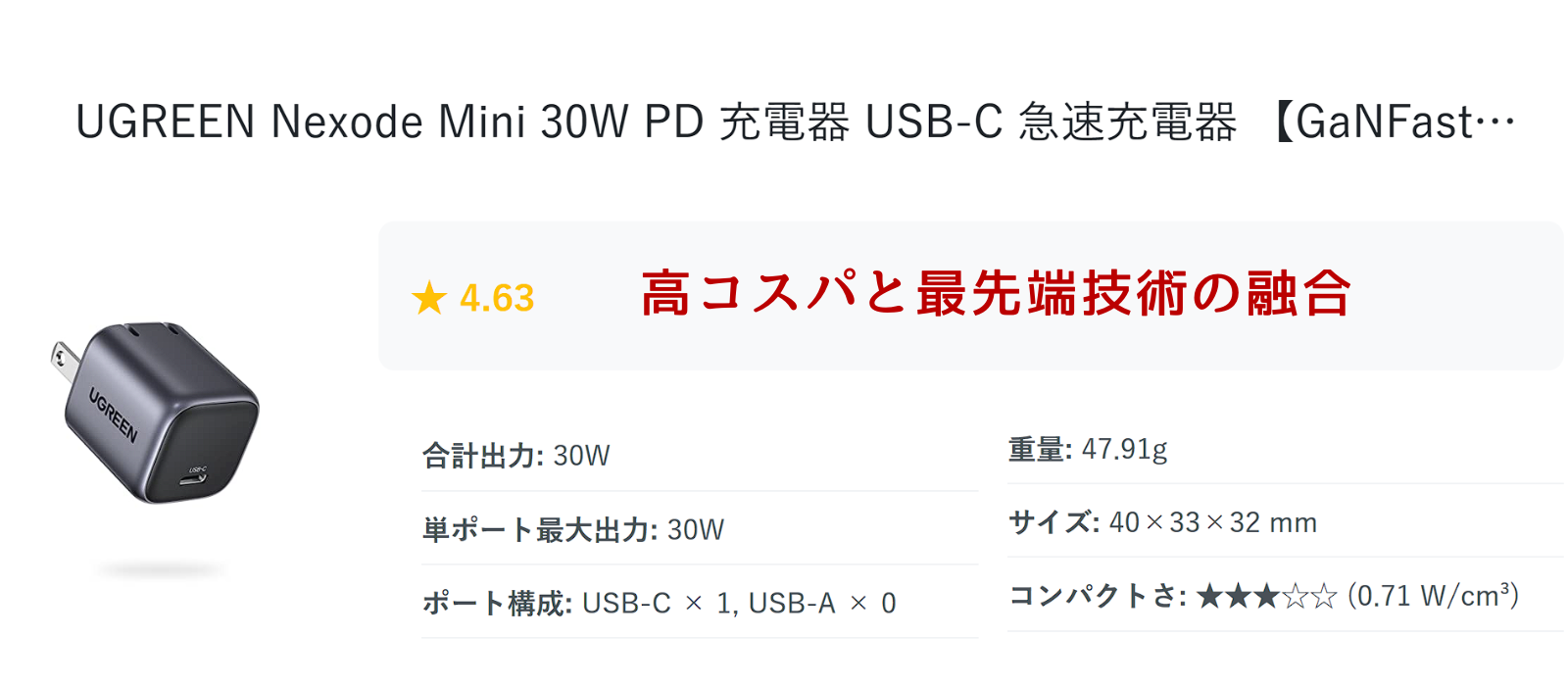
The UGREEN Nexode Mini 30W PD Charger solves such “troubles” of yours with the clear answer of being “equipped with a GaN II (Gallium Nitride) chip.”
Thanks to this next-generation technology, it achieves high power efficiency while suppressing heat generation, despite being amazingly compact.
I guarantee that for those of you who want to get the perfect balance of performance and price, there is no better choice than this.
As GaN technology spreads rapidly, I feel firsthand that this UGREEN product is “truly” maximizing the benefits of this technology.
In particular, the “fact” that it supports many charging protocols is proof that it can provide optimal charging for you, no matter what device you are using.
With just this one unit, the “trouble” of charging various devices will be solved.
| Pros | Cons |
|---|---|
| Equipped with a next-generation GaN II chip, achieving high efficiency and low heat generation in a compact size. Supports a wide range of charging protocols such as PD, PPS, and QC4+, so you can expect optimal rapid charging for many smartphones and tablets. The foldable plug provides excellent portability and fits smartly in bags or pockets. Comes with a 2-year product warranty from the manufacturer, so you can use it with “certain” peace of mind even in the unlikely event of an issue. | It has only one USB-C output port and does not support simultaneous charging of multiple devices. A charging cable is not included with the product, so you need to purchase one separately. |
Main Specifications
| Item | Details |
|---|---|
| Product Name | UGREEN Nexode Mini 30W PD Charger |
| Output | Max 30W USB-C PD3.0 (also supports PPS/QC4+/SCP/FCP/AFC) |
| Number of Ports | USB-C × 1 |
| Plug | Foldable |
| Semiconductor | Equipped with next-gen GaN II chip |
| Warranty | 2-year warranty |
The UGREEN Nexode Mini 30W PD Charger is the “only” option for those of you who want to experience the latest technology easily and with high “cost-performance.”
Why not end the wear and tear of using “old” chargers?
4th Place: [Docomo Genuine] Portable AC Adapter OW03
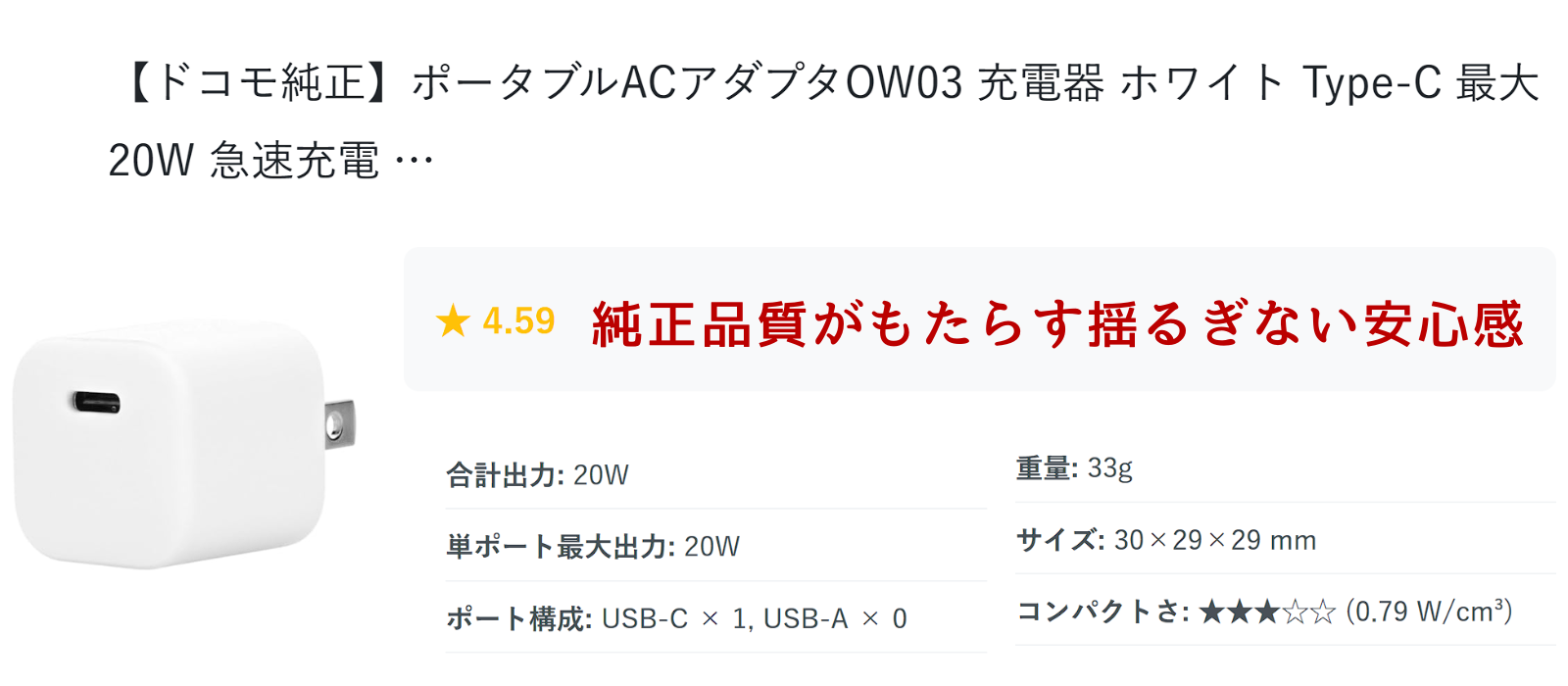
Aren’t there too many types of chargers on the market, leaving you wondering which one is “actually” safe and “certain” to choose? Especially since you charge your smartphone every day, the “trouble” of wanting to choose a reliable product to avoid any unexpected trouble is a natural “fact.”
I understand your “trouble” very well.
Precisely because you are charging your precious device, the feeling of not wanting to “fail” with a cheap, low-quality product is “natural.”
I also feel that the “peace of mind” of genuine products is very important.
Especially if you are willing to pay “money” to get “certain” safety, you don’t need to hesitate.
The [Docomo Genuine] Portable AC Adapter OW03 brings you “unwavering peace of mind” through the strict quality standards and thorough after-sales support unique to NTT Docomo genuine products.
Acquiring both PSE and MCPC certification, I guarantee that this product is the “ultimate” choice for those of you who want to “prioritize” safety above all else.
Main Specifications
| Item | Details |
|---|---|
| Product Name | Portable AC Adapter OW03 |
| Model Number | OW03 |
| Brand | NTT Docomo |
| Number of Output Ports | USB Type-C × 1 |
| Max Output | 20W |
| PPS Output | 3.3V–11V/2.2A |
| Size (excluding plug) | Approx. 29 × 29 × 30 mm |
| Weight | Approx. 33g |
| Plug Type | Fixed |
| Supported Standards | USB Power Delivery, PPS, PSE compliant, MCPC certified |
| Warranty Period | 2 years |
The Docomo genuine Portable AC Adapter OW03 promises to “release” you from charging “troubles” if you want to “prioritize” safety and reliability.
To protect your expensive smartphone, make a “certain” choice right now.
No More Guesswork! The Ultimate Guide and Truth About Choosing a 30W or Under Charger
Key points in this section!
- How to choose wattage (W): What is the difference between 20W and 30W?
- Checking the number of ports: Single port vs. multi-port, points for proper use
- Size and weight: Choosing based on portability! Explanation of GaN (Gallium Nitride) technology
- Supported charging standards: The importance of PD (Power Delivery) and PPS support
- Safety features: Beyond PSE certification, points to look out for as an added plus
- Manufacturer reliability: Choosing a manufacturer for long-term peace of mind
Are you still harboring vague anxieties about which wattage or standard to choose so you don’t make a mistake when choosing a smartphone charger?
Ms.ガジェットHonestly, I don’t really understand the difference between 20W and 30W, or what PD and PPS are, so I’m lost on which one to choose.
Mr.ガジェットThat’s okay. If you know the optimal way to choose, you won’t regret your charger selection again.
Here, I will thoroughly explain the way to choose the perfect charger for you in a way that can be understood without specialized knowledge.
I have condensed only the truly important points that I learned after testing dozens of chargers myself.
To definitely make your smartphone life comfortable, read on right now.
How to choose wattage (W): What is the difference between 20W and 30W?
You know that “wattage (W)” refers to the maximum power that a charger can supply to a device, right? Generally, the higher this number, the faster the charging speed.
Even for the latest models like the iPhone 15 Pro Max, an output of 20W or more is recommended for optimal rapid charging.
On the other hand, when charging some laptops like the MacBook Air equipped with M1/M2 chips, if you have 30W of output, you can charge at a sufficiently practical speed.
Ms.ガジェットI don’t really get what the optimal wattage output is for my smartphone.
Mr.ガジェットIf you match the charger’s output to the value required by the device, you can achieve high-speed charging without waste.
By checking your device’s required wattage and choosing a charger with an output equal to or greater than that, you achieve the most efficient charging.
Checking the number of ports: Single port vs. multi-port, points for proper use
“Number of ports” refers to the number of USB connection terminals mounted on the charger.
There are mainly two types of ports on chargers: USB-C and USB-A.
USB-C ports support Power Delivery (PD) and allow for high-output rapid charging for iPhones, the latest Android smartphones, iPads, and laptops.
On the other hand, USB-A ports are suitable for charging conventional devices, wireless earphones, etc.
For example, if you want to charge your smartphone and wireless earphones at the same time, a product with 2 or more ports is definitely more convenient.
Ms.ガジェットI have many things to charge other than my smartphone, so I’m confused about which port to choose.
Mr.ガジェットIf you choose the optimal number and type of ports to match your device configuration, you won’t be troubled anymore.
Choosing ports according to the type and number of devices you want to charge at the same time is the secret to establishing a comfortable charging environment.
Size and weight: Choosing based on portability! Explanation of GaN (Gallium Nitride) technology
“GaN (Gallium Nitride)” is a new material that replaces conventional silicon, and it is a technology that uses this material to dramatically miniaturize chargers and make them highly efficient.
Like the Anker 511 Charger (Nano 3, 30W), which is only about 40g, chargers that adopt GaN technology realize a powerful output of 30W with the weight of one egg.
Let’s end the practice of carrying around old chargers.
If it supports a foldable plug, it won’t take up any more space in your bag.
Ms.ガジェットI hear about GaN often, but what is so great about it?
Mr.ガジェットIt’s truly next-generation technology that can provide high output while suppressing heat generation.
By choosing a small and lightweight charger that adopts GaN, you will be freed from the stress of carrying it, and your mobile life will be more comfortable than you can imagine.
Supported charging standards: The importance of PD (Power Delivery) and PPS support
“PD (Power Delivery)” is a rapid charging standard that uses a USB-C port and can supply power up to 100W.
“PPS (Programmable Power Supply)” is an extended feature included in PD 3.0, referring to a technology where the device being charged and the charger adjust voltage and current in real-time, charging with optimal power.
PD support is essential for rapid charging of iPhones and iPads.
Furthermore, for Android smartphones such as Galaxy and Pixel, using a PPS-supported charger enables faster and battery-friendly charging.
Cases have been reported where there is up to a 20% difference in charging speed depending on whether PPS is supported or not.
Are you still going to continue using a charger that doesn’t support PPS?
Ms.ガジェットI understand PD support, but is it necessary to worry about PPS too?
Mr.ガジェットIf you want the best charging experience, PPS support is a point you should definitely grasp.
By choosing a charger that supports not only PD but also PPS, you can maximize the charging efficiency of the diverse devices you use and also reduce the load on the battery.
Safety features: Beyond PSE certification, points to look out for as an added plus
“PSE certification” is a national standard that indicates the safety of electrical appliances in Japan based on the Electrical Appliance and Material Safety Act.
In addition to this, various safety features are installed in chargers.
Taking PSE certification as a given, checking whether multiple safety features such as overcurrent protection, short-circuit protection, overvoltage protection, and overheating protection are installed is essential for choosing a charger without mistakes.
Products from major manufacturers such as Anker, CIO, and UGREEN have multiple layers of these protection features installed, protecting your precious devices even in the unlikely event of an incident.
I also always select products by checking if they are well-equipped with multiple protection features.
Ms.ガジェットIt’s hard to understand exactly what to look for when it comes to safety features.
Mr.ガジェットChoosing a product equipped with multiple protection features provided by a reliable manufacturer is the most certain method.
Without being deceived by superficial cheapness, choosing a highly reliable charger equipped with multiple safety features is the only method to protect your device, and above all, your safety forever.
Manufacturer reliability: Choosing a manufacturer for long-term peace of mind
“Manufacturer reliability” refers to the comprehensive peace of mind provided by a company, such as product quality, support systems, and warranty periods.
It is a fact that proven manufacturers like Anker, CIO, UGREEN, and Docomo have thorough product quality control, and their support in case of any issues is very generous.
For example, Anker offers an 18-month warranty, and UGREEN and Docomo offer 2-year long-term warranties, which is nothing but an expression of confidence in their products.
Based on my experience, products from reliable manufacturers have fewer initial defects, and even in the unlikely event of an issue, they will respond smoothly.
Are you still going to gamble on a product from an unknown manufacturer?
Ms.ガジェットManufacturer selection just means it’s okay if it’s a major brand, right?
Mr.ガジェットChoosing a major brand is a wise choice, but checking the warranty period and support content is the professional way to choose.
In order to continue using it with peace of mind for a long time, choosing a product from a manufacturer with a solid track record and support system holds the ultimate key to success in choosing a charger you won’t regret.
Summary
This ranking and selection guide is the definitive version for you, who have been troubled by choosing a smartphone charger until now, to obtain the best charging experience.
- A ranking of 30W and under smartphone chargers selected by me and their detailed comparison
- Important points for choosing the optimal charger, such as wattage, number of ports, the latest GaN technology, and PD/PPS support
- Essential safety features and tips for choosing a manufacturer for long-term, worry-free use
Referencing the information introduced in this article, find the one that is optimal for your lifestyle and make your charging “troubles” a thing of the past.



Thank you for reading until the end!
- The evaluation in this article is unique to this site.
- Unless otherwise specified, product prices and information are current as of the time of writing.
- Please note that this site cannot be held responsible for any inaccuracies in this information.
- Product and service names mentioned on this site are trademarks of their respective companies.
コメント