
SD cards are used in many devices such as digital cameras, smartphones, and dashcams.
However, there are many types of capacity and speed, and specifications, so many people feel they don’t know
which one to choose. In this article, we will explain the specifications and how to choose an SD card in an easy-to-understand manner.
We will organize the points that are easy to get confused when choosing, such as capacity, speed, compatibility, and durability, and show the criteria for judging according to the usage.
Whether you are buying one for the first time or considering a replacement, acquire the knowledge to avoid failure.
What you will learn in this article!
What is an SD card?
An SD card is a common standard small storage using flash memory.
It is used in a wide range of devices such as digital cameras, action cameras, drones, dashcams, portable game consoles, and smartphones (microSD).
First, what you want to grasp is the 4 “axes” in the world of SD cards.
- Shape (external form): SD / microSD
- Capacity logo: SD / SDHC / SDXC / SDUC (= division of the maximum usable capacity)
- Minimum guaranteed speed: Speed Class (C / UHS / Video)
- Upper limit of speed: Bus interface (High Speed / UHS-I / UHS-II…)
As we will discuss in detail in the following chapters, the most important points when choosing are “the capacity logo supported by the device” and “the required minimum write speed”.
If you miss this, the card may not perform its best, or may not work at all.
Shape (SD / microSD)
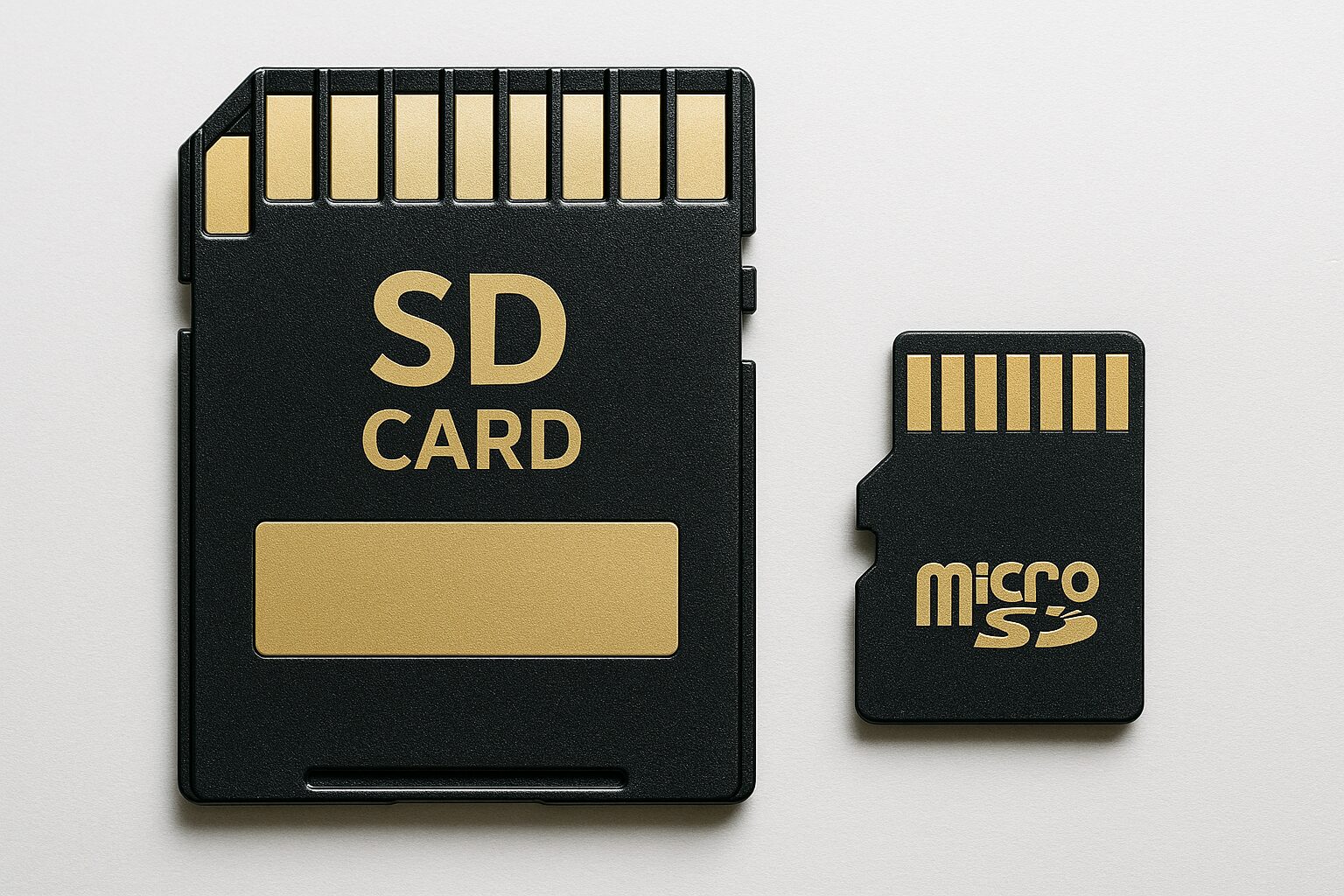
- SD (standard size): 32 × 24 × 2.1 mm.
Mainly used in interchangeable lens cameras, video cameras, and PC card readers. - microSD: 15 × 11 × 1.0 mm.
For small devices such as smartphones, action cameras, drones, and portable game consoles.
It can be used by attaching it to an SD slot with an adapter.
- Single-lens/mirrorless cameras: Basically SD slot. SD size is easier to handle in terms of card rigidity and handling.
- Small cameras/mobile devices: The main body has a microSD slot → microSD only. Import to PC with an adapter if necessary.
SD card “speed” has a two-layer structure
The speed indication of an SD card appears complicated, but it is divided into two layers with different purposes.
- Speed Class (= indicator of recording stability)
Class notation such as C10 / U1・U3 / V30・V60・V90 guarantees “at least this speed can be written”. This is crucial for video recording. - Bus interface (= theoretical upper limit)
The higher the stage such as High Speed / UHS-I / UHS-II…, the faster the continuous shooting buffer release and PC transfer.
However, the speed will be limited if all three of the device, card, and reader do not have the same grade.
 Mr.Gadgets
For example, if you insert a UHS-II card into a camera or reader that supports UHS-I, it will operate at the UHS-I upper limit.
What is Speed Class: Minimum guarantee for stable video recording and continuous writing
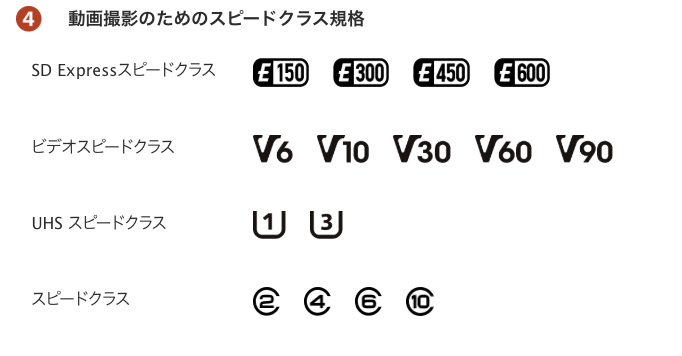
SD cards have class marks such as “C”, “U”, and “V”.
This is a standard that guarantees “at least this speed can be written”, and is directly related to the stability of video recording.
- Speed Class (C): C4 = 4MB/s, C10 = 10MB/s
- UHS Speed Class (U): U1 = 10MB/s, U3 = 30MB/s
- Video Speed Class (V): V30 = 30MB/s, V60 = 60MB/s, V90 = 90MB/s
- SD Express Speed Class (E): E150 = 150MB/s, E300 = 300MB/s, etc.
- Full HD video: C10 / U1 / V10 is often sufficient
- 4K video: U3 / V30 is a common minimum line
- 8K video/All-Intra: V60 / V90 recommended (requires device confirmation)
What is Bus Interface: A standard that determines the theoretical maximum speed

The speed indication of an SD card appears complicated, but it is divided into two layers with different purposes.
| Bus standard | Terminal shape | Theoretical upper limit | Main features |
|---|---|---|---|
| UHS-I | 1 stage | 104MB/s | Current standard standard |
| UHS-II | 2 stage | 312MB/s | Fast continuous shooting and transfer |
| UHS-III | 2 stage | 624MB/s | Rarely found in the market |
- The speed does not increase if the card, device, and card reader do not all support the same standard
- If you insert a UHS-II card into a device or card reader that supports UHS-I, it will operate at the UHS-I speed.
What is capacity specification: a division of the maximum savable amount
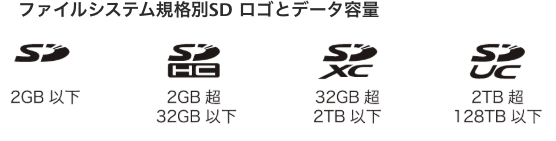
SD cards have a fixed name and logo for each capacity band. This is not just a difference in size, but also includes the file system format and compatibility rules.
- SD: up to 2GB
- SDHC: Over 2GB to 32GB (mostly FAT32)
- SDXC: Over 32GB to 2TB (mostly exFAT)
- SDUC: Over 2TB to a maximum of 128TB (exFAT assumed)
- If the card logo is greater than or equal to the device’s support, it will not work (e.g., SDXC cards cannot be used with SDHC-only devices).
- If the device supports a higher grade, lower grade cards can be used (e.g., SDXC-compatible devices can use SD/SDHC/SDXC).
- If in doubt, check the “supported logo” in the device’s instruction manual.
Typical usage and indicators that are often needed
- Photo-centric (RAW + continuous shooting): UHS bus and UHS-II are effective.
The minimum write speed of C10/U1 is often sufficient, but increasing the interface can shorten the waiting time after continuous shooting. - Video-centric (FHD/4K/8K): Minimum write speed (U3 or V30~V90) is key to stability.
- Smartphone expansion: A1/A2 (application performance class).
- Surveillance/dashcam: High durability and ample capacity.
- Game console: UHS-I is often assumed, and capacity is important.
What is Application Performance Class: For smartphones and app usage

For running apps and saving game data on smartphones and tablets, random access performance is effective.
The A1/A2 mark indicates this.
| Specification | Random read | Random write | Sequential write |
|---|---|---|---|
| A1 | 1,500 IOPS | 500 IOPS | 10MB/s |
| A2 | 4,000 IOPS | 2,000 IOPS | 10MB/s |
Note: To take advantage of A2 performance, the device must support command queue and cache functions. In some cases, A1 may be more stable if it is not supported.
First decide here (introduction check)
- Capacity band supported by the device (SD / SDHC / SDXC / SDUC)
- Usage (photo / video resolution & bitrate / continuous recording / smartphone expansion)
- Required “minimum write speed” (C / U / V)
- Consider UHS-II or higher bus if you want to shorten continuous shooting and transfer time
 Mr.Gadgets
Solidifying these four points in advance will make it easier to narrow down the candidates.
- Capacity logo compatibility and minimum write speed. These two determine whether it “can be used” and whether “recording will not stop”.
- Look at the class mark rather than the “maximum XXMB/s” number, which is a guide to read speed.
How to choose an SD card
Key points of this heading!
- Capacity: Choose a size that matches your usage
- Speed: Secure the necessary transfer performance for your usage
- Compatibility: Be sure to check the device’s supported standards and logos
- Durability: Choose according to the usage environment
- Price and performance: Determine the necessary and sufficient specs
When choosing an SD card, it is convenient to check the following 6 criteria in order.
If you think in this order, you can naturally narrow down “which one can be used and which one is necessary”.
Capacity: Choose a size that matches your usage
Determine the capacity based on “usage”, “number of shots/recording time”, and “frequency of overwriting”.
- Photo-centric (RAW + JPEG): About 25-50MB per shot.
→ About 600-1,200 shots with 32GB, double with 64GB. 64-128GB is recommended for travel. - Video-centric (FHD): About 8-12GB per hour (depending on the bitrate).
→ About 3 hours with 32GB, about 6 hours with 64GB. - 4K video (30fps, 100Mbps): About 45GB per hour.
→ About 2.5 hours with 128GB. 256GB or more is realistic for long-time shooting.
Mr.GadgetsLarge capacity cards are convenient, but the damage from breakage is also large.
For long-term storage and important shooting, it is also effective to divide the capacity and use multiple cards.
Speed: Secure the necessary transfer performance for your usage
Judge the speed by the minimum guaranteed speed standard (C/U/V).
- Still image-centric (RAW + less continuous shooting): C10 or U1 is often sufficient
- More continuous shooting / Sports shooting: Minimum U3, consider UHS-II or higher to speed up buffer release
- Video (FHD): C10 / U1 / V10-V30 for stability
- Video (4K): U3 / V30 or higher is recommended
- Video (8K or All-Intra): V60-V90 recommended (requires device confirmation)
 Mr.Gadgets
I think the class mark is more important than the maximum speed number.
Compatibility: Be sure to check the device’s supported standards and logos
- Capacity logo (SD / SDHC / SDXC / SDUC)
- Bus standard (UHS-I / UHS-II…)
- Speed Class (C / U / V)
Durability: Choose according to the usage environment
- Outdoor shooting or travel: Waterproof, dustproof, temperature resistance
- In-car / surveillance cameras: High durability (emphasis on write endurance)
- Aerial photography / Sports: Shock and vibration resistance
 Mr.Gadgets
If you use a low-durability card with a dashcam, the write error may occur after a few months. Durability specifications are insurance for long-term stability.
Price and performance: Determine the necessary and sufficient specs
- The price may be more than double if you go for “just in case” high specs
- It is a good balance of cost and peace of mind to choose one level higher than the performance required for your usage.
- Example: If your main purpose is 4K video, V30 is often sufficient rather than V60 or higher.
 Mr.Gadgets
Technology is advancing day by day, so it will be a regret to buy an expensive one unnecessarily😭
Supplementary terms and specifications
Key points of this heading!
SD (Secure Digital)
A common standard small storage using flash memory. Developed by the SD Association.
Features: Small size, removable, usable with a wide range of devices.
microSD
A smaller version of the SD card (15 × 11 × 1.0 mm). For small devices such as smartphones, action cameras, and drones.
It can also be used in SD slots with an adapter.
Summary
SD cards may all look the same, but there are many factors that affect performance, such as capacity specification, speed class, bus interface, and durability.
To choose the card that suits your device and usage, it is important to
- Check the capacity band and logo compatibility
- Understand the minimum speed required for your usage
- Check the device’s supported specifications
- Choose durability according to the usage environment
is effective.
Finding the “necessary and sufficient performance” will lead to a balance of cost and peace of mind.
Before purchasing, double-check the capacity logo, speed mark, and supported specifications, and choose the best one for your shooting and storage style.
This article was originally written in Japanese and has been translated.
Comments